Full Text (PDF)
Physiotherapy and Occupational Therapy Journal 19(1):p 67-72, Jan - March 2026. | DOI: 10.21088/potj.0974.5777.19126.8
Original Article
Secondary Versus Primary Persistent Postural-Perceptual Dizziness (PPPD): A Narrative Review
Neetu Rani Dhiman, Vyom Gyanpuri
Author Information
Licence:
Attribution-Non-commercial 4.0 International (CC BY-NC 4.0)This license enables reusers to distribute, remix, adapt, and build upon the material in any medium or format for noncommercial purposes only, and only so long as attribution is given to the creator.
Physiotherapy and Occupational Therapy Journal 19(1):p 67-72, Jan - March 2026. | DOI: 10.21088/potj.0974.5777.19126.8
How Cite This Article:
Neetu Rani Dhiman, Vyom Gyanpuri. Digital Transformation of Healthcare: E-Health Systems and their Impact. Therapy Jr. 2026; 19(1): 64-69.Timeline
Received : February 12, 2026
Accepted : March 13, 2026
Published : March 30, 2026
Abstract
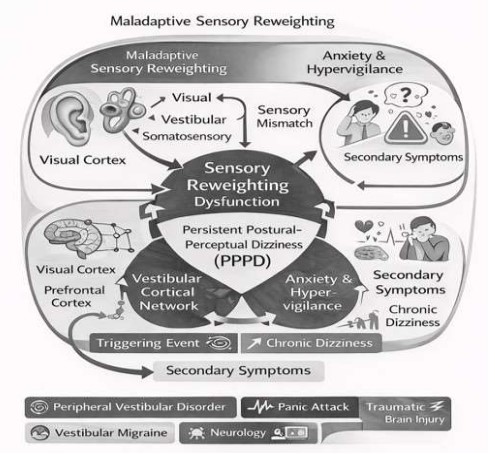
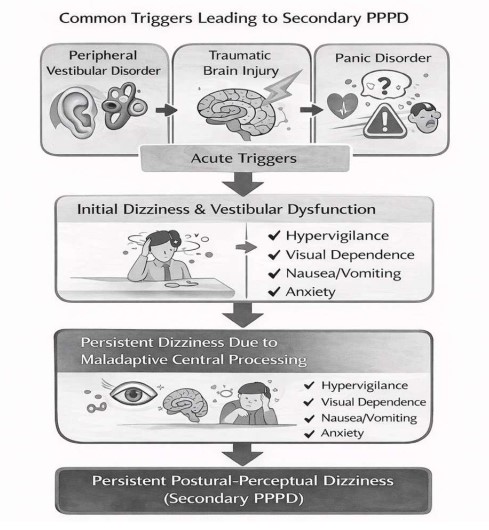
Persistent Postural-Perceptual Dizziness (PPPD) is a chronic functional vestibular disorder characterized by persistent dizziness, unsteadiness, and non-spinning vertigo exacerbated by upright posture, active or passive motion, and exposure to complex visual stimuli. PPPD may arise as a primary functional disorder or develop secondary to an identifiable precipitating vestibular, neurological, or medical event. This review synthesizes current evidence differentiating primary and secondary PPPD, focusing on pathophysiology, clinical characteristics, precipitating factors, assessment strategies, and rehabilitation implications. Emphasis is placed on neuro-vestibular maladaptation, visual dependence, and psychosomatic interactions that underpin symptom persistence. Understanding these distinctions is essential for early diagnosis and individualized neurorehabilitation strategies.
References
- 1. Staab J.P., Eckhardt-Henn A., Horii A., Jacob R., Strupp M., Brandt T., et al. Diagnostic criteria for persistent postural-perceptual dizziness (PPPD): Consensus document of the Bárány Society. J Vestib Res. 2017; 27(4): 191–208
- 2. 2. Brandt T., Huppert D., Dieterich M. Phobic postural vertigo: a first follow-up. J Neurol. 1994 Feb; 241(4): 191-5. doi: 10.1007/ BF00863767. PMID: 8195816.
- 3. Popkirov S., Staab J.P., Stone J. Persistent postural-perceptual dizziness (PPPD): a common, characteristic and treatable cause ofchronic dizziness. Pract Neurol. 2018 Feb; 18(1): 5-13. doi: 10.1136/practneurol-2017-001809. Epub 2017 Dec 5. PMID: 29208729.
- 4. Staab J.P. Chronic subjective dizziness. Continuum (Minneap Minn). 2012 Oct;18(5 Neuro-otology): 1118-41. doi: 10.1212/01.CON.0000421622.56525.58. PMID: 23042063.
- 5. Cousins S., Kaski D., Cutfield N., Arshad Q., Ahmad H., Gresty M.A., Seemungal B.M., Golding J., Bronstein A.M. Predictors of clinical recovery from vestibular neuritis: a prospective study. Ann Clin Transl Neurol. 2017 Mar 22; 4(5): 340-346. doi: 10.1002/acn3.386. PMID: 28491901; PMCID: PMC5420806.
- 6. Indovina I., Riccelli R., Chiarella G., Petrolo C., Augimeri A., Giofrè L., Lacquaniti F., Staab J.P., Passamonti L. Role of the Insula and Vestibular System in Patients with Chronic Subjective Dizziness: An fMRI Study Using Sound-Evoked Vestibular Stimulation. Front Behav Neurosci. 2015 Dec 9; 9: 334. doi: 10.3389/fnbeh.2015.00334. PMID: 26696853; PMCID: PMC4673311.
- 7. Balaban C.D., Thayer J.F. Neurological bases for balance-anxiety links. J Anxiety Disord. 2001 Jan-Apr; 15(1-2): 53-79. doi: 10.1016/ s0887-6185(00)00042-6. PMID: 11388358.
- 8. Persistent postural-perceptual dizziness (PPPD) from brain imaging to behaviour and perception. Castro P, Bancroft MJ, Arshad Q, Kaski D. Brain Sci. 2022; 12: 753. doi: 10.3390/ brainsci12060753.
- 9. Brain correlates of Postural-perceptual dizziness: a review of neuroimaging studies. Indovina I, Passamonti L, Mucci V, Chiarella G, Lacquaniti F, Staab JP. J Clin Med. 2021; 10: 4274. doi: 10.3390/jcm10184274.
- 10. Persistent postural-perceptual dizziness (PPPD) and quality of life: a cross-sectional study. Steensnaes M.H., Knapstad M.K., Goplen F.K., Berge JE. Eur Arch Otorhinolaryngol. 2023; 280: 5285–5292. doi: 10.1007/s00405-023- 08040-7
- 11. Altered brain function in persistent postural perceptual dizziness: a study on resting state functional connectivity. Lee J.O., Lee E.S., Kim J.S., et al. Hum Brain Mapp. 2018; 39: 3340– 3353. doi: 10.1002/hbm.24080.
- 12. 12. Persistent postural-perceptual dizziness: precipitating conditions, co-morbidities and treatment with cognitive behavioral therapy. Waterston J, Chen L, Mahony K, Gencarelli J, Stuart G. Front Neurol. 2021; 12: 795516. doi: 10.3389/fneur.2021.795516.
- 13. Effect of central sensitization on dizzinessrelated symptoms of persistent posturalperceptual dizziness. Hashimoto K, Takeuchi T, Ueno T, et al. Biopsychosoc Med. 2022; 16: 7. doi: 10.1186/s13030-022-00235-4.
- 14. Reduced vestibular perception thresholds in persistent postural-perceptual dizziness- a cross-sectional study. Wurthmann S., Holle D., Obermann M., et al. BMC Neurol. 2021; 21: 394. doi: 10.1186/s12883-021-02417-z.
- 15. Multimodal non-invasive non-pharmacological therapies for chronic pain: mechanisms and progress. Shi Y., Wu W. BMC Med. 2023; 21: 372. doi: 10.1186/s12916-023-03076-2.
- 16. Psychosocial factors and central sensitivity syndromes. Adams LM, Turk DC. Curr Rheumatol Rev. 2015; 11: 96–108. doi: 10.2174 /1573397111666150619095330.
- 17. Vestibular and multi-sensory influences upon self-motion perception and the consequences for human behavior. Britton Z, Arshad Q. Front Neurol. 2019; 10: 63. doi: 10.3389/fneur.2019.00063
- 18. Knight B., Bermudez F., Shermetaro C. StatPearls [Internet] Treasure Island (FL): StatPearls Publishing; 2024. Persistent postural-perceptual dizziness.
- 19. The effect of accompanying anxiety and depression on patients with different vestibular syndromes. Feng S, Zang J. Front Aging Neurosci. 2023; 15: 1208392. doi: 10.3389/ fnagi.2023.1208392.
- 20. Quality of life in patients with persistent postural-perceptual dizziness: results from a survey in Hispanic patients. Madrigal J, Olier P, Fonseca M, et al. MOJ Surg. 2023; 11: 38–40.
- 21. Best C, Eckhardt-Henn A, Diener G, Bense S, Breuer P, Dieterich M. Interaction of somatoform and vestibular disorders. J Neurol Neurosurg Psychiatry. 2006 May; 77(5): 658-64. doi: 10.1136/jnnp.2005.072934. PMID: 16614028; PMCID: PMC2117464.
- 22. Godemann F, Siefert K, Hantschke-Brüggemann M, Neu P, Seidl R, Ströhle A. What accounts for vertigo one year after neuritis vestibularis - anxiety or a dysfunctional vestibular organ? J Psychiatr Res. 2005 Sep; 39(5): 529-34. doi: 10.1016/j.jpsychires.2004.12.006. Epub 2005 Mar 4. PMID: 15992562.
- 23. Staab JP, Ruckenstein MJ. Chronic dizziness and anxiety: effect of course of illness on on treatment outcome. Arch Otolaryngol Head Neck Surg. 2005 Aug; 131(8): 675-9. doi: 10.1001/archotol.131.8.675. PMID: 16103297.
- 24. Jacobson GP, Newman CW. The development of the Dizziness Handicap Inventory. Arch Otolaryngol Head Neck Surg. 1990 Apr; 116(4): 424-7. doi: 10.1001/archotol.1990.01870040046011. PMID: 2317323.
- 25. The impact of disease duration in persistent postural-perceptual dizziness (PPPD) on the quality of life, dizziness handicap and mental health. Teh CS, Prepageran N. J Vestib Res. 2022; 32: 373–380. doi: 10.3233/VES-210087.
- 26. A review on the alterations in the brain of persistent postural-perceptual dizziness patients and non-pharmacological interventions for its management. Sun L., Xiang K. Rev Neurosci. 2020; 31: 675–680. doi: 10.1515/revneuro-2019-0109.
- 27. Persistent postural-perceptual dizziness (PPPD) and quality of life: a cross-sectional study. Steensnaes M.H., Knapstad M.K., Goplen F.K., Berge J.E. Eur Arch Otorhinolaryngol.2023; 280: 5285–5292. doi: 10.1007/s00405-023- 08040-7.
- 28. Persistent postural-perceptual dizziness (PPPD): a common, characteristic and treatable cause of chronic dizziness. Popkirov S., Staab J.P., Stone J. Pract Neurol. 2018; 18: 5–13. doi: 10.1136/practneurol-2017-001809.
- 29. Whitney S.L., Alghwiri A., Alghadir A. Physical therapy for persons with vestibular disorders. Curr Opin Neurol. 2015 Feb; 28(1): 61-8. doi: 10.1097/WCO.0000000000000162. PMID: 25514252.
- 30. Dieterich M., Staab J.P. Functional dizziness: from phobic postural vertigo and chronic subjective dizziness to persistent posturalperceptual dizziness. Curr Opin Neurol. 2017 Feb; 30(1): 107-113. doi: 10.1097/ WCO.0000000000000417. PMID: 28002123.
- 31. Wuehr M., Nusser E., Decker J, Krafczyk S., Straube A., Brandt T., Jahn K., Schniepp R. Noisy vestibular stimulation improves dynamic walking stability in bilateral vestibulopathy. Neurology. 2016 Jun 7; 86(23): 2196-202. doi: 10.1212/WNL.0000000000002748. Epub 2016 May 6. PMID: 27164706.
Data Sharing Statement
There are no additional data available. All raw data and code are available upon request.
Funding
This research received no funding.
Author Contributions
All authors contributed significantly to the work and approve its publication.
Ethics Declaration
This article does not involve any human or animal subjects, and therefore does not require ethics approval.
Acknowledgements
We would like to express our gratitude to the patients, their families, and all those who have contributed to this study.
Conflicts of Interest
No conflicts of interest in this work.
About this article

Cite this article
Neetu Rani Dhiman, Vyom Gyanpuri. Digital Transformation of Healthcare: E-Health Systems and their Impact. Therapy Jr. 2026; 19(1): 64-69.
Licence:
Attribution-Non-commercial 4.0 International (CC BY-NC 4.0)This license enables reusers to distribute, remix, adapt, and build upon the material in any medium or format for noncommercial purposes only, and only so long as attribution is given to the creator.
| Received | Accepted | Published |
|---|---|---|
| February 12, 2026 | March 13, 2026 | March 30, 2026 |
DOI: 10.21088/potj.0974.5777.19126.8
Keywords
Persistent Postural-Perceptual DizzinessPPPDFunctional DizzinessSecondary PPPDVestibular RehabilitationSearch for Similar Articles
Similar Articles
- Leadership in Physiotherapy: A Narrative Review
- Effectiveness of Low Level Laser Theapy in the Management of Temporomandibular J...
- The Impact of Air Pollution on Cardiopulmonary Health: Molecular Mechanisms, Pre...
- Efectiveness of Physiotherapy in Postpartum Women with Diastasis Recti: A Review
- Pain Neuroscience Education: Transforming Physiotherapy Practice
Article Level Metrics
Last UpdatedSaturday 24 October 2026, 16:07:50 (IST)
4389
Accesses
43
739
00
Citations
NA
NA
NA
Download citation
Article Keywords
Keyword Highlighting
Highlight selected keywords in the article text.
Timeline
| Received | February 12, 2026 |
| Accepted | March 13, 2026 |
| Published | March 30, 2026 |
licence
Attribution-Non-commercial 4.0 International (CC BY-NC 4.0)
This license enables reusers to distribute, remix, adapt, and build upon the material in any medium or format for noncommercial purposes only, and only so long as attribution is given to the creator.