Full Text (PDF)
Indian Journal of Anatomy 13(2):p 65-69, April - June 2024. | DOI: https://doi.org/10.21088/ija.2320.0022.13224.3
Original Article
Horseshoe Kidneys: Tertiary Care Centre Experience
Author Information
Licence:
Attribution-Non-commercial 4.0 International (CC BY-NC 4.0)This license enables reusers to distribute, remix, adapt, and build upon the material in any medium or format for noncommercial purposes only, and only so long as attribution is given to the creator.
Indian Journal of Anatomy 13(2):p 65-69, April - June 2024. | DOI: https://doi.org/10.21088/ija.2320.0022.13224.3
How Cite This Article:
Sakore SD, Shinde TA, Waghmare RS. Horseshoe kidneys: tertiary care centre experience. Ind J Anat. 2024;13(2):65-69.Timeline
Received : May 03, 2024
Accepted : May 18, 2024
Published : September 30, 2024
Abstract
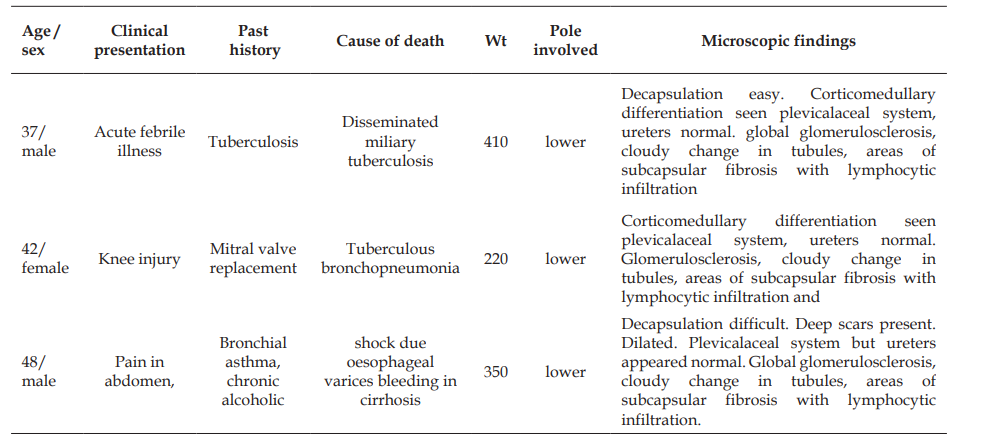
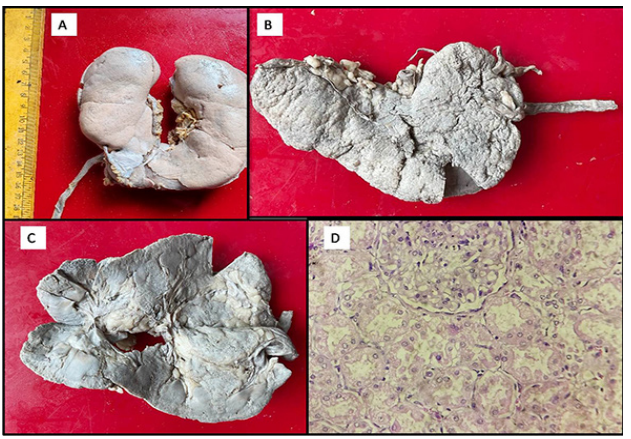
Context: Horseshoe kidney (HSK) is well known congenital anomaly of the upper urinary tract. It is occurring in approximately 0.25% of the general populations and two to three times more frequently in men than in women. Isolated HSK can be isolated, remain undiagnosed until adulthood. Aims: The present study reports gross and histological findings of horseshoe kidney detected during autopsy. Settings and Design: All clinical autopsies which were carried out during 2017 to 2022 at Topiwala National Medical College, Mumbai, India and during gross examination and dissection of kidney specimen were carried out. Methods and Material: Amongst 2524 clinical autopsies which were carried out during 6 years of period 2017 to 2022 at Topiwala National Medical College, Mumbai, India gross examination and dissection, was performed and renal anomaly was noticed. Statistical analysis used: No. Results: During period of six years study, we noticed a total 3 cases of horseshoe kidneys. On gross examination the lower poles of kidneys were fused to form the isthmus in all 3 cases. On histological examination, in all above cases kidneys showed global glomerulosclerosis, cloudy change in tubules, areas of subcapsular fibrosis with lymphocytic infiltration. Conclusions: Horseshoe kidney is one of the most common congenital anomalies of the upper rinary tract. Many times it may function normally and remain unnoticed/ asymptomatic till adulthood causing no harm. An isolated finding of a horseshoe kidney is generally considered benign. Such cases incidentally come to notice due to other medical or surgical scenarios or at the autopsies.
References
- 1. Je BK, Kim HK, Horn PS. Incidence and spectrum of renal complications and extrarenal diseases and syndromes in 380 children and young adults with horseshoe kidney. AJR Am J Roentgenol. 2015;205(6):1306-14.
- 2. Humphries A, Speroni S, Eden K, Nolan M, Gilbert, McNamara J. Horseshoe kidney: morphologic features, embryologic and genetic etiologies, and surgical implications. Clin Anat. 2023;36(8):1065-1153.
- 3. Houat AP, Guimarães JB, Takahashi MS, Rodi GP, Taísa PD, Blasbalg GS, et al. Congenital anomalies of the upper urinary tract: a comprehensive review. Radiographics. 2021;41(1):462-486.
- 4. Gupta T, Goyal S, Aggarwal A, Chawla K, Kaur H, Sahni D. Congenital renal anomalies in Indian population. J Postgrad Med Res. 2017;51(1):12-16.
- 5. Gupta M, Pandey AK, Goyal N. Horseshoe kidney - a case report. Nepal Med Coll J. 2007;9(1):63-6.
- 6. Nation EF. Horseshoe kidney, a study of thirty-two autopsy and nine surgical cases. J Urol. 1945;53(6):762-768.
- 7. Barakat AJ, Drougas JG. Occurrence of congenital abnormalities of kidney and urinary tract in 13,775 autopsies. Urology. 1991;38(4):347-350.
- 8. Campbell MF. Anomalies of the kidney. In: Campbell MF, Harrison JH, editors. Urology. 3rd ed. Philadelphia: WB Saunders; 1970. p. 1417-1422.
- 9. O’Brien J, Buckley O, Doody O, Ward E, Persaud T, Torreggiani W. Imaging of horseshoe kidneys and their complications. J Med Imaging Radiat Oncol. 2008;52(3):216-226.
- 10. Basar H, Basar R, Basar MM, Erbil M. The comparison of the incidence of horseshoe kidney in autopsy cases versus urologic patient population. Okajimas Folia Anat Jpn. 1999;76(2-3):137-139.
- 11. Kirkpatrick JJ, Leslie SW. Horseshoe Kidney [Updated 2023 May 30]. In: StatPearls [Internet]. Treasure Island (FL): StatPearls Publishing; 2024.
- 12. Glodny B, Petersen J, Hofmann KJ, et al. Kidney fusion anomalies revisited: clinical and radiological analysis of 209 cases of crossed fused ectopia and horseshoe kidney. BJU Int. 2009;103(2):224-235.
- 13. Casey GP, Sedlmayr JC, Oliver P, Cork J. Gross anatomy of a horseshoe kidney: a case report. FASEB J. 2009;23(1_supplement):823.8.
- 14. Yoshinaga K, Kodama K, Tanii I, Toshimori K. Morphological study of a horseshoe kidney with special reference to the vascular system. Anat Sci Int. 2002;77(2):134-139.
- 15. Allen AC. The kidney: medical and surgical diseases. New York: Grune and Stratton; 1951. p. 94.
- 16. Flower C. The kidneys and ureters. In: Russell RCG, Williams NS, Bulstrode CJK, editors. Bailey and Love’s short practice of surgery. 23rd ed. London: Arnold; 2000.
- 17. Perlmutter AD, Retik AB, Bauer SB. Anomalies of the upper urinary tract. In: Walsh PC, Gittes RF, Perlmutter AD, Stamey TA, editors. Campbell’s urology. 5th ed. Philadelphia: WB Saunders; 1986. p. 1665-1759.
- 18. Fuyuta M, Ukeshima A, Miyayama Y. An autopsy case of horseshoe kidney. Okajimas Folia Anat Jpn. 1977;53(6):323-336.
- 19. Basar H, Basar R, Basar MM, Erbil M. The comparison of the incidence of horseshoe kidney in autopsy cases versus urologic patient population. Okajimas Folia Anat Jpn. 1999;76(2-3):137-139.
- 20. Dahlen CP, Schlumberger FC. Surgery of diseased horseshoe kidney. Am J Surg. 1957;93(3):405-412.
- 21. Dajani AM. Horseshoe kidney: a review of twenty-nine cases. Br J Urol. 1966;38(4):388-402.
- 22. Glenn JF. Analysis of 51 patients with horseshoe kidney. N Engl J Med. 1959;261:684-687.
- 23. Raj GV, Auge BK, Assimos D, Preminger GM. Metabolic abnormalities associated with renal calculi in patients with horseshoe kidneys. J Endourol. 2004;18(2):157-161.
- 24. Love L, Wasserman D. Massive unilateral nonfunctioning hydronephrosis in horseshoe kidney. Clin Radiol. 1975;26(3):409-415.
Data Sharing Statement
There are no additional data available. All raw data and code are available upon request.
Funding
This research received no funding.
Author Contributions
Whether all authors contributed significantly to the work and approve its publication.
Ethics Declaration
This article does not involve any human or animal subjects, and therefore does not require ethics approval.
Acknowledgements
We would like to express our gratitude to the patients, their families, and all those who have contributed to this study.
Conflicts of Interest
The authors report no conflicts of interest in this work.
About this article

Cite this article
Sakore SD, Shinde TA, Waghmare RS. Horseshoe kidneys: tertiary care centre experience. Ind J Anat. 2024;13(2):65-69.
Licence:
Attribution-Non-commercial 4.0 International (CC BY-NC 4.0)This license enables reusers to distribute, remix, adapt, and build upon the material in any medium or format for noncommercial purposes only, and only so long as attribution is given to the creator.
| Received | Accepted | Published |
|---|---|---|
| May 03, 2024 | May 18, 2024 | September 30, 2024 |
DOI: https://doi.org/10.21088/ija.2320.0022.13224.3
Keywords
Congenital renal anomaliesHorseshoe kidneyAutopsySearch for Similar Articles
Similar Articles
- Supernumerary Pulmonary Vein: A Rare Anatomical Variation Observed During Cadave...
- Elongated Styloid Process: Anatomical Variations and Their Clinical Relevance: A...
- Bridging the Gap Between Dissection and Surgery: The Role of Soft Embalming in M...
- A Cadaveric Study of Retro Hepatic Segment of Inferior Vena Cava and Ostia Venae...
- Estimation of Stature from Forearm Length in Medical Undergraduate Students of a...
Article Level Metrics
Last UpdatedSunday 20 September 2026, 21:48:57 (IST)
5038
Accesses
18
601
00
Citations
NA
NA
NA
Download citation
Article Keywords
Keyword Highlighting
Highlight selected keywords in the article text.
Timeline
| Received | May 03, 2024 |
| Accepted | May 18, 2024 |
| Published | September 30, 2024 |
licence
Attribution-Non-commercial 4.0 International (CC BY-NC 4.0)
This license enables reusers to distribute, remix, adapt, and build upon the material in any medium or format for noncommercial purposes only, and only so long as attribution is given to the creator.