Full Text (PDF)
Indian Journal of Anatomy 15(2):p 78-87, May-August 2026. | DOI: https://doi.org/10.21088/ija.2320.0022.15226.5
Review Article
Elongated Styloid Process: Anatomical Variations and Their Clinical Relevance: A Review
Author Information
Licence:
Attribution-Non-commercial 4.0 International (CC BY-NC 4.0)This license
enables reusers to distribute, remix, adapt, and build upon the material in any
medium or format for noncommercial purposes only, and only so long as
attribution is given to the creator.
Indian Journal of Anatomy 15(2):p 78-87, May-August 2026. | DOI: https://doi.org/10.21088/ija.2320.0022.15226.5
How Cite This Article:
Deepa G, Shrikrishna B H. Elongated Styloid Process: Anatomical Variations and Their Clinical Relevance: A Review. Ind Jr Anat. 2026; 15(2): 78-87.Timeline
Received : July 08, 2026
Accepted : August 04, 2026
Published : August 30, 2026
Abstract
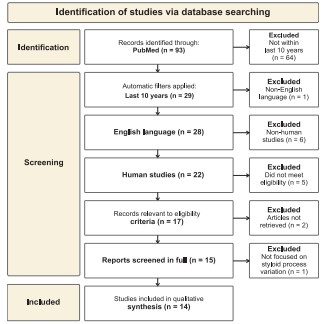
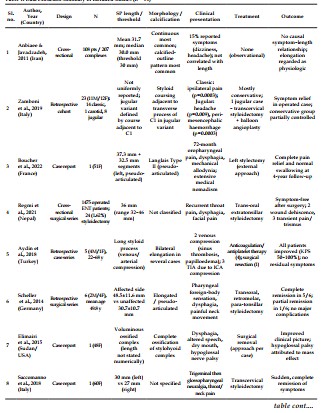
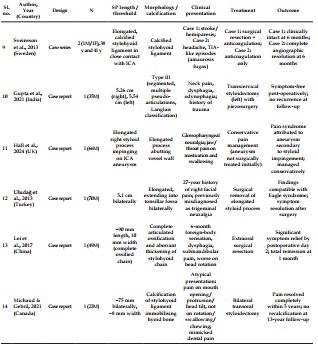
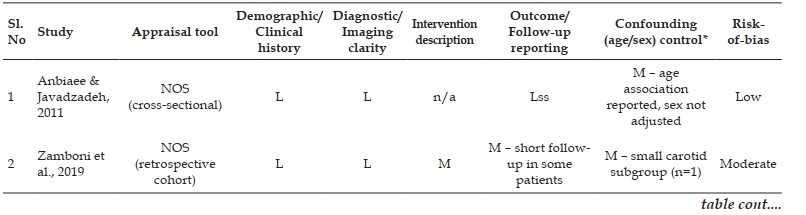
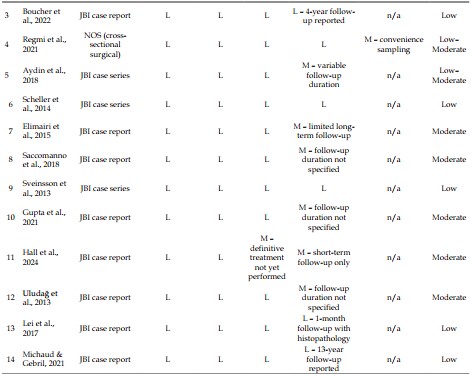
Background: The styloid process is a slender bony projection of the temporal bone that varies considerably in length, morphology, and calcification. When it becomes abnormally elongated, it can produce a symptomatic condition broadly known as Eagle syndrome, with craniofacial pain, dysphagia, and, less often, neurovascular compromise. Objective: To review the anatomical variations of the styloid process reported in the peer-reviewed literature and to relate these to symptomatology, diagnostic imaging, and management. Methods: A PubMed database search using the Boolean string: (“elongated styloid process” OR “styloid process elongation” OR “elongated styloid” OR “Eagle syndrome”) AND (“anatomical variation” OR “morphological variation” OR “styloid length” OR “styloid morphology” OR “calcified stylohyoid ligament”) AND (“clinical relevance” OR “clinical significance” OR “clinical symptoms” OR “dysphagia” OR “neuralgia”) filtered automatically by date, free full text, English language, and human studies, then screened and synthesised narratively. Risk of bias was appraised using the Joanna Briggs Institute checklists for case reports/ series and the Newcastle–Ottawa criteria for cross-sectional and retrospective studies. Results: Of 93 records identified, 14 studies met the eligibility criteria. Reported normal styloid length ranged from roughly 20–32 mm, with elongation thresholds of 30 mm most often applied and individual elongated processes measuring up to 75–80 mm. Morphological variants like continuous, segmented, and pseudo-articulated were most often classified using the Langlais system. Clinical presentations clustered into three overlapping phenotypes: classic oropharyngeal/cervicofacial pain with dysphagia; stylocarotid/neurovascular compression (transient ischaemic attack, stroke, carotid dissection, aneurysm); and styloidogenic jugular compression (headache, intracranial venous hypertension). Three-dimensional CT was the diagnostic reference standard throughout. Surgical styloidectomy achieved remission of symptoms. Conclusions: Elongation and morphological variation of the styloid process are anatomically diverse but clinically important, producing a recognisable yet frequently under-diagnosed spectrum of craniofacial, pharyngeal, and neurovascular symptoms. Standardised measurement and greater clinical awareness are needed to reduce diagnostic delay; surgical shortening remains the most reliably effective treatment for symptomatic cases.
References
- 1. Abuhaimed AK, Alvarez R, Menezes RG. Anatomy, Head and Neck, Styloid Process. In:StatPearls. Treasure Island (FL): StatPearls Publishing; January 9, 2023.
- 2. Rodríguez-Vázquez JF, Verdugo-López S, Abe H, Murakami G. The Origin of the Variations of the Hyoid Apparatus in Human. Anat Rec (Hoboken). 2015;298(8):1395-1407. doi:10.1002/ar.23166.
- 3. Anbiaee N, Javadzadeh A. Elongated styloid process: is it a pathologic condition? Indian J Dent Res. 2011;22(5):673-677. doi:10.4103/0970- 9290.93455
- 4. Zamboni P, Scerrati A, Menegatti E, Galeotti R, Lapparelli M, Traina L, Tessari M, Ciorba A, De Bonis P, Pelucchi S. The Eagle jugular syndrome. BMC Neurol. 2019;19:333. doi:10.1186/s12883-019-1572-3
- 5. Boucher Y, Mularski A, Felizardo R, Tankere F, Dieb M. Chronic oropharyngeal pain and medical nomadism in an Eagle’s syndrome patient: a case report. J Med Case Rep. 2022;16:201. doi:10.1186/s13256-022-03372-0
- 6. Regmi D, Baidhya R, Rajak A, Shrestha S, Bista M. Trans-oral extra tonsillar approach of styloidectomy for treatment of Eagle’s syndrome among operated cases of the Department of Otolaryngology-Head and Neck Surgery at a tertiary care hospital: a descriptive cross-sectional study. J Nepal Med Assoc. 2021;59(240):738-740. doi:10.31729/ jnma.6756
- 7. Aydin E, Quliyev H, Cinar C, Bozkaya H, Oran I. Eagle syndrome presenting with neurological symptoms. Turk Neurosurg. 2018;28(2):219- 225. doi:10.5137/1019-5149.JTN.17905-16.6
- 8. Scheller K, Eckert AW, Scheller C. Transoral, retromolar, para-tonsillar approach to the styloid process in 6 patients with Eagle’s syndrome. Med Oral Patol Oral Cir Bucal. 2014;19(1):e61-e66. doi:10.4317/medoral.18749
- 9. Elimairi I, Baur DA, Altay MA, Quereshy FA, Minisandram A. Eagle’s syndrome. Head Neck Pathol. 2015;9(4):492-495. doi:10.1007/ s12105-014-0599-4
- 10. Saccomanno S, Greco F, De Corso E, Lucidi D, Deli R, D’Addona A, Paludetti G. Eagle’s syndrome, from clinical presentation to diagnosis and surgical treatment: a case report. Acta Otorhinolaryngol Ital. 2018;38(2):166-169. doi:10.14639/0392-100X-1479
- 11. Sveinsson O, Kostulas N, Herrman L. Internal carotid dissection caused by an elongated styloid process (Eagle syndrome). BMJ Case Rep. 2013;2013:bcr2013009878. doi:10.1136/ bcr-2013-009878
- 12. Gupta M, Kumar Y, Vig H, Rizvi A. Classic Eagle’s syndrome: styloidectomy via the transcervical approach. BMJ Case Rep. 2021;14(8):e244634. doi:10.1136/bcr-2021- 244634
- 13. Hall S, Michell K, Howlett D. A rare cause of atypical facial pain. Clin Med (Lond). 2024;24(6):100254. doi:10.1016/j. clinme.2024.100254
- 14. Uludağ İF, Öcek L, Zorlu Y, Uludağ B. Eagle syndrome: case report. Ağrı. 2013;25(2):87-89. doi:10.5505/agri.2013.26779
- 15. Lei J, Yap AU, Zhang Y, Fu KY. Unilateral complete articulated ossification and aberrant thickening of the stylohyoid chain. J Oral Sci. 2017;59(1):157-160. doi:10.2334/ josnusd.16-0383
- 16. Michaud PL, Gebril M. A prolonged time to diagnosis due to misdiagnoses: a case report of an atypical presentation of Eagle syndrome. Am J Case Rep. 2021;22:e929816. doi:10.12659/ AJCR.929816
Data Sharing Statement
There are no additional data available. All raw data and code are available upon request.
Funding
This research received no funding.
Author Contributions
All authors contributed significantly to the work and approve its publication.
Ethics Declaration
This article does not involve any human or animal subjects, and therefore does not require ethics approval.
Acknowledgements
We would like to express our gratitude to the patients, their families, and all those who have contributed to this study.
Conflicts of Interest
No conflicts of interest in this work.
About this article

Cite this article
Deepa G, Shrikrishna B H. Elongated Styloid Process: Anatomical Variations and Their Clinical Relevance: A Review. Ind Jr Anat. 2026; 15(2): 78-87.
Licence:
Attribution-Non-commercial 4.0 International (CC BY-NC 4.0)This license
enables reusers to distribute, remix, adapt, and build upon the material in any
medium or format for noncommercial purposes only, and only so long as
attribution is given to the creator.
| Received | Accepted | Published |
|---|---|---|
| July 08, 2026 | August 04, 2026 | August 30, 2026 |
DOI: https://doi.org/10.21088/ija.2320.0022.15226.5
Keywords
Styloid ApparatusEagle SyndromeStylohyoid LigamentDysphagiaSearch for Similar Articles
Similar Articles
- Supernumerary Pulmonary Vein: A Rare Anatomical Variation Observed During Cadave...
- Bridging the Gap Between Dissection and Surgery: The Role of Soft Embalming in M...
- A Cadaveric Study of Retro Hepatic Segment of Inferior Vena Cava and Ostia Venae...
- Estimation of Stature from Forearm Length in Medical Undergraduate Students of a...
- Morphological Variations of Gall-bladder: A Cadaveric and Ultrasonographic Study
Article Level Metrics
Last UpdatedMonday 28 September 2026, 07:40:05 (IST)
5243
Accesses
28
661
00
Citations
NA
NA
NA
Download citation
Article Keywords
Keyword Highlighting
Highlight selected keywords in the article text.
Timeline
| Received | July 08, 2026 |
| Accepted | August 04, 2026 |
| Published | August 30, 2026 |
licence
Attribution-Non-commercial 4.0 International (CC BY-NC 4.0)
This license
enables reusers to distribute, remix, adapt, and build upon the material in any
medium or format for noncommercial purposes only, and only so long as
attribution is given to the creator.