Full Text (PDF)
Indian Journal of Anatomy 15(2):p 66-77, May-August 2026. | DOI: https://doi.org/10.21088/ija.2320.0022.15226.4
Review Article
Bridging the Gap Between Dissection and Surgery: The Role of Soft Embalming in Medical Education
Madhavi Keole, Akash null, Anita Fating
Author Information
Licence:
Attribution-Non-commercial 4.0 International (CC BY-NC 4.0)This license enables reusers to distribute, remix, adapt, and build upon the material in any medium or format for noncommercial purposes only, and only so long as attribution is given to the creator.
Indian Journal of Anatomy 15(2):p 66-77, May-August 2026. | DOI: https://doi.org/10.21088/ija.2320.0022.15226.4
How Cite This Article:
Madhavi Keole, Akash, Anita Fating. Bridging the gap between Dissection and Surgery – The role of soft Embalming in Medical Education. Ind Jr Anat. 2026; 15(2): 66-77.Timeline
Received : June 22, 2026
Accepted : July 20, 2026
Published : August 30, 2026
Abstract
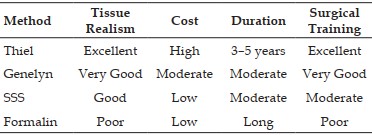
Background: Cadavers are fundamental teaching tools that allow students and surgeons to study human structure in detail. The soft-fixation techniques have been developed to overcome the challenges while using formalin models and fresh-frozen cadavers. Soft embalming techniques were gradually developed in order to find a safer and economical alternative. Aim: The present narrative review aims to explore the key differences between soft embalming techniques. To examine their growing role in anatomical education, and surgical skill development. Methods: A literature search was performed using electronic databases including PubMed, Google Scholar, Scopus, Embase, Science Direct and Web of Science. Relevant articles published between 2000 and 2025 were identified and reviewed. The advantages, limitations and future prospects of various soft embalming techniques were critically reviewed. Results: Cadavers preserved with Thiel’s method have near normal tissue softness, natural organ colour. They can be used for training of ENT, cardiothoracic, and vascular surgery. Genelyn embalmed cadavers are better suited for laparoscopic and pelvic surgery training. N-vinyl-2-pyrrolidone (NVP) is particularly useful for neurosurgical training because of better preservation of neurological tissue.Softembalmed cadavers provide a platform for procedural rehearsals ranging from basic operative skills to microsurgical techniques. Soft-embalmed cadavers have emerged as versatile resources that support research and lifelong learning across modern medical sciences. Post-graduate students consistently report greater confidence and satisfaction when training on soft-embalmed models compared to other alternatives. Limitations: Financial and infrastructure limitations narrow down widespread implementation. Prolonged preparation periods and the need of well trained staff should also be considered. There is need of standardized preservation protocols. Conclusion: Soft embalming has transformed the study of anatomy by preserving structure with a life like feel to it. These techniques have not only benefitted undergraduate anatomy teaching but also postgraduate surgical training. Unlike formalin embalming, soft-embalmed cadavers allow students to learn anatomy in a clinically oriented pattern. Reforms in medical education, may lead to increasingly important role of soft embalmed cadavers for training. In future it may be possible to create increasingly sophisticated training environment to closely resemble real clinical practice. Increasing progress in embalming techniques ensures that these cadavers will remain indispensable tools for education in the years to come.
References
- 1. Suyashi, Sharma RS, Sharma S, Ramteke M. Beyond The Traditional: Discovering The Benefits Of Thiel-Embalmed Cadavers In Learning Human Anatomy. African Journal OF Biomedical Research. 2024 Sep 29;27:5561–8.
- 2. Eisma R, Wilkinson T. From “Silent Teachers” to Models. PLoS Biology. 2014 Oct 21;12(10):e1001971.
- 3. Ariyanachi Kaliappan, Motwani R, Gupta T, Mrudula Chandrupatla. Innovative Cadaver Preservation Techniques: a Systematic Review. PubMed [Internet]. 2023 Mar 1 [cited 2026 Jun 18];18(1):127–35. Available from: https:// www.ncbi.nlm.nih.gov/pmc/articles/ PMC10231151/
- 4. Pezzino S, Angelico G, Luca T, Crescimanno C, Castorina M, Puleo S, et al. Revitalizing the Silent Teacher: Cutting-Edge Techniques for High-Fidelity Cadaveric Anatomy. Applied Sciences [Internet]. 2026 Jun 18 [cited 2026 Apr 24];16(4):1782. Available from: https:// www.mdpi.com/2076-3417/16/4/1782?utm_ source=chatgpt.com
- 5. Shaffer K. Teaching Anatomy in the Digital World. New England Journal of Medicine. 2004 Sep 23;351(13):1279–81.
- 6. Theeuwes H. A New Model for Training on Human Specimens in Surgical-Anatomical Skills Labs. Anatomy Physiology & Biochemistry International Journal. 2017 Jul 18;3(1).
- 7. Balta JY, Cronin M, Cryan JF, O’Mahony SM. Human preservation techniques in anatomy: A 21st century medical education perspective. Clinical Anatomy. 2015 Jun 28;28(6):725–34.
- 8. Badash I, Burtt K, Solorzano CA, Carey JN. Innovations in surgery simulation: a review of past, current and future techniques. Annals of Translational Medicine [Internet]. 2016 Dec [cited 2026 Jun 18];4(23):453–3. Available from: https://www.ncbi.nlm.nih.gov/pmc/ articles/PMC5220028/#r7
- 9. Varner C, Dixon L, Simons MC. The Past, Present, and Future: A Discussion of Cadaver Use in Medical and Veterinary Education. Frontiers in Veterinary Science. 2021 Nov 10;8(8).
- 10. Donczo B, Guttman A. Biomedical analysis of formalin-fixed, paraffin-embedded tissue samples: The Holy Grail for molecular diagnostics. Journal of Pharmaceutical and Biomedical Analysis. 2018 Jun;155:125–34.
- 11. Sparey K. Effectiveness, Adaptation, and Health Risks of Embalming Fluids: Just what is the Solution? The FASEB Journal. 2012 Apr;26(S1).
- 12. Toy S, Secgin Y. Cadaver embalming and fixing solutions from past to present. Journal of Clinical Medicine of Kazakhstan. 2022 Oct 27;19(5):9–11.
- 13. Charlier B, Coglianese A, De Rosa F, De Caro F, Piazza O, Motta O, et al. Chemical Risk in Hospital Settings: Overview on Monitoring Strategies and International Regulatory Aspects. Journal of Public Health Research [Internet]. 2021 Jan 14 [cited 2022 Sep 11];10(1):jphr.2021.1993. Available from: https://www.ncbi.nlm.nih.gov/pmc/ articles/PMC8018262/
- 14. Kundu S, De A, Mitra S. Formaldehyde: Fact sheet reflecting uses, exposure hazards, health effects and toxicological profile- A broad overview for medical professionals and embalmers. Journal of Clinical & Experimental Research. 2015;3(2):183.
- 15. Alnagar FA, Shmela ME, M Alrtib A, M Benashour F, Buker AO, Abdalmula AM. Health adverse effects of formaldehyde exposure to students and staff in gross anatomy. International Journal of Scientific Research and Management. 2018 Feb 9;6(02).
- 16. Arora DL. Exposure of Medical fraternity to formaldehyde in Anatomy and search for better alternatives to formalin. IOSR Journal of Dental and Medical Sciences. 2014;13(10):56–7.
- 17. Ganesh Handady, Dsouza A, Nayak V, Abraham J. Formaldehyde Levels and the Indoor Air Quality of an Anatomy Dissection Hall with Different Ventilation Setups. Environmental Health Insights [Internet]. 2024 Jan 1 [cited 2025 Feb 28];18. Available from: https://pmc.ncbi.nlm.nih.gov/articles/ PMC11603455/
- 18. Checkoway H, Boffetta P, Mundt DJ, Mundt KA. Critical review and synthesis of the epidemiologic evidence on formaldehyde exposure and risk of leukemia and other lymphohematopoietic malignancies. Cancer Causes & Control. 2012 Sep 15;23(11):1747–66.
- 19. Song YK, Jo DH. Current and potential use of fresh frozen cadaver in surgical training and anatomical education. Anatomical Sciences Education. 2022 Jan 20;
- 20. Jansen MM, Hazenberg CEVB, de Ruiter QMB, van Hamersvelt RW, Bleys RLAW, van Herwaarden JA. Feasibility of fresh frozen human cadavers as a research and training model for endovascular image guided interventions. PLoS ONE [Internet]. 2020 Nov 30;15(11):e0242596. Available from: https:// www.ncbi.nlm.nih.gov/pmc/articles/ PMC7704126/
- 21. McGarvey CR, Drees SM, Lawrence A, Miller ND, Kapur S, De Silva V, et al. Establishing a best practice for the freeze-thaw cycle of cryopreservation to approximate living muscle, joint, and associated soft tissue properties in cadaveric upper limbs. JPRAS Open [Internet]. 2025 Aug 22;46:500–9. Available from: https:// www.sciencedirect.com/science/article/pii/ S2352587825001470
- 22. De Bakshi S, Priya P, Gandhi J. Cadaver Models: The Future of Surgical Training or the Need of the Hour? A Narrative Review. Annals of Minimal Access Surgery & Allied Science. 2025 Sep;1(3):114–8.
- 23. Yiasemidou M, Roberts D, Glassman D, Tomlinson J, Biyani S, Miskovic D. A Multispecialty Evaluation of Thiel Cadavers for Surgical Training. World Journal of Surgery [Internet]. 2017 [cited 2021 Apr 14];41(5):1201– 7. Available from: https://www.ncbi.nlm.nih. gov/pmc/articles/PMC5394144/
- 24. G A, Ray S, Mohapatra S, G A, Ray S, Jr SM. Preparation of Soft Embalmed Cadavers by the Modified Thiel Embalming Technique for Surgical Skill Training and Development of a Universal Quantitative Scoring System to Assess the Suitability of Soft Embalmed Cadavers for Such Training Purposes. Cureus [Internet]. 2023 Aug 23;15(8). Available from: https://www.cureus.com/articles/178007- preparation-of-soft-embalmed-cadavers-bythe-modified-thiel-embalming-techniquefor-surgical-skill-training-and-developmentof-a-universal-quantitative-scoring-systemto-assess-the-suitability-of-soft-embalmedcadavers-for-such-training-purposes#
- 25. Amanda Teixeira Prata, Baptista S. The proposition of a new method to convert formalin cadavers to academic and museology purposes. Research, Society and Development. 2021 Jan 8;10(1):e21510111575-e21510111575.
- 26. Rakuša M, Kocbek Šaherl L. Thiel embalming method used for anatomy dissection as an educational tool in teaching human anatomy, in research, and in training in comparison of different methods for long term preservation. Folia Morphologica. 2022 Jun 10;
- 27. Hammer N, Löffler S, Bechmann I, Steinke H, Hädrich C, Feja C. Comparison of modified thiel embalming and ethanol-glycerin fixation in an anatomy environment: Potentials and limitations of two complementary techniques. Anatomical Sciences Education. 2014 Apr 4;8(1):74–85.
- 28. Ottone NE, Vargas CA, Fuentes R, del Sol M. Walter Thiel’s Embalming Method: Review of Solutions and Applications in Different Fields of Biomedical Research. International Journal of Morphology [Internet]. 2016 Dec [cited 2020 Oct 22];34(4):1442–54. Available from: https://scielo. conicyt.cl/pdf/ijmorphol/v34n4/art44.pdf
- 29. Liao PY, Wang ZG Thiel-embalming technique: investigation of possible modification in embalming tissue as evaluation model for radiofrequency ablation J Biomed Res 2019 Apr 8;33(4):280–8 doi: 107555/JBR3220160148 Epub ahead of print PMID: 30956232; PMCID: PMC6813523.
- 30. Miyake S, Suenaga J, Miyazaki R, Sasame J, Akimoto T, Tanaka T, et al. Thiel’s embalming method with additional intra-cerebral ventricular formalin injection (TEIF) for cadaver training of head and brain surgery. Anatomical Science International. 2020 Apr 27;95(4):564–70.
- 31. Kalayarasan R, Rajasekhar SSSN, Kumar Vd, Raveendranath V, Gnanasekaran S, Pottakkat B, et al. Advanced training in laparoscopic gastrointestinal surgical procedures using Genelyn®-embalmed human cadavers: A novel model. Journal of Minimal Access Surgery. 2021;17(4):495.
- 32. Manikumari B, Jaggavarapu SR, Subha K, Kalpana T, Muni RKN, Kishve P, et al. Simulation of Reconstructive Microsurgery in Soft Embalmed Cadavers: A Teaching Module for Plastic Surgery Residents. Indian Journal of Plastic Surgery. 2022 Jun;55(03):262–7.
- 33. Hayashi S, Homma H, Naito M, Oda J, Nishiyama T, Kawamoto A, et al. Saturated salt solution method: a useful cadaver embalming for surgical skills training. Medicine. 2014 Dec;93(27):e196.
- 34. Nagase M, Kimoto Y, Eiji Sunami, Matsumura G. A new human cadaver model for laparoscopic training using N-vinyl-2- pyrrolidone: a feasibility study. Anatomical Science International. 2019 Jul 26;95(1):156–64.
- 35. Maruyama K, Yokoi H, Nagaase M, Yoshida H, Noguchi A, Matsumura G, et al. Usefulness of N-vinyl-2-pyrrolidone Embalming for Endoscopic Transnasal Skull Base Approach in Cadaver Dissection. Neurologia medicochirurgica. 2019;59(10):379–83.
- 36. Akaike M, Fukutomi M, Nagamune M, Fujimoto A, Tsuji A, Ishida K, et al. Simulation-based medical education in clinical skills laboratory. The Journal of Medical Investigation. 2012;59(1,2):28–35.
- 37. Reddy R, Iyer S, Pillay M, Thankappan K, Ramu J. Soft embalming of cadavers for training purposes: Optimising for long-term use in tropical weather. Indian Journal of Plastic Surgery. 2017 Jan;50(01):029–34.
- 38. Sthapak E, Pasricha N, Bhatnagar R, Siddiqui M, Jaiswal S. Soft-fixed embalming: Our experiences. National Journal of Clinical Anatomy. 2020;9(2):43.
- 39. Arce JE, Contreras ES, Vaghani P, Goyal K, Balta JY. Using Soft-Preserved Body Donors to Improve the Anatomy Learning Experience for Orthopedic Residents. Journal of Surgical Education [Internet]. 2024 Nov 21;82(1):103321. Available from: https:// www.sciencedirect.com/science/article/ p i i / S 1 9 3 1 7 2 0 4 2 4 0 0 4 6 9 0 ? p e s = vor&utm_source=scopus&getft_integrator= scopus#sec0020.
- 40. Ackermann J, Wedel T, Hagedorn H, Maass N, Mettler L, Heinze T, et al. Establishment and evaluation of a training course in advanced laparoscopic surgery based on human body donors embalmed by ethanol-glycerollysoformin fixation. Surgical Endoscopy. 2020 May 22;35(3):1385–94.
- 41. Abraham JK, Souza AD, Bhat AK, Thomas J, Pereira CB, Iyer S, et al. Enhancing Cadaveric Soft-Tissue Dissection Training for Plastic Surgery Residents. Annals of Plastic Surgery. 2025 Sep 1;95(3S):S42–8.
- 42. Kawashima T, Sakai M, Hiramatsu K, Sato F. Integrated anatomical practice combining cadaver dissection and matched cadaver CT data processing and analysis. Surgical and Radiologic Anatomy. 2022 Jan 25;44(3):335–43.
- 43. Tripathy P, Gaikwad M, Mishra P. Role of Cadaveric workshop in refining the Surgical Skills: an experience and way ahead in an institute of National importance. Indian Journal of Anatomy and Surgery of Head, Neck and Brain. 2017 Feb 5;3(1):6–8.
- 44. Schlottmann F, Herbella FAM, Patti MG. Simulation for Foregut and Bariatric Surgery: Current Status and Future Directions. Journal of Laparoendoscopic & Advanced Surgical Techniques. 2021 May 1;31(5):546–50.
- 45. Desmond P.J. Barton, Davies L, Mahadevan V, Dennis L, Adib T, Satvinder Mudan, et al. Dissection of soft-preserved cadavers in the training of gynaecological oncologists: Report of the first UK workshop. Gynecologic Oncology. 2009 Jun 1;113(3):352–6.
- 46. Mantica G, Pini G, De Marchi D, Paraboschi I, Esperto F, Van der Merwe A, et al. Intensive simulation training on urological mini-invasive procedures using Thiel-embalmed cadavers: The IAMSurgery experience. Archivio Italiano di Urologia e Andrologia. 2020 Jun 23;92(2).
- 47. Gehlot D, Srivastava S. Unlocking the Advantages Of N-Vinyl-2-Pyrrolidone as A Superior Alternative to Formalin in Cadaver Preservation: A Comprehensive Review. Journal of Biomedicine and Biochemistry. 2023 Dec 1;
- 48. Stirling ER, Lewis TL, Ferran NA. Surgical skills simulation in trauma and orthopaedic training. Journal of Orthopaedic Surgery and Research. 2014 Dec;9(1).
- 49. Grullo PER, Hernando HCT, Carrillo RJDC, Villacorta PRF, Hernandez JG, Lopa RAB, et al. Surgical Simulation of Endoscopic Sinus Surgery using Thiel Soft-Embalmed Human Cadaver. Acta Medica Philippina. 2017 Mar 31;51(1).
- 50. Saw A. A New Approach to Body Donation for Medical Education: The Silent Mentor Programme. Malaysian Orthopaedic Journal [Internet]. 2018 Jul 1 [cited 2021 Dec 8];12(2):68–72. Available from: https://www.ncbi.nlm.nih.gov/pmc /articles/PMC6092528/?tool=pmcentrez &report=abstract
- 51. Nesbitt CI, Birdi N, Mafeld S, Stansby G. The role of simulation in the development of endovascular surgical skills. Perspectives on Medical Education. 2016 Jan 21;5(1):8–14.
- 52. McLeod H, Cox BF, Robertson J, Duncan R, Matthew S, Bhat R, et al. Human ThielEmbalmed Cadaveric Aortic Model with Perfusion for Endovascular Intervention Training and Medical Device Evaluation. CardioVascular and Interventional Radiology. 2017 Apr 27;40(9):1454–60.
- 53. Sanchez-Ferrer F, Grima-Murcia MD, Sánchezdel-Campo F, Sánchez-Ferrer ML, FernándezJover E. Thiel embalming in neonates: methodology and benefits in medical training. Anatomical Science International. 2022 Feb 8;97(3):290–6.
- 54. Ajileye AB, Esan EO, Adeyemi OA. Human Embalming Techniques: A Review. American Journal of Biomedical Sciences [Internet]. 2018 Apr;10(2):82–95. Available from: http://www. nwpii.com/ajbms/papers/AJ20180203.pdf
- 55. Eisma R, Lamb C, Soames RW. From formalin to thiel embalming: What changes? One anatomy department’s experiences. Clinical Anatomy. 2013 Feb 13;26(5):564–71.
- 56. Kennel L, Martin DMA, Shaw H, Wilkinson T. Learning anatomy through Thiel- vs. formalinembalmed cadavers: Student perceptions of embalming methods and effect on functional anatomy knowledge. Anatomical Sciences Education. 2017 Jul 18;11(2):166–74.
- 57. Ghosh SK. Human cadaveric dissection: a historical account from ancient Greece to the modern era. Anatomy & Cell Biology. 2015 Sep 22;48(3):153.
- 58. Niels H. Thirty years of Thiel embalming—A systematic review on its utility in medical research. Clinical Anatomy. 2022 Aug 18;35(7):987–97.
- 59. Giger U, Frésard I, Häfliger A, Bergmann M, Krähenbühl L. Laparoscopic training on Thiel human cadavers: A model to teach advanced laparoscopic procedures. Surgical Endoscopy. 2007 Aug 18;22(4):901–6.
- 60. Jaung R, Cook P, Blyth P. A comparison of embalmingfluidsforuseinsurgicalworkshops. Clinical Anatomy. 2011 Jan 12;24(2):155–61.
- 61. Dea Aaldijk, Reusser A, Eppler E, Yao E, Djonov V, Halm S. Morphological changes in striated muscle fibers caused by components of the Thiel embalming method. Folia Morphologica. 2023 Feb 22;83(1):83–91.
- 62. Munirama S, Eisma R, Columb M, Corner GA, McLeod GA. Physical properties and functional alignment of soft-embalmed Thiel human cadaver when used as a simulator for ultrasound-guided regional anaesthesia. British Journal of Anaesthesia. 2016 May;116(5):699–707.
- 63. Balta JY, Twomey M, Moloney F, Duggan O, Murphy KP, O’Connor OJ, et al. A comparison of embalming fluids on the structures and properties of tissue in human cadavers. Anatomia, Histologia, Embryologia. 2018 Nov 18;48(1):64–73.
- 64. Brenner E. Human body preservation - old and new techniques. Journal of Anatomy [Internet]. 2014 Jan 18 [cited 2019 Oct 14];224(3):316–44. Available from: https:// www.ncbi.nlm.nih.gov/pmc/articles/ PMC3931544/#!po=3.76344
- 65. Leake M, Ejaz A, Patel R, Balta JY. The utility of soft-preservation in Medical Education: Current trends & future directions. European Journal of Anatomy. 2024 May;28(3):389–98.
Data Sharing Statement
There are no additional data available. All raw data and code are available upon request.
Funding
This research received no funding.
Author Contributions
All authors contributed significantly to the work and approve its publication.
Ethics Declaration
This article does not involve any human or animal subjects, and therefore does not require ethics approval.
Acknowledgements
We would like to express our gratitude to the patients, their families, and all those who have contributed to this study.
Conflicts of Interest
No conflicts of interest in this work.
About this article

Cite this article
Madhavi Keole, Akash, Anita Fating. Bridging the gap between Dissection and Surgery – The role of soft Embalming in Medical Education. Ind Jr Anat. 2026; 15(2): 66-77.
Licence:
Attribution-Non-commercial 4.0 International (CC BY-NC 4.0)This license enables reusers to distribute, remix, adapt, and build upon the material in any medium or format for noncommercial purposes only, and only so long as attribution is given to the creator.
| Received | Accepted | Published |
|---|---|---|
| June 22, 2026 | July 20, 2026 | August 30, 2026 |
DOI: https://doi.org/10.21088/ija.2320.0022.15226.4
Keywords
Soft EmbalmingThiel EmbalmingCadaver PreservationAnatomy EducationSurgical SimulationCompetency-Based Medical EducationGenelynSaturated Salt Solution EmbalmingSoft-Fixed CadaversSurgical TrainingSearch for Similar Articles
Similar Articles
- Supernumerary Pulmonary Vein: A Rare Anatomical Variation Observed During Cadave...
- Elongated Styloid Process: Anatomical Variations and Their Clinical Relevance: A...
- A Cadaveric Study of Retro Hepatic Segment of Inferior Vena Cava and Ostia Venae...
- Estimation of Stature from Forearm Length in Medical Undergraduate Students of a...
- Morphological Variations of Gall-bladder: A Cadaveric and Ultrasonographic Study
Article Level Metrics
Last UpdatedSaturday 17 October 2026, 08:29:14 (IST)
5730
Accesses
118
684
00
Citations
NA
NA
NA
Download citation
Article Keywords
Keyword Highlighting
Highlight selected keywords in the article text.
Timeline
| Received | June 22, 2026 |
| Accepted | July 20, 2026 |
| Published | August 30, 2026 |
licence
Attribution-Non-commercial 4.0 International (CC BY-NC 4.0)
This license enables reusers to distribute, remix, adapt, and build upon the material in any medium or format for noncommercial purposes only, and only so long as attribution is given to the creator.