Full Text (PDF)
Indian Journal of Anatomy 13(2):p 71-73, April - June 2024. | DOI: https://doi.org/10.21088/ija.2320.0022.13224.4
Case Report
An Anomalous Additional Muscle Belly of Flexor Digitorum Profundus: A Case Report with its Clinical Insight
Author Information
Licence:
Attribution-Non-commercial 4.0 International (CC BY-NC 4.0)This license enables reusers to distribute, remix, adapt, and build upon the material in any medium or format for noncommercial purposes only, and only so long as attribution is given to the creator.
Indian Journal of Anatomy 13(2):p 71-73, April - June 2024. | DOI: https://doi.org/10.21088/ija.2320.0022.13224.4
How Cite This Article:
Choudhary A. An anomalous additional muscle belly of flexor digitorum profundus: a case report with its clinical insight. Ind J Anat. 2024;13(2):71-73.Timeline
Received : April 17, 2024
Accepted : July 01, 2024
Published : September 30, 2024
Abstract
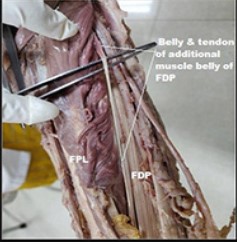
The muscular abnormality in the flexor compartment of forearm is less common compared to that of extensor compartment. The anatomical variations and abnormalities of muscles of the forearm and hand have become significant because of new imaging techniques. An unusual and complete additional flexor digitorum profundus muscle to index finger was found bilaterally during routine dissection of a 61 year old male cadaver. Length of additional muscle was approximately 15 cm with spindle shaped belly and long tendon (belly length 5cm, tendon 10 cm. width of belly was 1cm). In provisions of Clinical and functional significance; the knowledge of abnormalities of muscles and their tendons are important to the clinician in appropriate detection of etiology for symptoms and management of the patient. Acknowledgment of such variations could be useful for the clinicians, hand surgeons and plastic surgeons.
References
- 1. Cıftcıoglu E, Kopuz C, Corumlu U, Demır MT. Accessory muscle in the forearm: a clinical and embryological approach. Anat Cell Biol. 2011;44(2):160–163.
- 2. Standring S. Gray’s anatomy: the anatomical basis of clinical practice. 40th ed. London: Elsevier Churchill Livingstone; 2008. p. 847-848.
- 3. Biant LC. Elbow and the forearm. In: Standring S, editor. Gray’s anatomy: the anatomical basis of clinical practice. 41st ed. Philadelphia: Elsevier; 2016. p. 837–861.
- 4. Kumar S, Verma R, Mehra RD. An anomalous origin of accessory head of flexor digitorum profundus in forearm: a rare variant. J Anat Soc India. 2016;65(Suppl 1):S73–S75.
- 5. Wahba MY, Singh GD, Lozanoff S. An anomalous accessory flexor digiti minimi profundus muscle: a case study. Clin Anat. 1998;11(1):55–59.
- 6. Orellana-Donoso M, Valenzuela-Fuenzalida J, GoldSemmler M, et al. Neural entrapments associated with musculoskeletal anatomical variations of the upper limb: literature review. Transl Res Anat. 2021;22:100094.
- 7. El Domiaty MA, Zoair MM, Sheta AA. The prevalence of accessory heads of the flexor pollicis longus and the flexor digitorum profundus muscles in Egyptians and their relations to median and anterior interosseous nerves. Folia Morphol. 2008;67(1):63-71.
- 8. Jones M, Abrahams PH, Sanudo JR, Campillo M. Incidence and morphology of accessory heads of flexor pollicis longus and flexor digitorum profundus (Gantzer’s muscles). J Anat. 1997;191(3):451-455.
- 9. Nayak SR, et al. Multiple muscular anomalies of upper extremity: a cadaveric study. Rom J Morphol Embryol. 2008;49(3):411-415.
- 10. Vollala VR, et al. Multiple accessory structures in the upper limb of a single cadaver. Singapore Med J. 2008;49(9):e254-e258.
- 11. MacAlister A. Additional observations on muscular anomalies in the human anatomy. Trans R Ir Acad. 1875;25:1-34.
- 12. Hollinshead HW. Anatomy for surgeons. 2nd ed. Vol. 3, The back and limbs. Philadelphia: Harper and Row; 1969. p. 408-409.
- 13. Williams PL, Warwick R. Gray’s anatomy. 36th ed. Edinburgh: Churchill Livingstone; 1980. p. 576-577.
- 14. Bergman RA, editor. Compendium of human anatomic variation. Baltimore: Urban and Schwarzenberg; 1988. p. 14-15.
- 15. Williams PL, Bannister LM, Berry MM, et al. Gray’s anatomy. 38th ed. Edinburgh: Churchill Livingstone; 1995. p. 847-848.
- 16. Falcon S, Everist B, Brubacher J. Anomalous flexor digitorum profundus muscle bellies as a cause of snapping wrist and carpal tunnel syndrome: a case report. JBJS Case Connect. 2021;11(4):e21.00311.
- 17. Honing ML, Ritt MJ, Bos KE. An anomalous flexor digitorum superficialis to the index finger. Surg Radiol Anat. 1995;17(4):339–341.
- 18. Smith RJ. Anomalous muscle belly of the flexor digitorum superficialis causing carpal-tunnel syndrome: report of a case. J Bone Joint Surg Am. 1971;53(6):1215–1216.
- 19. Stephens N, Marques E, Livingston C. Anomalous flexor digitorum superficialis muscle belly presenting as a mass within the palm. Can J Plast Surg. 2007;15(1):44–46.
Data Sharing Statement
There are no additional data available. All raw data and code are available upon request.
Funding
This research received no funding.
Author Contributions
All authors contributed significantly to the work and approve its publication.
Ethics Declaration
Provide information related to the Ethics Committee approval with approval number OR write This article does not involve any human or animal subjects, and therefore does not require ethics approval.
Acknowledgements
We would like to express our gratitude to the patients, their families, and all those who have contributed to this study.
Conflicts of Interest
The authors report no conflicts of interest in this work.
About this article

Cite this article
Choudhary A. An anomalous additional muscle belly of flexor digitorum profundus: a case report with its clinical insight. Ind J Anat. 2024;13(2):71-73.
Licence:
Attribution-Non-commercial 4.0 International (CC BY-NC 4.0)This license enables reusers to distribute, remix, adapt, and build upon the material in any medium or format for noncommercial purposes only, and only so long as attribution is given to the creator.
| Received | Accepted | Published |
|---|---|---|
| April 17, 2024 | July 01, 2024 | September 30, 2024 |
DOI: https://doi.org/10.21088/ija.2320.0022.13224.4
Keywords
FlexorImagingSurgeonsBellyTendonSearch for Similar Articles
Similar Articles
- Supernumerary Pulmonary Vein: A Rare Anatomical Variation Observed During Cadave...
- Elongated Styloid Process: Anatomical Variations and Their Clinical Relevance: A...
- Bridging the Gap Between Dissection and Surgery: The Role of Soft Embalming in M...
- A Cadaveric Study of Retro Hepatic Segment of Inferior Vena Cava and Ostia Venae...
- Estimation of Stature from Forearm Length in Medical Undergraduate Students of a...
Article Level Metrics
Last UpdatedTuesday 22 September 2026, 00:52:46 (IST)
5057
Accesses
28
655
00
Citations
NA
NA
NA
Download citation
Article Keywords
Keyword Highlighting
Highlight selected keywords in the article text.
Timeline
| Received | April 17, 2024 |
| Accepted | July 01, 2024 |
| Published | September 30, 2024 |
licence
Attribution-Non-commercial 4.0 International (CC BY-NC 4.0)
This license enables reusers to distribute, remix, adapt, and build upon the material in any medium or format for noncommercial purposes only, and only so long as attribution is given to the creator.