Full Text (PDF)
Indian Journal of Pathology: Research and Practice 12(1):p 9-14, January-March 2023. | DOI: https://doi.org/10.21088/ijprp.2278.148X.12123.1
Original Article
Histopathological Evaluation of Hysterectomy Specimens among Rural Patients in a Zonal Care Centre & Its Clinicopathological Correlation
Author Information
Licence:
Attribution-Non-commercial 4.0 International (CC BY-NC 4.0)This license enables reusers to distribute, remix, adapt, and build upon the material in any medium or format for noncommercial purposes only, and only so long as attribution is given to the creator.
Indian Journal of Pathology: Research and Practice 12(1):p 9-14, January-March 2023. | DOI: https://doi.org/10.21088/ijprp.2278.148X.12123.1
How Cite This Article:
Dayal Singh Bisht, Amit Kumar/Histopathological Evaluation of Hysterectomy Specimens among Rural Patients in a Zonal care Centre & Its Clinicopathological Correlation/Indian Journal of Pathology: Research and Practice 2023;12(1) 9–14.Timeline
Received : December 03, 2022
Accepted : December 26, 2022
Published : March 30, 2023
Abstract
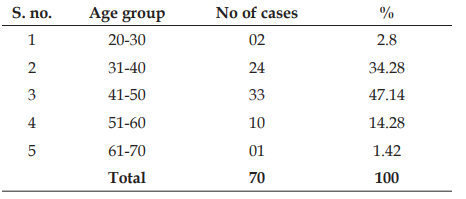
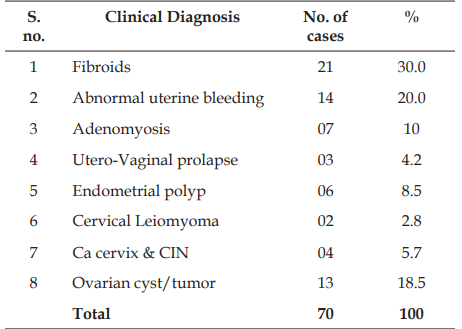
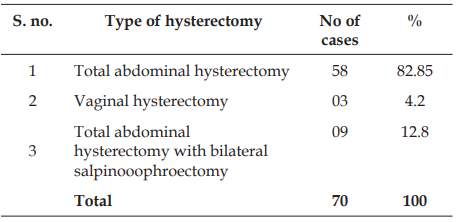
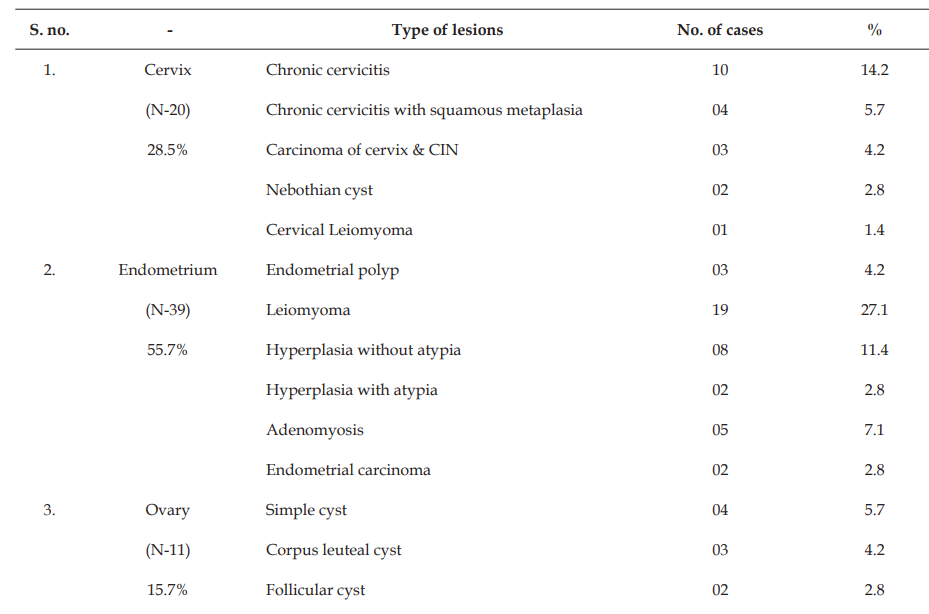
Background: Hysterectomy is considered the gold standard gynaecological procedure and is performed all over the world for the treatment of benign and malignant disorders. Aim & Objective: To study the clinical indication, gross and histopathological feature of uterus and cervix in hysterectomy specimens and correlate with clinical finding. Material & Methods: A retrospective was conducted in Department of Pathology Aug 2020 to Aug 2022. A total duration of the study was two years. The gross and histopathological findings of 70 hysterectomy specimens received in the department of pathology. Surgical specimens were fixed in formalin and tissues were adequately processed from them and stained with hematoxylin and eosin. A thorough microscopic examination of the stained slide were carried out & a histopathological diagnosis was made. The histopathological findings of the hysterectomy specimen were noted and then correlated with the clinical findings. Results: A clinicopathological correlation was noted in 70 cases. The endomyomatrium was the most commonly seen in 39 cases, the cervix 20 cases and ovary 11 cases. The incidence of chronic cervicitis was high, followed by squamous metaplasia, carcinoma of the cervix, nebothian cysts and cervical leiomyoma. The most common lesion among the endometrium was hyperplasia without atypia, followed by endometrial polyps, endometrium carcinoma, and atypical hyperplasia. Among the myomatrium lesions leiomyomas were the most common followed by adenomyosis. Among the ovarian lesions were simple cysts, corpus leuteal cysts, follicular cysts, fibroma, and serous cysteadenoma. Conclusion: This study found a good correlation between clinical indication and histopathology in benign and malignant pathologies. All the hysterectomy specimens should be sent for histopathological examination to ensure better post-operative management, especially in malignant diseases.
References
- 1. Saadia A, Mubarik A, Zubair A, Jamal S, Zafar A. Diagnostic accuracy of endometrial curettage in endometrial pathology. J Ayub Med Coll Abbottabad. 2011;23(1):129–131.
- 2. Wu JM, Wechter ME, Geller EJ, Nguyen TV, Visco AG. Hysterectomy rates in the United States, 2003. Obstet Gynecol. 2007;110(5):1091–1095.
- 3. Neena Y, Honey B. Clinico-pathological correlation of hysterectomy specimens for abnormal uterine bleeding in rural area. J Evol Med Dent Sci. 2013;39(2):7506–7512.
- 4. Gangadharan V, Prasanthi C. Hysterectomy—a clinico-pathological correlation in a rural setting. Indian J Basic Appl Med Res. 2016;5(2):8–15.
- 5. Chryssikopoulos A, Loghis C. Indications and results of total hysterectomy. Int Surg. 1986;71(3):188–194.
- 6. MacKenzie IZ, Naish C, Rees M, Manek S. 1170 consecutive hysterectomies: indications and pathology. Br Menopause Soc J. 2004;10(3):108–112.
- 7. Pradhan SB, Sedhain M, Acharya S, Maharjan S, Regmi S. Clinico-pathological study of hysterectomy specimens in Kathmandu Medical College Teaching Hospital. Birat J Health Sci. 2018;3(2):423–426.
- 8. Karthikeyan T, Veenaa N, Kumar A, Thomas E. Clinico-pathological study of hysterectomy among rural patients in a tertiary care center. IOSR J Dent Med Sci. 2015;14(5):25–27.
- 9. Bala R, Devi PK, Singh CM. Trend of hysterectomy: a retrospective analysis. J Med Soc. 2015;29(1):1.
- 10. Pity IS, Jalal JA, Hassawi BA. Hysterectomy: a clinicopathologic study. Tikrit Med J. 2011;17(2):7–16.
- 11. Patil HA, Patil A, Mahajan SV. Histopathological findings in uterus and cervix of hysterectomy specimens. MVP J Med Sci. 2015:26–29.
- 12. Jandial R, Choudhary M, Singh K. Histopathological analysis of hysterectomy specimens in a tertiary care centre: study of 160 cases. Int Surg J. 2019;6(8):2856–2859.
- 13. Zaid SMO, Thabet MAB. Histopathological findings in hysterectomy specimens: a retrospective study. Middle East J Intern Med. 2017;10(1):12–24.
- 14. Jha R, Pant A, Jha A, Adhikari R, Sayami G. Histopathological analysis of hysterectomy specimens. JNMA J Nepal Med Assoc. 2006;45(163):283–290.
- 15. Bhide P, Bhide A. Uterine adenomyosis. J Obstet Gynecol. 1994;44(4):612–615.
- 16. Weiss G, Maseelall P, Schott LL, Brockwell SE, Schocken M, Johnston JM. Adenomyosis: a variant, not a disease? Evidence from hysterectomized menopausal women in the Study of Women's Health Across the Nation (SWAN). Fertil Steril. 2009;91(1):201–206.
- 17. Ebinesh A, Sharada M, Krishna M. Clinicopathological correlation of abdominal hysterectomy specimens. Int J Sci Res (IJSR). 2013;4:1084–1089.
- 18. Perveen S, Tayyab S. A clinicopathological review of elective abdominal hysterectomy. J Surg Pak (Int). 2008;13(1):27.
- 19. Jamal S, Baqai S. A clinicohistopathological analysis of 260 hysterectomies. Pak J Pathol. 2001;12(2):11–14.
- 20. Singh K, Agarwal C, Pujani M, Raychaudhuri S, Sharma N, Chauhan V, et al. A clinicopathological correlation of International Federation of Gynecology and Obstetrics' PALM–COEIN classification of abnormal uterine bleeding: Indian scenario. J Midlife Health. 2019;10(3):147.
Data Sharing Statement
There are no additional data available. All raw data and code are available upon request.
Funding
This research received no funding.
Author Contributions
All authors contributed significantly to the work and approve its publication.
Ethics Declaration
This article does not involve any human or animal subjects, and therefore does not require ethics approval.
Acknowledgements
We would like to express our gratitude to the patients, their families, and all those who have contributed to this study.
Conflicts of Interest
No conflicts of interest in this work.
About this article

Cite this article
Dayal Singh Bisht, Amit Kumar/Histopathological Evaluation of Hysterectomy Specimens among Rural Patients in a Zonal care Centre & Its Clinicopathological Correlation/Indian Journal of Pathology: Research and Practice 2023;12(1) 9–14.
Licence:
Attribution-Non-commercial 4.0 International (CC BY-NC 4.0)This license enables reusers to distribute, remix, adapt, and build upon the material in any medium or format for noncommercial purposes only, and only so long as attribution is given to the creator.
| Received | Accepted | Published |
|---|---|---|
| December 03, 2022 | December 26, 2022 | March 30, 2023 |
DOI: https://doi.org/10.21088/ijprp.2278.148X.12123.1
Keywords
BenignMalignantEndometriumHysterectomySquamous Cell CarcinomaEndometrial AdenocarcinomaAdenomyosisLeiomyomaSearch for Similar Articles
Similar Articles
- Clinico-Pathological and Immunohistochemical Study of Primary CNS Tumors in a Te...
- The Role of SGLT2 Inhibitors in Cardiovascular Protection Beyond Diabetes: A Co...
- Epidermal Inclusion Cyst Presenting as 4th Ventricle Space Occupying Lesion: A R...
- Silent Retroperitoneal Seminoma Arising from an Occult Undescended Testis: Diagn...
- Scapular Metastasis of Oral Squamous Cell Carcinoma: A Case Report of an Unusual...
Article Level Metrics
Last UpdatedSunday 20 September 2026, 22:03:04 (IST)
3662
Accesses
15
541
00
Citations
NA
NA
NA
Download citation
Article Keywords
Keyword Highlighting
Highlight selected keywords in the article text.
Timeline
| Received | December 03, 2022 |
| Accepted | December 26, 2022 |
| Published | March 30, 2023 |
licence
Attribution-Non-commercial 4.0 International (CC BY-NC 4.0)
This license enables reusers to distribute, remix, adapt, and build upon the material in any medium or format for noncommercial purposes only, and only so long as attribution is given to the creator.