Full Text (PDF)
Indian Journal of Forensic Medicine and Pathology 19(1):p 101-105, Jan - March 2026. | DOI: https://doi.org/10.21088/ijfmp.0974.3383.19126.12
Review Article
Forensic View of Suicide in Healthcare Workers
Deeksha Pandey, Shambhuvi null, Ahongsangbam Sanathoi Chanu, Adil Hussain, Anshika Rosha, Mamta Bhandari, Vinod Bhatt
Author Information
Licence:
Attribution-Non-commercial 4.0 International (CC BY-NC 4.0)This license enables reusers to distribute, remix, adapt, and build upon the material in any medium or format for noncommercial purposes only, and only so long as attribution is given to the creator.
Indian Journal of Forensic Medicine and Pathology 19(1):p 101-105, Jan - March 2026. | DOI: https://doi.org/10.21088/ijfmp.0974.3383.19126.12
How Cite This Article:
Pandey D, Shambhuvi, Chanu AS, et al. Forensic View of Suicide in Healthcare Workers. Indian J Forensic Med Pathol. 2026;19(1):101-105.Timeline
Received : July 15, 2025
Accepted : January 25, 2026
Published : March 30, 2026
Abstract
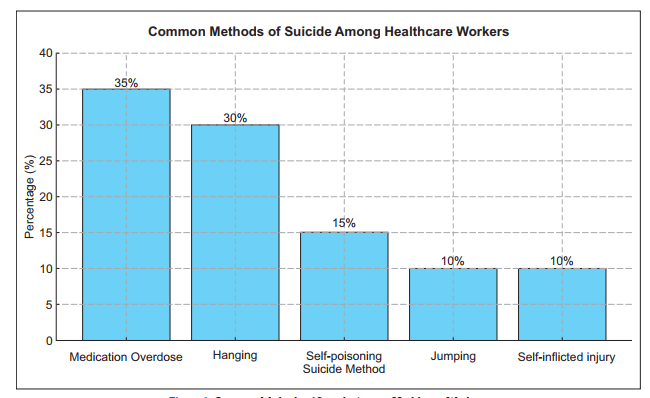
Background: Suicide among healthcare workers, particularly doctors and nurses, has emerged as a major concern both for forensic experts and public health professionals.1 The emotionally taxing nature of their roles, exposure to trauma, easy access to lethal substances, and high workload contribute to an increased risk of suicide. Aim: To explore the forensic aspects, patterns, and medico-legal implications of suicide among healthcare workers and evaluate the role of forensic investigations in identifying causes and occupational linkages. Objectives: 1. To assess the prevalence and occupational risk factors for suicide in healthcare professionals. 2. To review forensic pathology and autopsy findings in these cases. 3. To evaluate medico-legal protocols and recommend preventive strategies. Material: An integrative review of literature from PubMed, Scopus, and other indexed databases covering forensic case reports, autopsy studies, psychological autopsy data, and medico-legal investigations from 2010 to 2024. Author’ Result: The analysis indicates that suicide in healthcare professionals is underreported due to stigma and institutional concerns. Common methods include medication overdose (35%), hanging (30%), and self-poisoning (15%). Forensic investigations frequently show usage of hospital medications or familiarity with lethal procedures. Mental health histories often reveal untreated depression, burnout, or anxiety, all exacerbated by occupational pressures.2,6,7 Conclusion: Understanding the forensic and medico-legal dimensions of suicides in healthcare workers is vital for prevention and legal accountability. Forensic pathologists play a key role in establishing occupational causes, ruling out negligence or foul play, and supporting institutional reforms.3,10
References
- 1. Hawton K, Agerbo E, Simkin S, et al. Risk of suicide in medical and related occupational groups: a national study. Psychol Med. 2011;41(6):1233–1240.105 IJFMP/Volume 19 Number 1 January–March 2026
- 2. Shanafelt TD, Boone S, Tan L, et al. Burnout and satisfaction with work-life balance among US physicians. Arch Intern Med. 2012;172(18):1377– 1385.
- 3. Dutheil F, Aubert C, Pereira B, et al. Suicide among physicians and health-care workers: A systematic review and meta-analysis. PLoS One. 2019;14(12):e0226361.
- 4. Gold KJ, Sen A, Schwenk TL. Details on suicide among US physicians: Data from the National Violent Death Reporting System. Gen Hosp Psychiatry. 2013;35(1):45–49.
- 5. Milner A, Witt K, Maheen H, et al. Access to means of suicide, occupation, and the risk of suicide: A national study. Aust N Z J Psychiatry. 2017;51(3):235–242.
- 6. Davidson JE, Zisook S, Proudfoot J, et al. A longitudinal analysis of nurse suicide in the United States (2005–2016). J Nurs Adm. 2020;50(5):287–292.
- 7. Monteith LL, Bahraini NH, Matarazzo BB, et al. Perceptions of institutional betrayal and mental health functioning among veterans with military sexual trauma. Psychol Serv. 2016;13(3):273–280.
- 8. Brooks SK, Chalder T, Gerada C. Doctors vulnerable to psychological distress and suicidal ideation: a cross-sectional study of medical students and newly qualified doctors in the UK. BMJ Open. 2021;11(1):e042797.
- 9. Shah A, Garland R, Katz C. Suicide among physicians and other health care workers: A review and commentary. J Nerv Ment Dis. 2020;208(7):559–563.
- 10. Saini S, Sharma S, Khurana D, et al. Forensic aspects of suicide by overdose in Indian hospital staff: A retrospective review. Indian J Forensic Med Pathol. 2022;15(3):101–107
Data Sharing Statement
There are no additional data available. All raw data and code are available upon request.
Funding
This research received no funding.
Author Contributions
All authors contributed significantly to the work and approve its publication.
Ethics Declaration
This article does not involve any human or animal subjects, and therefore does not require ethics approval.
Acknowledgements
We would like to express our gratitude to the patients, their families, and all those who have contributed to this study.
Conflicts of Interest
No conflicts of interest in this work.
About this article

Cite this article
Pandey D, Shambhuvi, Chanu AS, et al. Forensic View of Suicide in Healthcare Workers. Indian J Forensic Med Pathol. 2026;19(1):101-105.
Licence:
Attribution-Non-commercial 4.0 International (CC BY-NC 4.0)This license enables reusers to distribute, remix, adapt, and build upon the material in any medium or format for noncommercial purposes only, and only so long as attribution is given to the creator.
| Received | Accepted | Published |
|---|---|---|
| July 15, 2025 | January 25, 2026 | March 30, 2026 |
DOI: https://doi.org/10.21088/ijfmp.0974.3383.19126.12
Keywords
Healthcare worker suicideForensic pathologyAutopsyMedico-legalMedico-legal investigationPsychological autopsySearch for Similar Articles
Similar Articles
- Diatom Analysis in Thermophilic water bodies: A Study on Hot Water Springs of Ma...
- Morphometric Study of Supra-meatal Triangle and Mastoid process in the Adult dry...
- Histopathological Spectrum of Autopsy Cases: A One Year Retrospective Observatio...
- Forensic Differentiation of Manner of Death in Railway Fatalities: A FourCase Se...
- Understanding assault Patterns: A Cross-sectional study of Cases at Chri, Kelamb...
Article Level Metrics
Last UpdatedSaturday 17 October 2026, 05:49:43 (IST)
16164
Accesses
55
3204
00
Citations
NA
NA
NA
Download citation
Article Keywords
Keyword Highlighting
Highlight selected keywords in the article text.
Timeline
| Received | July 15, 2025 |
| Accepted | January 25, 2026 |
| Published | March 30, 2026 |
licence
Attribution-Non-commercial 4.0 International (CC BY-NC 4.0)
This license enables reusers to distribute, remix, adapt, and build upon the material in any medium or format for noncommercial purposes only, and only so long as attribution is given to the creator.