Full Text (PDF)
Indian Journal of Forensic Medicine and Pathology 19(3):p 279-291, July -Sept. 2026. | DOI: https://doi.org/10.21088/ijfmp.0974.3383.19326.1
Original Article
Evaluation of Forensic Genetic Efficiency Parameters of 23 Autosomal STR Markers (PowerPlex® Fusion 6C system) in a Population Sample of Hadoti Region
Author Information
Licence:
Attribution-Non-commercial 4.0 International (CC BY-NC 4.0)This license enables reusers to distribute, remix, adapt, and build upon the material in any medium or format for noncommercial purposes only, and only so long as attribution is given to the creator.
Indian Journal of Forensic Medicine and Pathology 19(3):p 279-291, July -Sept. 2026. | DOI: https://doi.org/10.21088/ijfmp.0974.3383.19326.1
How Cite This Article:
Bhawna Poonia, Sangita Gupta. Evaluation of Forensic Genetic Efficiency Parameters of 23 Autosomal STR Markers (PowerPlex® Fusion 6C system) in a Population Sample of Hadoti Region. Indian J Forensic Med Pathol. 2026; 19(3): 279-291.Timeline
Received : April 11, 2026
Accepted : June 20, 2026
Published : September 30, 2026
Abstract
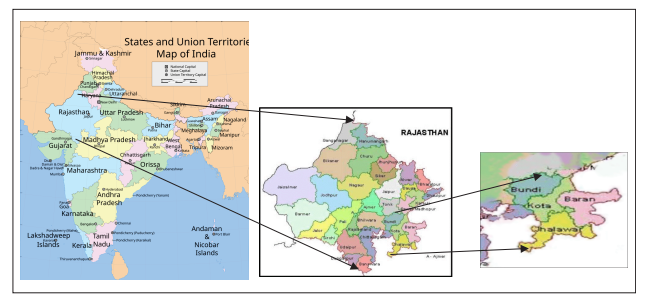
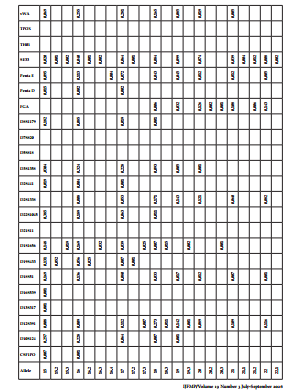
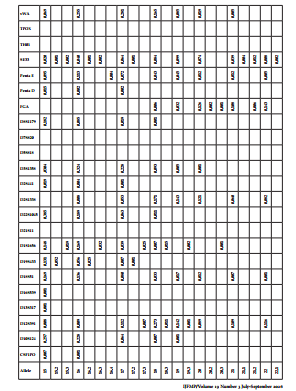
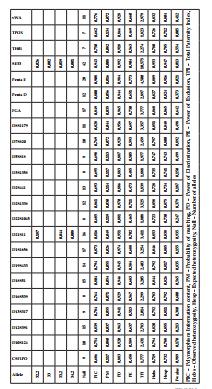
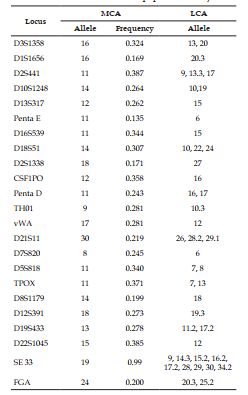
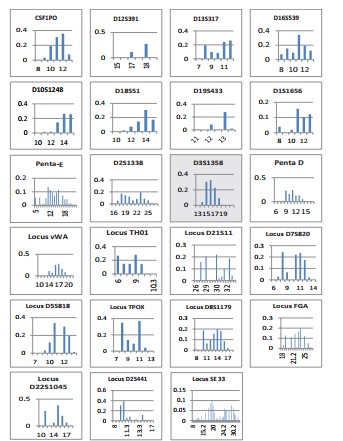
Rajasthan’s southeastern part is known as “the land of Hada (Clan) Rajputs” i.e Hadoti. In this study, genetic structure of Hadoti population, who exhibited diverse ethanographic past, have been explored using 23 autosomal STR loci [PowerPlex® Fusion 6C (PPF) system] by the way of determining allele distribution and forensic efficiency parameters. Autosomal STR data was collected from the blood samples of 423 (194 females and 229 males) individuals of Rajasthani roots related to the Hadoti region. The STRs were amplified by using PPF 6C system (Promega Corporation) and the amplified samples were examined using Gene Mapper ID-X 1.6 software (Applied Biosystems) on a 3500xl Genetic Analyzer. Following Bonferroni correction, all the studied STR loci fulfilled the terms of the HardyWeinberg equilibrium. With the exception of Amelogenin and DYS391, DYS570, DYS576, this study found that among the 23 autosomal STR loci, SE 33 is the most informative (power of discrimination (PD) = 0.992), whereas TPOX locus (PD = 0.866)is the least. The obtained parameters of forensic interest demonstrated the compatibility of all the studied 23 STRs across Hadoti population of Rajasthan for forensic DNA identification and paternity testing.
References
- 1. Khan M. Haryana. In The Territories and States of India 2024 2024 Feb 22 (pp. 140-147). Routledge.
- 2. Butler J.M., Hill C.R. Biology and genetics of new autosomal STR loci useful for forensic DNA analysis. Forensic Science Review. 2012 Jan 4; 24(1): 15.
- 3. Butler J.M. Short tandem repeat typing technologies used in human identity testing. Biotechniques. 2007 Oct 1; 43(4): Sii-v.
- 4. Cavalli-Sforza L.L., Barrai I., Edwards A.W. Analysis of human evolution under random genetic drift. InCold Spring Harbor symposia on quantitative biology 1964 Jan 1 (Vol. 29, pp. 9-20). Cold Spring Harbor Laboratory Press.
- 5. Bhasin M.K. Morphology to molecular anthropology: Castes and tribes of India. Int J Hum Genet. 2009 Sep 1; 9(3-4): 145-230.
- 6. Lewontin R.C. The apportionment of human diversity. Evol. Biol. 1972; 6: 381–398. (doi:10.1007/978- 1-4684-9063-3_14)
- 7. Nei M., Roychoudhury A.K. Genic variation within and between the three major races of man, Caucasoids, Negroids, and Mongoloids. American journal of human genetics. 1974 Jul; 26(4): 421.
- 8. Nei M. Estimation of average heterozygosity and genetic distance from a small number of individuals. genetics. 1978 Jul 20; 89(3): 583-90.
- 9. Promega Corporation. PowerPlex® Fusion 6C System [Product information]. Promega; (cited n.d.). Available from https://www.promega. com/products/forensic-dna-analysis-ce/stramplification/powerplex-fusion-6c-system
- 10. Boavida A., Bogas V., Sampaio L., Gouveia N., Porto M.J., Corte-Real F. PowerPlex® fusion 6C system: internal validation study. Forensic sciences research. 2018 Jun; 3(2): 130-7.
- 11. Dixit S., Shrivastava P., Kumawat R.K., Kaitholia K., Dash H.R., Sharma H., Choubey G. Forensic genetic analysis of population of Madhya Pradesh with PowerPlex Fusion 6C™ multiplex system. International journal of legal medicine. 2019 May 1; 133(3): 803-5.
- 12. Srivastava V., Surekha Rani H., Kumawat R., Chaubey G., Shrivastava P. Genomic diversity of the Muslim population from Telangana (India) inferred from 23 autosomal STRs. Annals of Human Biology. 2020 Nov 16; 47(7- 8): 652-8.
- 13. Srivastava A., Nath S., Das K.K., Kumar A., Kushwaha P., Kumar A., Srivastav K.V., Bhasney V., Rana M., Dixit S., Kumawat RK. Forensic characterization and genomic diversity of Assam population viewed from 23 autosomal STRs. International journal of legal medicine. 2021 Nov; 135(6): 2307-8.
- 14. Dev K., Kesharwani L., Kushwaha P., Kumar A., Srivastav K.V., Bhasney V., Kumawat R.K., Dixit S., Srivastava A., Chaubey G., Shrivastava P. Molecular characterization of 23 Y chromosomal STR markers in the Gurjar population of National Capital Region (NCR), India. International Journal of Legal Medicine. 2022 Mar; 136(2): 555-6.
- 15. Alaeddini R. Forensic implications of PCR inhibition—a review. Forensic Science International: Genetics. 2012 May 1; 6(3): 297-305.
- 16. Gouy A., Zieger M. STRAF—a convenient online tool for STR data evaluation in forensic genetics. Forensic Science International: Genetics. 2017 Sep 1; 30: 148-51.
- 17. Bhasin M.K., Walter H., Danker-Hopfe H. People of India: an investigation of biological variability in ecological, ethno-economic, and linguistic groups. (No Title). 1994.
- 18. Papiha S.S. Genetic variation in India. Human biology. 1996 Oct 1: 607-28.
- 19. Bhasin M.K., Walter H. Genetics of castes and tribes of India. Kamla-Raj Enterprises; 2001.
- 20. Shrivastava P., Jain T., Trivedi V.B. Genetic polymorphism study at 15 autosomal locus in central Indian population. Springerplus. 2015 Sep 30; 4(1): 566.
- 21. Sharma S., Sahajpal V., Singh A., Yadav R., Thakur M., Bhandari D., Ranga S., Kadian L., Yadav C. Genetic diversity of autosomal STR markers in the brahmin population of Rajasthan and Haryana: significance in population and forensic genetics. Современные технологии в медицине. 2023; 15(1 (eng)): 63-72.
- 22. Sahoo S., Samal R., Behera S., Swain A.K., Biswas S., Shrivastava P., Kumawat R.K., Chaubey G., Dash H.R. Genomic portrait of Odisha, India drawn by using 21 autosomal STR markers. International journal of legal medicine. 2020 Sep; 134(5): 1671-3.
- 23. Dixit S., Dubey I.P., Kumawat R.K., Tripathi I.P., Shrivastava D., Panda M., Shrivastava P. Genetic Polymorphism of 15 Autosomal STR loci in Population of Madhya Pradesh. MedicoLegal Update. 2020 Oct 1; 20(4).
- 24. Nath S., Kumawat R.K., Badiye A., Srivastava A., Dash H.R., Dixit S., Kaitholia K., Chaubey G., Shrivastava P. Genetic diversity and forensic characterization of 15 autosomal microsatellite markers in the North-east Indian Tripuri population. International Journal of Legal Medicine. 2021 Sep; 135(5): 1797-8.
- 25. Dixit S., Shrivastava P., Dash H.R., Kaitholia K., Sahajpal V., Sahoo S., Srivastava V., Rani H.S., Mishra A., Choudhary S.K., Thekkatavan A. Assessment of significance and forensic relevance of SE33 (ACTBP2) locus in five Indian populations. Gene Reports. 2021 Sep 1; 24: 101293.
- 26. Sarkar N., Kashyap V.K. Genetic diversity at two pentanucleotide STR and thirteen tetranucleotide STR loci by multiplex PCR in four predominant population groups of central India. Forensic science international. 2002 Aug 28; 128(3): 196-201.
- 27. Kashyap V.K., Sitalaximi T., Chattopadhyay P., Trivedi R. DNA profiling technologies in forensic analysis. International Journal of Human Genetics. 2004 Mar 1; 4(1): 11-30.
- 28. Kumar P, Singh S, & Kashyap VK. Genetic variation at 15 autosomal STR loci in four populations of India. Forensic Science International: Genetics. (2012);6(2):e71–e73. https://doi.org/10.1016/j.fsigen.2011.03.001
- 29. Singh S., Trivedi R., & Kashyap V.K. Forensic evaluation of 21 autosomal STR loci in Indian populations. BMC Research Notes. (2018); 11(1): 32. https://doi.org/10.1186/s13104-018- 3125-0
Data Sharing Statement
There are no additional data available. All raw data and code are available upon request.
Funding
This research received no funding.
Author Contributions
All authors contributed significantly to the work and approve its publication.
Ethics Declaration
This article does not involve any human or animal subjects, and therefore does not require ethics approval.
Acknowledgements
We would like to express our gratitude to the patients, their families, and all those who have contributed to this study.
Conflicts of Interest
No conflicts of interest in this work.
About this article

Cite this article
Bhawna Poonia, Sangita Gupta. Evaluation of Forensic Genetic Efficiency Parameters of 23 Autosomal STR Markers (PowerPlex® Fusion 6C system) in a Population Sample of Hadoti Region. Indian J Forensic Med Pathol. 2026; 19(3): 279-291.
Licence:
Attribution-Non-commercial 4.0 International (CC BY-NC 4.0)This license enables reusers to distribute, remix, adapt, and build upon the material in any medium or format for noncommercial purposes only, and only so long as attribution is given to the creator.
| Received | Accepted | Published |
|---|---|---|
| April 11, 2026 | June 20, 2026 | September 30, 2026 |
DOI: https://doi.org/10.21088/ijfmp.0974.3383.19326.1
Keywords
Genetic polymorphismPopulation variationsHadoti population23 STRsPowerPlex® Fusion (PPF) 6C systemSearch for Similar Articles
Similar Articles
- Diatom Analysis in Thermophilic water bodies: A Study on Hot Water Springs of Ma...
- Morphometric Study of Supra-meatal Triangle and Mastoid process in the Adult dry...
- Histopathological Spectrum of Autopsy Cases: A One Year Retrospective Observatio...
- Forensic Differentiation of Manner of Death in Railway Fatalities: A FourCase Se...
- Understanding assault Patterns: A Cross-sectional study of Cases at Chri, Kelamb...
Article Level Metrics
Last UpdatedSaturday 17 October 2026, 09:06:26 (IST)
16171
Accesses
51
3204
00
Citations
NA
NA
NA
Download citation
Article Keywords
Keyword Highlighting
Highlight selected keywords in the article text.
Timeline
| Received | April 11, 2026 |
| Accepted | June 20, 2026 |
| Published | September 30, 2026 |
licence
Attribution-Non-commercial 4.0 International (CC BY-NC 4.0)
This license enables reusers to distribute, remix, adapt, and build upon the material in any medium or format for noncommercial purposes only, and only so long as attribution is given to the creator.