Full Text (PDF)
Indian Journal of Forensic Medicine and Pathology 17(4):p 259-263, OCT. DEC. 2024. | DOI: https://doi.org/10.21088/ijfmp.0974.3383.17424.5
Original Article
Estimation of Gender from Footwear Impression in the Haryana Population
Ms. Dimple, Priyanka Verma, Ms. Shalini
Author Information
Licence:
Attribution-Non-commercial 4.0 International (CC BY-NC 4.0)This license enables reusers to distribute, remix, adapt, and build upon the material in any medium or format for noncommercial purposes only, and only so long as attribution is given to the creator.
Indian Journal of Forensic Medicine and Pathology 17(4):p 259-263, OCT. DEC. 2024. | DOI: https://doi.org/10.21088/ijfmp.0974.3383.17424.5
How Cite This Article:
Dimple, Verma P, Shalini. Estimation of gender from footwear impression in the Haryana population. Indian J Forensic Med Pathol. 2024;17(4):259-263.Timeline
Received : June 26, 2024
Accepted : September 12, 2024
Published : December 15, 2024
Abstract
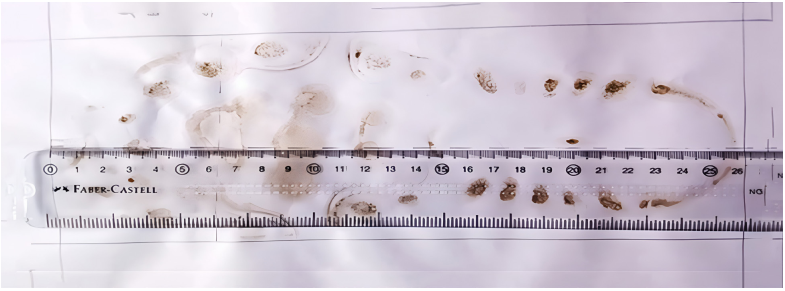
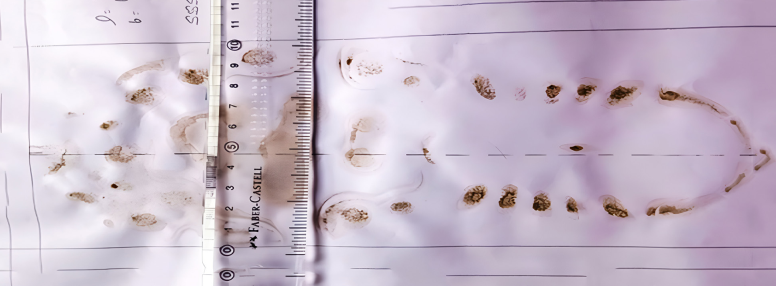
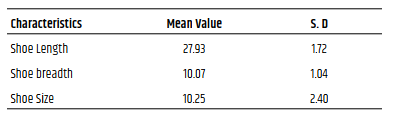
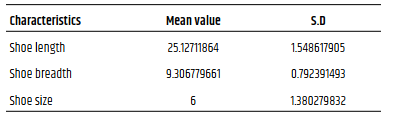
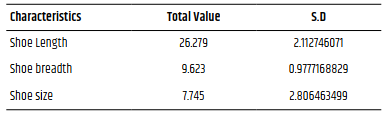
During crime scene inspection, footwear impressions (shoe prints) are one of the most common pieces of evidence. It can establish the facts of the absence and presence of an individual at the scene, as well as the linkage of minute traces of the soil, dust, dirt, or any such material to the crime scene and the surroundings. In this study, the right-leg shoe prints from 100 participants (59 females and 41 males) of the Haryana population within the range of 18 to 50 years were collected. The parameters selected were shoe length, shoe breadth shoe size along with manufacturing marks (if any), wear and tear pattern, etc. Based upon the statistical analysis, this study provides us with information that shoe size and shoe breadth can be considered a few important parameters to differentiate between male and female footwear impressions. Therefore, this study could be used as a method for the gender determination of an individual from the available shoe print present at a crime scene and can provide a more accurate link with the suspect.
References
- 1. Adair T. Basic Skills for Scene Processing: Impression Evidence. In Practical Crime Scene Processing and Investigation, Third Edition 2018 Sep 20 (pp. 233-253). CRC Press.
- 2. Budka M, Bennett MR, Reynolds SC, Barefoot S, Reel S, Reidy S, Walker J. Sexing white 2D footprints using convolutional neural networks. Plos one. 2021 Aug 18;16(8):e0255630.
- 3. Daniel O, Levi A, Pertsev R, Issan Y, Pasternak Z, Cohen A. The Next Step–a semi-automatic coding and comparison system for forensic footwear impressions. Forensic Science International. 2022 Aug 1;337:111378.
- 4. Kostenko, D. (2020). An investigator is not a friend of a forensic investigator?. НаучныйКомпонент, (2), 74-84. doi: 10.51980/2686-939x_2020_2_74.
- 5. Mishra A, Nagda B. Study of water quality in Udaipur Region, India. Asian Journal of Water, Environment and Pollution. 2020 Jan 1;17(1):51-7.
- 6. Millen, P. (2000). Is crime scene investigation forensic science? Are crime scene investigators forensic scientists?. Science &Amp; Justice, 40(2), 125-126. doi: 10.1016/s1355-0306(00)71957-5.
- 7. Kumar A, Mishra A. Anatomical variations in the branching pattern of human aortic arch: a cadaveric study from Nepal. Eur J Anat. 2015 Jan 1;19(1):43-7.
- 8. Singh C, Rani MS, Mishra A. Development of analytical method for detection of monocrotophos insecticide from biological matrix using lc-ms/ms. International Journal of Medical Toxicology & Legal Medicine. 2020;23(1and2):210-9.
- 9. Smale AN, Speir JA. Estimate of the random match frequency of acquired characteristics in footwear: Part I— Impressions in blood. Science & Justice. 2024 Jan 1;64(1):117-33.
- 10. Wright, W., & Hirsch, C. (1987). The Physician Assistant as Forensic Investigator. Journal of Forensic Sciences, 32(4), 12414J. doi: 10.1520/ jfs12414j.
- 11. Mishra A, Shukla SK, Tayal I, Ashwini K, Shilekh M, Rajiv J. Trends of Poisoning in Developing Country–A Ten-year Retrospective Study. Journal of Punjab Academy of Forensic Medicine & Toxicology. 2017;17(1) 35-39.
- 12. Yadav N, Mudgal D, Mishra A, Shukla S, Malik T, Mishra V. Harnessing fluorescent carbon quantum dots from natural resource for advancing sweat latent fingerprint recognition with machine learning algorithms for enhanced human identification. Plos one. 2024 Jan 4;19(1):e0296270.
- 13. Barbaro A, Mishra A, editors. Manual of Crime Scene Investigation. CRC Press; 2022 Oct 28.
Data Sharing Statement
There are no additional data available.
Funding
This research received no funding.
Author Contributions
All authors contributed significantly to the work and approve its publication.
Ethics Declaration
This article does not involve any human or animal subjects, and therefore does not require ethics approval.
Acknowledgements
Information not provide.
Conflicts of Interest
The authors report no conflicts of interest in this work.
About this article

Cite this article
Dimple, Verma P, Shalini. Estimation of gender from footwear impression in the Haryana population. Indian J Forensic Med Pathol. 2024;17(4):259-263.
Licence:
Attribution-Non-commercial 4.0 International (CC BY-NC 4.0)This license enables reusers to distribute, remix, adapt, and build upon the material in any medium or format for noncommercial purposes only, and only so long as attribution is given to the creator.
| Received | Accepted | Published |
|---|---|---|
| June 26, 2024 | September 12, 2024 | December 15, 2024 |
DOI: https://doi.org/10.21088/ijfmp.0974.3383.17424.5
Keywords
Crime Scene InvestigatorsFootwear ImpressionSex DeterminationShoe SizeShoe BreadthShoe LengthSearch for Similar Articles
Similar Articles
- Diatom Analysis in Thermophilic water bodies: A Study on Hot Water Springs of Ma...
- Morphometric Study of Supra-meatal Triangle and Mastoid process in the Adult dry...
- Histopathological Spectrum of Autopsy Cases: A One Year Retrospective Observatio...
- Forensic Differentiation of Manner of Death in Railway Fatalities: A FourCase Se...
- Understanding assault Patterns: A Cross-sectional study of Cases at Chri, Kelamb...
Article Level Metrics
Last UpdatedMonday 19 October 2026, 10:56:04 (IST)
16327
Accesses
27
3215
00
Citations
NA
NA
NA
Download citation
Article Keywords
Keyword Highlighting
Highlight selected keywords in the article text.
Timeline
| Received | June 26, 2024 |
| Accepted | September 12, 2024 |
| Published | December 15, 2024 |
licence
Attribution-Non-commercial 4.0 International (CC BY-NC 4.0)
This license enables reusers to distribute, remix, adapt, and build upon the material in any medium or format for noncommercial purposes only, and only so long as attribution is given to the creator.