Full Text (PDF)
Indian Journal of Forensic Medicine and Pathology 18(4):p 515-520, Oct. - Dec. 2025. | DOI: https://doi.org/10.21088/ijfmp.0974.3383.18425.3
Original Article
EGFR Immunohistochemical Expression in Head and Neck Squamous Cell Carcinoma and its Prognostic Significance
Vijaya Lakshmi Muram Reddy, Fameena Rahman Shaik, Pratima Jonnadula, Durga Kharidehal, Syam Sundara Rao Byna, Bhavana Grandhi
Author Information
Licence:
Attribution-Non-commercial 4.0 International (CC BY-NC 4.0)This license enables reusers to distribute, remix, adapt, and build upon the material in any medium or format for noncommercial purposes only, and only so long as attribution is given to the creator.
Indian Journal of Forensic Medicine and Pathology 18(4):p 515-520, Oct. - Dec. 2025. | DOI: https://doi.org/10.21088/ijfmp.0974.3383.18425.3
How Cite This Article:
Shaik F.R., Reddy V.L.M., Jonnadula P., et al. EGFR Immunohistochemical Expression in Head and Neck Squamous Cell Carcinoma and Its Prognostic Significance. Indian J Forensic Med Pathol. 2025 Oct-Dec; 18(4): 227-232.Timeline
Received : July 17, 2025
Accepted : November 03, 2025
Published : December 30, 2025
Abstract
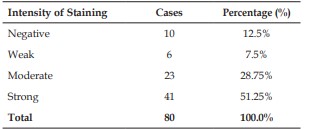
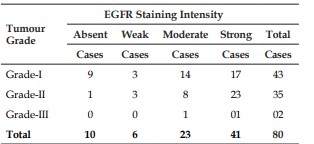
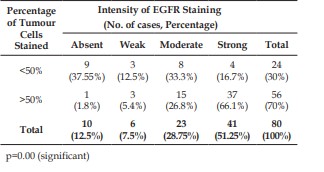
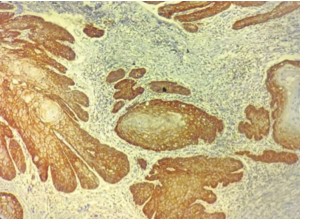
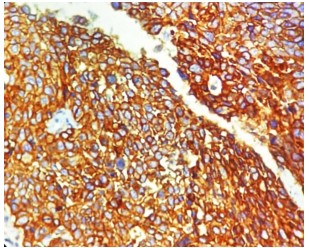
Background: Head and neck Squamous cell carcinoma (HNSCC) is a highly rapidly spreading invasive malignant tumour of the epithelium and in the entire world, it is the sixth most common malignant neoplasm. EGFR protein is crucial for several processes that impact tumor genesis, growth, differentiation, suppression of apoptosis and metastatic development. Increased expression of EGFR is linked to poor clinical outcomes and resistance to radiation therapy. Aim: Evaluation of expression of EGFR is done in HNSCC and it is correlated with various parameters like histological grade, staining intensity, percentage of tumor cells stained and its prognostic significance is determined. Materials and methods: Total number of 80 cases were studied and statistically p value is determined. Results: Females holds the majority of 51cases (63.75%) and males were 29 cases (36.25%). Age group 41 to 50 years has highest occurrence which is followed by 51 to 60 years. 63.75% of patients have positive smoking history. 71.25% have history of tobacco use. Most common site of tumor is oral cavity (95%). Majority of the cases were conventional Squamous Cell Carcinoma (95%) and verrucous carcinoma comprising (5%) cases. Most of the patients had grade I tumors (53.75%). 51.25% of cases have strong intensity in staining. Greater than 50% of cells are stained by EGFR in 56 cases and p value is statistically significant. Conclusion: High EGFR expression is a helpful diagnostic and prognostic immunohistochemical marker especially in advanced cancers. EGFR targeted therapy along with radiotherapy, chemotherapy can be used for locally advanced, metastatic and recurrent Head and Neck squamous cell carcinomas
References
- 1. Lingen W. Head and neck. In: Kumar V., Abbas A.K., Fausto N., Aster J.C., editors. Robbins and Cotran pathologic basis of disease. Saunders: Elsevier; 2010. p. 745–9.
- 2. Bianchini C., Ciorba A., Pelucchi S., Piva R., Pastore A. Targeted therapy in head and neck cancer. Tumori. 2011; 97(2): 137–41.
- 3. Quon H., Liu F.F., Cummings B.J. Potential molecular prognostic markers in head and neck squamous cell carcinomas. Head Neck. 2001 Feb; 23(2): 147–59.
- 4. Zimmermann M., Zouhair A., Azria D., Ozsahin M. The epidermal growth factor receptor (EGFR) in head and neck cancer: Its role and treatment implications. Radiat Oncol. 2006 Dec; 1(1): 1–6.
- 5. Sarkis S.A., Abdullah B.H., Abdul Majeed B.A., Talabani N.G. Immunohistochemical expression of epidermal growth factor receptor (EGFR) in oral squamous cell carcinoma in relation to proliferation, apoptosis, angiogenesis and lymphangiogenesis. Head Neck Oncol. 2010; 2:13.
- 6. Kim J.C., Ali M.A., Nandi A., Mukhopadhyay P., Choy H., Cao C., Saha D. Correlation of HER1/EGFR expression and degree of radiosensitizing effect of the HER1/EGFRtyrosine kinase inhibitor erlotinib. Indian J Biochem Biophys. 2005; 42(6): 358–65.
- 7. Issa H.I. Immunoexpression of epidermal growth factor receptor, Ki-67 and P53 protein in squamous cell carcinoma of the head and neck. Res J Med Med Sci. 2013; 8(1): 9–15.
- 8. Mariezkurrena X.A., Guimera J.A., Rodriguez J.W., Weisman R., Ongkeko W. Immunohistochemistry study of EGFR expression in head and neck squamous cell carcinoma. Acta Otorrinolaringol Esp. 2005; 56(4): 143–6.
- 9. Willmore-Payne C., Holden J.A., Layfield L.J. Detection of EGFR-and HER2-activating mutations in squamous cell carcinoma involving the head and neck. Mod Pathol. 2006 May; 19(5): 634–40.
- 10. Chung C.H., Ely K., McGavran L., VarellaGarcia M., Parker J., Parker N., et al. Increased epidermal growth factor receptor gene copy number is associated with poor prognosis in head and neck squamous cell carcinomas. J Clin Oncol. 2006 Sep 1; 24(25): 4170–6.
- 11. Ting Hsiung D., Marsit C.J., Houseman E.A., Eddy K., Furniss C.S., McClean M.D., Kelsey K.T. Global DNA methylation level in whole blood as a biomarker in head and neck squamous cell carcinoma. Cancer Epidemiol Biomarkers Prev. 2007 Jan; 16(1): 108–14.
- 12. Keller J., Shroyer K.R., Batajoo S.K., Zhao H.L., Dong L.M., Hayman M.J., Chan E.L. Combination of phosphorylated and truncated EGFR correlates with higher tumor and nodal stage in head and neck cancer. Cancer Investig. 2010; 28(10): 1054–62.
- 13. Hama T., Yuza Y., Saito Y., O-uchi J., Kondo S., Okabe M., et al. Prognostic significance of epidermal growth factor receptor phosphorylation and mutation in head and neck squamous cell carcinoma. Oncologist. 2009 Sep; 14(9): 900–8.
- 14. Basu R., Mandal S., Ghosh A., Poddar T.K. Role of tobacco in the development of head and neck squamous cell carcinoma in an eastern Indian population. Asian Pac J Cancer Prev. 2008 Jan 1; 9(3): 381–6.
- 15. Zhou J., Michaud D.S., Langevin S.M., McClean M.D., Eliot M., Kelsey K.T. Smokeless tobacco and risk of head and neck cancer: evidence from a case-control study in New England. Int J Cancer. 2013; 132(8): 1911–7.
- 16. Maiti G.P., Mondal P., Mukherjee N., Ghosh A., Ghosh S., Dey S., et al. Overexpression of EGFR in head and neck squamous cell carcinoma is associated with inactivation of SH3GL2 and CDC25A genes. PLoS One. 2013 May 10; 8(5): e63440.
- 17. Huang S.F., Cheng S.D., Chien H.T., Liao C.T., Chen I.H., Wang H.M., Chuang W.Y., Wang C.Y., Hsieh L.L. Relationship between epidermal growth factor receptor gene copy number and protein expression in oral cavity squamous cell carcinoma. Oral Oncol. 2012 Jan; 48(1): 67–72
Data Sharing Statement
There are no additional data available. All raw data and code are available upon request.
Funding
This research received no funding.
Author Contributions
All authors contributed significantly to the work and approve its publication.
Ethics Declaration
This article does not involve any human or animal subjects, and therefore does not require ethics approval.
Acknowledgements
We would like to express our gratitude to the patients, their families, and all those who have contributed to this study.
Conflicts of Interest
No conflicts of interest in this work.
About this article

Cite this article
Shaik F.R., Reddy V.L.M., Jonnadula P., et al. EGFR Immunohistochemical Expression in Head and Neck Squamous Cell Carcinoma and Its Prognostic Significance. Indian J Forensic Med Pathol. 2025 Oct-Dec; 18(4): 227-232.
Licence:
Attribution-Non-commercial 4.0 International (CC BY-NC 4.0)This license enables reusers to distribute, remix, adapt, and build upon the material in any medium or format for noncommercial purposes only, and only so long as attribution is given to the creator.
| Received | Accepted | Published |
|---|---|---|
| July 17, 2025 | November 03, 2025 | December 30, 2025 |
DOI: https://doi.org/10.21088/ijfmp.0974.3383.18425.3
Keywords
Head and NeckSquamous cell carcinomaEGFRGradeIntensityPrognosisSearch for Similar Articles
Similar Articles
- Diatom Analysis in Thermophilic water bodies: A Study on Hot Water Springs of Ma...
- Morphometric Study of Supra-meatal Triangle and Mastoid process in the Adult dry...
- Histopathological Spectrum of Autopsy Cases: A One Year Retrospective Observatio...
- Forensic Differentiation of Manner of Death in Railway Fatalities: A FourCase Se...
- Understanding assault Patterns: A Cross-sectional study of Cases at Chri, Kelamb...
Article Level Metrics
Last UpdatedSunday 18 October 2026, 14:54:15 (IST)
16276
Accesses
43
3209
00
Citations
NA
NA
NA
Download citation
Article Keywords
Keyword Highlighting
Highlight selected keywords in the article text.
Timeline
| Received | July 17, 2025 |
| Accepted | November 03, 2025 |
| Published | December 30, 2025 |
licence
Attribution-Non-commercial 4.0 International (CC BY-NC 4.0)
This license enables reusers to distribute, remix, adapt, and build upon the material in any medium or format for noncommercial purposes only, and only so long as attribution is given to the creator.