Full Text (PDF)
Indian Journal of Anatomy 13(1):p 07-14, January – March 2024. | DOI: https://doi.org/10.21088/ija.2320.0022.13124.1
Original Article
Distractor Efficacy, Difficulty and Discrimination Index of MCQ in Anatomy Formative Assessment: A Descriptive Analysis
Pushpalatha K null, Sunil Kumar D null, Manjunatha B null, Deepa Bhat
Author Information
Licence:
Attribution-Non-commercial 4.0 International (CC BY-NC 4.0)This license enables reusers to distribute, remix, adapt, and build upon the material in any medium or format for noncommercial purposes only, and only so long as attribution is given to the creator.
Indian Journal of Anatomy 13(1):p 07-14, January – March 2024. | DOI: https://doi.org/10.21088/ija.2320.0022.13124.1
How Cite This Article:
Pushpalatha K, Sunil Kumar D, Manjunatha B. Distractor efficacy, difficulty and discrimination index of MCQ in anatomy formative assessment: a descriptive analysis. Ind J Anat. 2024;13(1):7-14.Timeline
Received : January 23, 2024
Accepted : February 20, 2024
Published : May 30, 2024
Abstract
Background: Anatomy is the foundation stone of medical education, and assessing anatomy competency is essential. Assessment tools should fulfill objectivity, reliability, validity, and test higher cognitive skills. Assessment is a very significant component of education. To correctly judge the knowledge and skill of learners, assessment should be valid and should judge the appropriate levels of cognition. A large portion of the curriculum is assessed in a short period of time, requiring less effort from the student. However, it takes a lot of effort and time for the examiner to make high quality MCQs. Properly constructed multiple-choice questions assess higher-order cognitive processing of Bloom's taxonomy, such as interpretation, synthesis, and application of knowledge, instead of just testing recall of isolated facts
Methods: Hundred MCQ’s from internal examinations of anatomy papers were analyzed for difficulty index, discrimination index (DI), and distractor efficiency (DE).
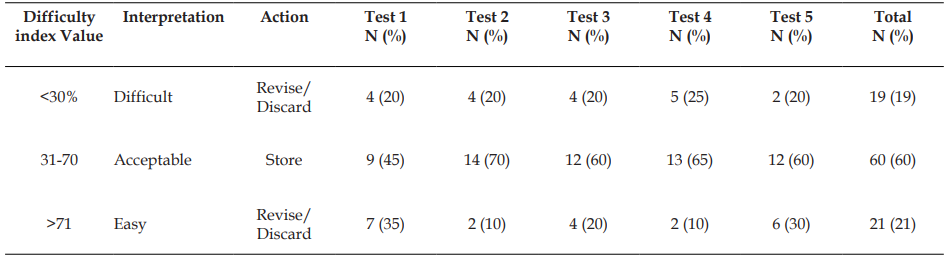
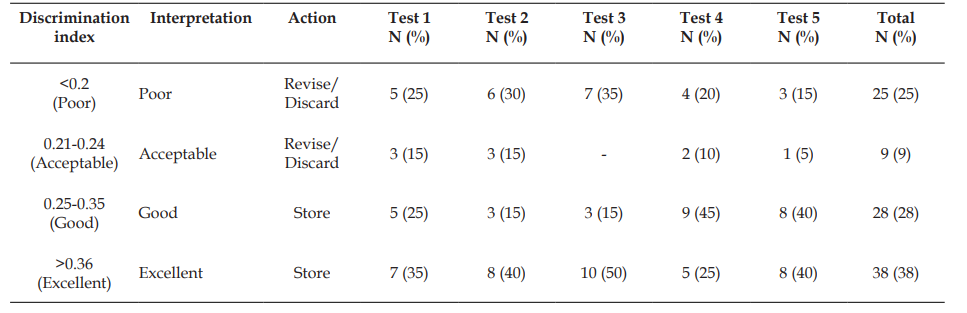
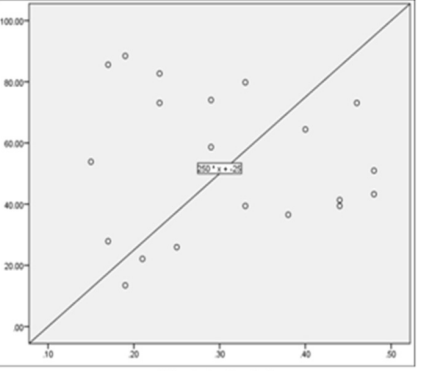
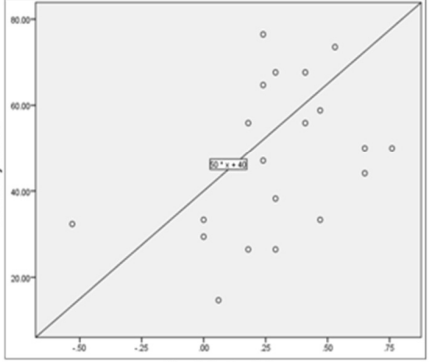
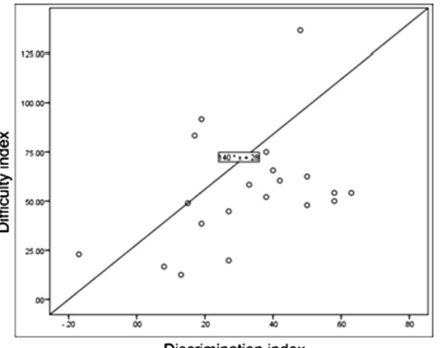
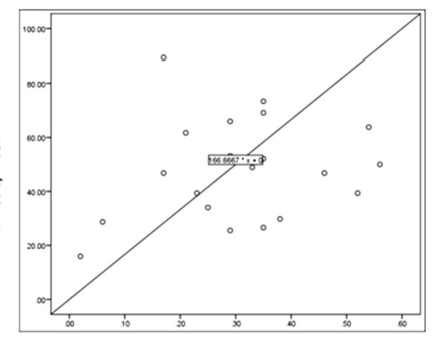
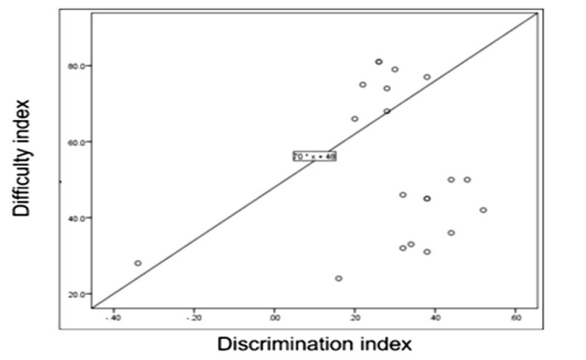
Results: In the present study, out of 100 MCQs, 19 were difficult, 60 were acceptable, and 21 were easy. 25 items did not discriminate against high achievers versus low achievers, 37 were acceptable, and 38 were highly discriminatory. There was a low positive correlation between the Difficulty Index and the Discrimination Index in tests two and three. However, there was a negligible correlation in tests one, four, and five.
Conclusion: Item analysis of the MCQs performed after the assessment provides insight into test item reliability and validity. In addition, it indicates how difficult or easy the questions were
References
- 1. Singh K, Bharatha A, Sa B, Adams OP, Majumder MA. Teaching anatomy using an active and engaging learning strategy. BMC Med Educ. 2019;19:149.
- 2. Adiga MNS, Acharya S, Holla R. Item analysis of multiple-choice questions in pharmacology in an Indian medical school. J Health Allied Sci NU. 2021;11(3):130-135.
- 3. Chakravarty M, Latif NA, Abu-Hijleh MF, Osman M, Dharap AS, Ganguly PK. Assessment of anatomy in a problem-based medical curriculum. Clin Anat. 2005;18(2):131-136.
- 4. Brenner E, Chirculescu AR, Reblet C, Smith C. Assessment in anatomy. Eur J Anat. 2015;19(1):105-124.
- 5. Yaqinuddin A, Zafar M, Ikram MF, Ganguly P. What is an objective structured practical examination in anatomy? Anat Sci Educ. 2013;6(2):125-133.
- 6. Khan GN, Ishrat N, Khan AQ. Using item analysis on essay types questions given in summative examination of medical college students: Facility value, discrimination index. Int J Res Med Sci. 2015;3(1):178-182.
- 7. Rao C, Kishan Prasad HL, Sajitha K, Permi H, Shetty J. Item analysis of multiple-choice questions: Assessing an assessment tool in medical students. Int J Educ Psychol Res. 2016;2(4):201-204.
- 8. Chauhan PR, Rathod SP, Chauhan BR, Chauhan GR, Adhvaryu A, Chauhan AP. Study of difficulty level and discriminating index of stem type multiple choice questions of anatomy in Rajkot. Biomirror. 2013;4:1-4.
- 9. Hingorjo MR, Jaleel F. Analysis of one-best MCQs: the difficulty index, discrimination index and distractor efficiency. J Pak Med Assoc. 2012;62(2):142-147.
- 10. Palmer EJ, Devitt PG. Assessment of higher order cognitive skills in undergraduate education: modified essay or multiple choice questions? Research paper. BMC Med Educ. 2007;7:49.
- 11. Mehta G, Mokhasi V. Item analysis of multiple choice questions- an assessment of the assessment tool. Int J Health Sci Res. 2014;4(7):197-202.
- 12. D’sa JL, Visbal-Dionaldo ML. Analysis of multiple choice questions: Item difficulty, discrimination index and distractor efficacy. Int J Nurs Educ. 2017;9(3):109-114.
- 13. Mahjabeen W, Alam S, Hassan U, Zafar T, Butt R, Konain S, et al. Difficulty index, discrimination index and distractor efficiency in multiple choice questions. Ann Pak Inst Med Sci. 2017;13(4):310-315.
- 14. Sim SM, Rasiah RI. Relationship between item difficulty and discrimination indices in true/false-type multiple choice questions of a para-clinical multidisciplinary paper. Ann Acad Med Singap. 2006;35(2):67-71.
- 15. Melovitz Vasan CA, DeFouw DO, Holland BK, Vasan NS. Analysis of testing with multiple choice versus open-ended questions: Outcome-based observations in an anatomy course. Anat Sci Educ. 2018;11(3):254-261.
- 16. Sharma LR. Analysis of difficulty index, discrimination index and distractor efficiency of multiple-choice questions of speech sounds of English. Int Res J MMC. 2021;2(1):1-10.
- 17. Tarrant M, Ware J, Mohammed AM. An assessment of functioning and non-functioning distractors in multiple-choice questions: a descriptive analysis. BMC Med Educ. 2009;9:40.
- 18. Sahoo DP, Singh R. Item and distracter analysis of multiple choice questions (MCQs) from a preliminary examination of undergraduate medical students. Int J Res Med Sci. 2017;5(12):5351-5355.
- 19. Ansari M, Sadaf R, Akbar A, Rehman S, Chaudhry ZR, Shakir S. Assessment of distractor efficiency of MCQS in item analysis. Professional Med J. 2022;29(5):730-734.
- 20. Date AP, Borkar AS, Badwaik RT, Siddiqui RA, Shende TR, Dashputra AV. Item analysis as tool to validate multiple choice question bank in pharmacology. Int J Basic Clin Pharmacol. 2019;8(9):1999-2003.
- 21. Puthiaparampil T, Rahman M. How important is distractor efficiency for grading Best Answer Questions? BMC Med Educ. 2021;21:2.
- 22. Testa S, Toscano A, Rosato R. Distractor efficiency in an item pool for a statistics classroom exam: Assessing its relation with item cognitive level classified according to Bloom’s taxonomy. Front Psychol. 2018;9:1585.
- 23. Sajjad M, Iltaf S, Khan RA. Nonfunctional distractor analysis: An indicator for quality of multiple-choice questions. Pak J Med Sci. 2020;36(5):982-986.
- 24. Thompson AR, O'Loughlin VD. The Blooming Anatomy Tool (BAT): A discipline-specific rubric for utilizing Bloom's taxonomy in the design and evaluation of assessments in the anatomical sciences. Anat Sci Educ. 2015;8(6):493-501.
- 25. Chéron M, Ademi M, Kraft F, Löffler-Stastka H. Case-based learning and multiple-choice questioning methods favored by students. BMC Med Educ. 2016;16:41.
- 26. Patil R, Palve SB, Vell K, Boratne AV. Evaluation of multiple-choice questions by item analysis in a medical college at Pondicherry, India. Int J Community Med Public Health. 2016;3(6):1612-1616.
- 27. Burud I, Nagandla K, Agarwal P. Impact of distractors in item analysis of multiple-choice questions. Int J Res Med Sci. 2019;7(4):1136-1139.
- 28. Fozzard N, Pearson A, du Toit E, Naug H, Wen W, Peak IR. Analysis of MCQ and distractor use in a large first year Health Faculty Foundation Program: assessing the effects of changing from five to four options. BMC Med Educ. 2018;18:252.
Data Sharing Statement
There are no additional data available. All raw data and code are available upon request.
Funding
This research received no funding.
Author Contributions
Whether all authors contributed significantly to the work and approve its publication.
Ethics Declaration
This article does not involve any human or animal subjects, and therefore does not require ethics approval.
Acknowledgements
We would like to express our gratitude to the patients, their families, and all those who have contributed to this study.
Conflicts of Interest
The authors report no conflicts of interest in this work.
About this article

Cite this article
Pushpalatha K, Sunil Kumar D, Manjunatha B. Distractor efficacy, difficulty and discrimination index of MCQ in anatomy formative assessment: a descriptive analysis. Ind J Anat. 2024;13(1):7-14.
Licence:
Attribution-Non-commercial 4.0 International (CC BY-NC 4.0)This license enables reusers to distribute, remix, adapt, and build upon the material in any medium or format for noncommercial purposes only, and only so long as attribution is given to the creator.
| Received | Accepted | Published |
|---|---|---|
| January 23, 2024 | February 20, 2024 | May 30, 2024 |
DOI: https://doi.org/10.21088/ija.2320.0022.13124.1
Keywords
Thermal burnsFeracrylumSearch for Similar Articles
Similar Articles
- Supernumerary Pulmonary Vein: A Rare Anatomical Variation Observed During Cadave...
- Elongated Styloid Process: Anatomical Variations and Their Clinical Relevance: A...
- Bridging the Gap Between Dissection and Surgery: The Role of Soft Embalming in M...
- A Cadaveric Study of Retro Hepatic Segment of Inferior Vena Cava and Ostia Venae...
- Estimation of Stature from Forearm Length in Medical Undergraduate Students of a...
Article Level Metrics
Last UpdatedSunday 20 September 2026, 22:37:49 (IST)
5038
Accesses
23
601
00
Citations
NA
NA
NA
Download citation
Article Keywords
Keyword Highlighting
Highlight selected keywords in the article text.
Timeline
| Received | January 23, 2024 |
| Accepted | February 20, 2024 |
| Published | May 30, 2024 |
licence
Attribution-Non-commercial 4.0 International (CC BY-NC 4.0)
This license enables reusers to distribute, remix, adapt, and build upon the material in any medium or format for noncommercial purposes only, and only so long as attribution is given to the creator.