Full Text (PDF)
Indian Journal of Anatomy 13(1):p 17-26, January – March 2024. | DOI: https://doi.org/10.21088/ija.2320.0022.13124.2
Original Article
Assessment of the Performance of ChatGPT in Human Anatomy of First Professional MBBS Competency Based Medical Education (CBME) Undergraduate Curriculum
Krishna Mohan Surapaneni, Mahima Sophia Manavalan, Indumathi Sundaramurthi
Author Information
Licence:
Attribution-Non-commercial 4.0 International (CC BY-NC 4.0)This license enables reusers to distribute, remix, adapt, and build upon the material in any medium or format for noncommercial purposes only, and only so long as attribution is given to the creator.
Indian Journal of Anatomy 13(1):p 17-26, January – March 2024. | DOI: https://doi.org/10.21088/ija.2320.0022.13124.2
How Cite This Article:
Manavalan MS, Sundaramurthi I, Surapaneni KM. Assessment of the performance of ChatGPT in human anatomy of first professional MBBS competency based medical education (CBME) undergraduate curriculum. Ind J Anat. 2023;12(4):17-26.Timeline
Received : February 14, 2024
Accepted : March 30, 2024
Published : May 30, 2024
Abstract
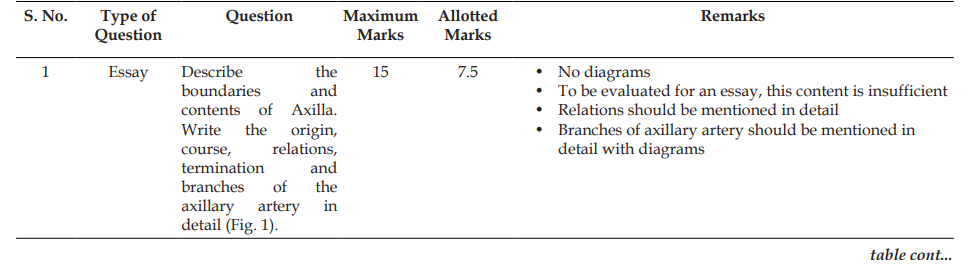
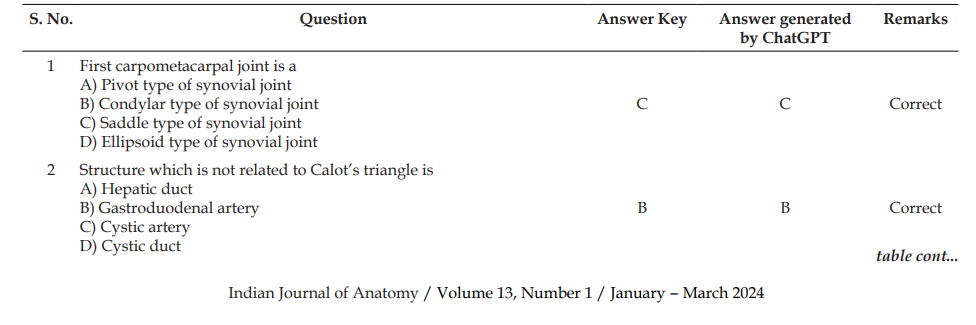
Background: ChatGPT developed by OpenAI is a state-of-the art innovation and is leading the field of technology with its massive ability to generate any of information in human like conversational manner. The utility of this Artificial Intelligence (AI) based model is being tested in various domains and usability in education is certainly a topic of sensation. ChatGPT has been successful in clearing competitive medical exams and could possibly emerge as an ideal tool for advancing teaching learning methodologies in medical education once the accuracy in its content can be validated and affirmed. Objective: In this study, we aim to evaluate the performance of ChatGPT Human Anatomy of first MBBS professional Methods: This assessment was carried out using the university examination question paper of Human Anatomy paper 1. The question paper comprised of 2 essay, 10 short notes and 20 Multiple Choice Questions (MCQ). All the questions were entered on ChatGPT one after the other and the responses generated were saved and sent to our evaluation team in the department of anatomy. Result: ChatGPT has provided brief explanations for all the questions. For the Multiple Choice Questions (MCQ), the option along with reasons were given. Out of 20, six answers were incorrect. Although ChatGPT has provided relevant answers for all the questions, there was no diagrammatic representation provided. The feedback from the faculties suggested that there were few incorrect explanations and content should be more elaborate with relations of the structures being explained in detail. Overall ChatGPT has passed the test with total of 56%. Conclusion: From the results of our study, we emphasize that ChatGPT has the potential to be used as an effective learning tool with its humanoid conversation that can create a personalised learning experience. However, the accuracy and dependability of such tools is a cause of concern. Also, due to lack of its ability to produce pictorial illustration, learning and understanding of subjects like anatomy may not be very efficient.
References
- 1. OpenAI. Introducing ChatGPT [Internet]. San Francisco: OpenAI; 2022 [updated 2023 Mar 19; cited 2023 Mar 19].
- 2. Botbark. ChatGPT: Reinforcement learning from human feedback [Internet]. 2023 [cited 2023 Mar 19].
- 3. Kung TH, Cheatham M, Medenilla A, Sillos C, De Leon L, Elepaño C, et al. Performance of ChatGPT on USMLE: Potential for AI-assisted medical education using large language models. PLOS Digit Health. 2023;2(2):e0000198.
- 4. Thorp HH. ChatGPT is fun, but not an author. Science. 2023;379(6630):313.
- 5. Baidoo-Anu D, Owusu Ansah L. Education in the era of generative artificial intelligence (AI): Understanding the potential benefits of ChatGPT in promoting teaching and learning. SSRN [Preprint]. 2023 [cited 2023 Mar 19].
- 6. Khan RA, Jawaid M, Khan AR, Sajjad M. ChatGPT - Reshaping medical education and clinical management. Pak J Med Sci. 2023;39(2):605-607.
- 7. Talan T, Kalınkara Y. The role of artificial intelligence in higher education: ChatGPT assessment for anatomy course. Int J Manag Inf Syst Comput Sci. 2023;7(1):33-40.
- 8. Mogali SR. Initial impressions of ChatGPT for anatomy education. Anat Sci Educ. 2023;16(3):391-393.
- 9. Sok S, Heng K. ChatGPT for education and research: A review of benefits and risks. SSRN [Preprint]. 2023 [cited 2023 Mar 19
- 10. Han Z, Battaglia F, Udaiyar A, Fooks A, Terlecky SR. An explorative assessment of ChatGPT as an aid in medical education: Use it with caution. medRxiv [Preprint]. 2023 [cited 2023 Mar 19].
- 11. Lee H. The rise of ChatGPT: Exploring its potential in medical education. Anat Sci Educ. 2023;16(5):731-736.
Data Sharing Statement
There are no additional data available. All raw data and code are available upon request.
Funding
This research received no funding.
Author Contributions
Whether all authors contributed significantly to the work and approve its publication.
Ethics Declaration
This article does not involve any human or animal subjects, and therefore does not require ethics approval.
Acknowledgements
We would like to express our gratitude to the patients, their families, and all those who have contributed to this study.
Conflicts of Interest
The authors report no conflicts of interest in this work.
About this article

Cite this article
Manavalan MS, Sundaramurthi I, Surapaneni KM. Assessment of the performance of ChatGPT in human anatomy of first professional MBBS competency based medical education (CBME) undergraduate curriculum. Ind J Anat. 2023;12(4):17-26.
Licence:
Attribution-Non-commercial 4.0 International (CC BY-NC 4.0)This license enables reusers to distribute, remix, adapt, and build upon the material in any medium or format for noncommercial purposes only, and only so long as attribution is given to the creator.
| Received | Accepted | Published |
|---|---|---|
| February 14, 2024 | March 30, 2024 | May 30, 2024 |
DOI: https://doi.org/10.21088/ija.2320.0022.13124.2
Keywords
ChatGPTHuman anatomyMedical educationArtificial intelligenceSearch for Similar Articles
Similar Articles
- Supernumerary Pulmonary Vein: A Rare Anatomical Variation Observed During Cadave...
- Elongated Styloid Process: Anatomical Variations and Their Clinical Relevance: A...
- Bridging the Gap Between Dissection and Surgery: The Role of Soft Embalming in M...
- A Cadaveric Study of Retro Hepatic Segment of Inferior Vena Cava and Ostia Venae...
- Estimation of Stature from Forearm Length in Medical Undergraduate Students of a...
Article Level Metrics
Last UpdatedSunday 20 September 2026, 22:46:54 (IST)
5038
Accesses
12
601
00
Citations
NA
NA
NA
Download citation
Article Keywords
Keyword Highlighting
Highlight selected keywords in the article text.
Timeline
| Received | February 14, 2024 |
| Accepted | March 30, 2024 |
| Published | May 30, 2024 |
licence
Attribution-Non-commercial 4.0 International (CC BY-NC 4.0)
This license enables reusers to distribute, remix, adapt, and build upon the material in any medium or format for noncommercial purposes only, and only so long as attribution is given to the creator.