Full Text (PDF)
Indian Journal of Forensic Medicine and Pathology 11(2):p 115-118, April-June 2018. | DOI: 10.21088/ijfmp.0974.3383.11218.13
Original Article
Dermatoglyphics Pattern in Patients with Ischemic Heart Disease
Shamshuddin R , Kakkeri, Habibullah Attar, Jandullah Khan
Author Information
Licence:
Attribution-Non-commercial 4.0 International (CC BY-NC 4.0)This license enables reusers to distribute, remix, adapt, and build upon the material in any medium or format for noncommercial purposes only, and only so long as attribution is given to the creator.
Indian Journal of Forensic Medicine and Pathology 11(2):p 115-118, April-June 2018. | DOI: 10.21088/ijfmp.0974.3383.11218.13
How Cite This Article:
Timeline
Received : March 19, 2018
Accepted : April 30, 2018
Published : May 30, 2018
Abstract
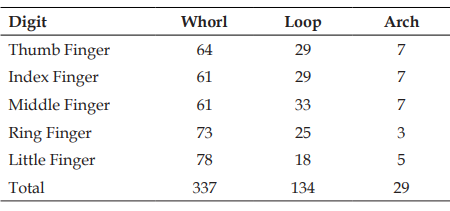
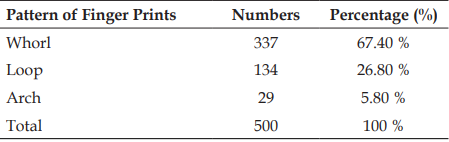
Objective: To study the association of Dermatoglyphics with Ischemic Heart Disease and it can be also helpful in identification of persons in court of law. Study design: Descriptive study Place and duration of study: Data was collected for the study which was conducted at Al-Ameen Medical College & Hospital, Bijapur, Karnataka from April 2017 to June 2017. Materials and methods: Finger prints were collected from the subjects after obtaining their informed consent in the month of 1 April, 2017 to 15 June, 2017. A total of 100 IHD diagnosed patients were selected from the OPD of Al-Ameen Medical College & Hospital and data were analyzed. The finger prints of both the hands were recorded on a plain white paper with a stamp ink pad by rolling method and each finger print was assigned by their Name, Age, and Sex. Results: A total of one hundred patients were selected for this study which were all known case of Coronary Heart disease patients. Out of these one hundred patients the majority of the patients were belonging to whorl pattern of finger prints i.e., 90 (57%) where as the number of patients belonging to Loop pattern was 40 (29%) pattern of Arch and composite was same i.e., 10 (7%) each, and so these various types of fingerprint patterns can be used for genetic correlation and screening. Conclusion: Majority of the patients was belonging to whorl pattern of finger prints followed by patients belonging to Loop pattern and the least patterns were Arch and composite. Each fingerprint is unique hence it can also be very effectively used as an evidence for identification in the court of law.
References
- 1. Penrose LS. Finger prints, palm and chromosomes. Nature. 1963;197:933-8.
- 2. Cummins H, Midlo C. Palmar and plantar epidermal configurations (dermatoglyphics) in European Americans. Am J Phys Anthropol. 1926;9(4):471-502.
- 3. Shamsoddini S, Masomi M, Nagad-Hossini M. Relation between the lines on the fingers of hand and the incidence of disease in human. Sci J Kerman Univ Med Sci. 1997;4(3):136-42.
- 4. Varma SL, Chary TV, Singh S, Ashorom Z. Dermatoglyphic patterns in schizophrenic patients. Acta Psychiatr Scand. 1995;91(3):213-5.
- 5. Drongowski RA, Coran AQ. Dermatoglyphic patterns in children with chronic constipation. Dig Dis Sci. 1995;40(7):1412.
- 6. Andrew PS, Eugene B. Ischemic heart disease. In: Kasper DL, Fauci AS, Longo DL, Braunwald E, Hauser SL, Jameson JL, editors. Harrison's principles of internal medicine. 16th ed. New York: McGraw-Hill; 2005. p. 1434-62.
- 7. Robert R, Doing M. Pathophysiology: recognition and treatment of acute MI. In: Schlant RC, Alexander RW, editors. Hurst’s the heart. 8th ed. New York: McGraw-Hill; 1994. p. 1107-8.
- 8. Jalali F, Hajian-Tilaki KO. A comparative study of dermatoglyphic patterns in patients with myocardial infarction and control group. Acta Med Iran. 2002;40(3):187-91.
- 9. Babler W. Embryonic development of epidermal ridges and their configurations. In: Plato CC, Garruto RM, Schaumann BA, editors. Dermatoglyphics: science in transition. New York: Wiley-Liss; 1991. p. 95-112.
- 10. van Oel CJ, Baare WF, Hulshoff Pol HE, Haag J, Balazs J, Dingemans A, et al. Differentiating between low and high susceptibility to schizophrenia in twins: the significance of dermatoglyphic indices in relation to other determinants of brain development. Schizophr Res. 2001;52(3):181-93.
- 11. Federal Bureau of Investigation. The science of fingerprints: classification and uses. Washington, DC: US Government Printing Office; 1984.
- 12. Schaumann B, Alter M, editors. Dermatoglyphics in medical disorders. New York: Springer-Verlag; 1976.
- 13. Martin NG, Eaves LJ, Loesch DZ. A genetical analysis of covariation between finger ridge counts. Ann Hum Biol. 1982;9(6):539-52.
- 14. Sudeep Dip PB, Mukerjee DP. Finger dermatoglyphic variations in Rengma Nagas of Nagaland, India. Coll Antropol. 2009;33(1):31-5.
- 15. Rastogi P, Pillai KR. A study of finger prints in relation to gender and blood group. J Indian Acad Forensic Med. 2010;32(1):11-3.
- 16. Hassan Q, Yousufani GM, Ishaq M, Abbasi MH. Comparative study of dermatoglyphic among the students of Ziauddin University. Med Forum Mon. 2011;22(12):1-4.
- 17. Shields JP, Wadsworth FJ, Baum JD. Dermatoglyphics, fetal growth, and diabetes in children. Arch Dis Child. 1995;72(2):159-60.
- 18. van Os J, Woodruff PW, Fananas L, Ahmad F, Shuriquie N, Howard R, et al. Association between cerebral structural abnormalities and dermatoglyphic ridge count in schizophrenia. Compr Psychiatry. 2000;41(5):380-4.
- 19. David TJ. Dermatoglyphics in congenital heart disease. J Med Genet. 1981;18(5):344-9.
- 20. Boroffice RA. Down’s syndrome in Nigeria: dermatoglyphic analysis of 50 cases. Niger Med J. 1978;8(6):571-6.
- 21. Abbasi MH, Mengal MA, Khan RMA, et al. Comparative study of dactylography among the students of Avicenna Medical College Lahore. Pak J Med Health Sci. 2012;6(2):362-5.
- 22. Rashad MN. Dermatoglyphic trait in patients cardiovascular disorders. Am J Phys Anthropol. 1975;42(2):281-3.
- 23. Bhatt SH. New signs of myocardial infarction. Medicine Update. 1996 Sep;411-6.
Data Sharing Statement
There are no additional data available. All raw data and code are available upon request.
Funding
This research received no funding.
Author Contributions
Whether all authors contributed significantly to the work and approve its publication.
Ethics Declaration
This article does not involve any human or animal subjects, and therefore does not require ethics approval.
Acknowledgements
We would like to express our gratitude to the patients, their families, and all those who have contributed to this study.
Conflicts of Interest
The authors report no conflicts of interest in this work.
About this article

Cite this article
Licence:
Attribution-Non-commercial 4.0 International (CC BY-NC 4.0)This license enables reusers to distribute, remix, adapt, and build upon the material in any medium or format for noncommercial purposes only, and only so long as attribution is given to the creator.
| Received | Accepted | Published |
|---|---|---|
| March 19, 2018 | April 30, 2018 | May 30, 2018 |
DOI: 10.21088/ijfmp.0974.3383.11218.13
Keywords
DermatoglyphicsIschemic Heart DiseaseWhorlLoopArchCourt of LawsIdentificationSearch for Similar Articles
Similar Articles
- Diatom Analysis in Thermophilic water bodies: A Study on Hot Water Springs of Ma...
- Morphometric Study of Supra-meatal Triangle and Mastoid process in the Adult dry...
- Histopathological Spectrum of Autopsy Cases: A One Year Retrospective Observatio...
- Forensic Differentiation of Manner of Death in Railway Fatalities: A FourCase Se...
- Understanding assault Patterns: A Cross-sectional study of Cases at Chri, Kelamb...
Article Level Metrics
Last UpdatedMonday 19 October 2026, 12:59:41 (IST)
16333
Accesses
9
3216
00
Citations
NA
NA
NA
Download citation
Article Keywords
Keyword Highlighting
Highlight selected keywords in the article text.
Timeline
| Received | March 19, 2018 |
| Accepted | April 30, 2018 |
| Published | May 30, 2018 |
licence
Attribution-Non-commercial 4.0 International (CC BY-NC 4.0)
This license enables reusers to distribute, remix, adapt, and build upon the material in any medium or format for noncommercial purposes only, and only so long as attribution is given to the creator.