Full Text (PDF)
Indian Journal of Forensic Medicine and Pathology 18(4):p 535-542, Oct. - Dec. 2025. | DOI: https://doi.org/10.21088/ijfmp.0974.3383.18425.6
Original Article
Craniofacial and Mandibular Morphometrics for Sex Determination in an Indian Population: A Radiographic Discriminant Function Analysis
Kiran K. Holikatti, Punnya V. Angadi, Chetan Belaldavar
Author Information
Licence:
Attribution-Non-commercial 4.0 International (CC BY-NC 4.0)This license enables reusers to distribute, remix, adapt, and build upon the material in any medium or format for noncommercial purposes only, and only so long as attribution is given to the creator.
Indian Journal of Forensic Medicine and Pathology 18(4):p 535-542, Oct. - Dec. 2025. | DOI: https://doi.org/10.21088/ijfmp.0974.3383.18425.6
How Cite This Article:
Holikatti K.K., Angadi P.V., Belaldavar C. Craniofacial and Mandibular Morphometrics for Sex Determination in an Indian Population: A Radiographic Discriminant Function Analysis. Indian J Forensic Med Pathol. 2025 Oct-Dec; 18(4): 247-254.Timeline
Received : July 09, 2025
Accepted : October 03, 2025
Published : December 30, 2025
Abstract
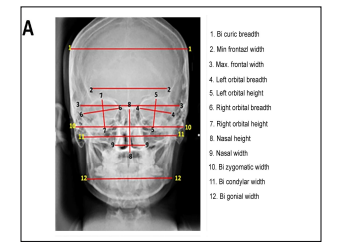
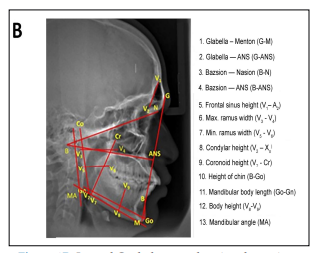
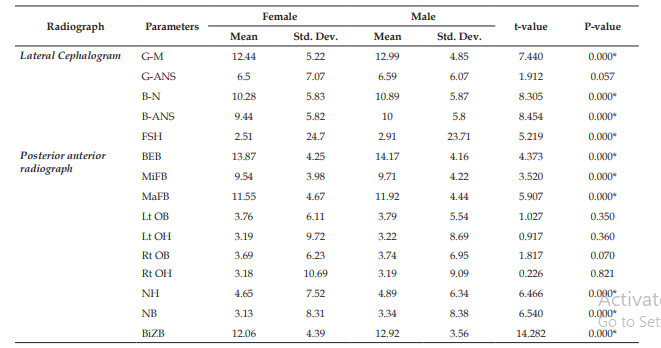
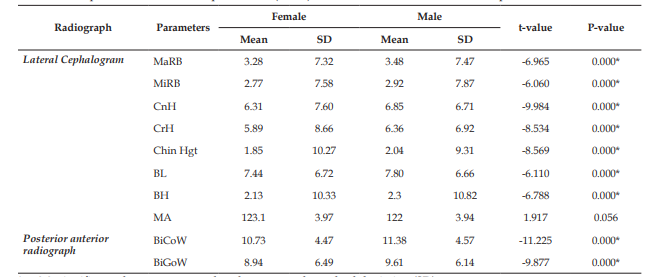
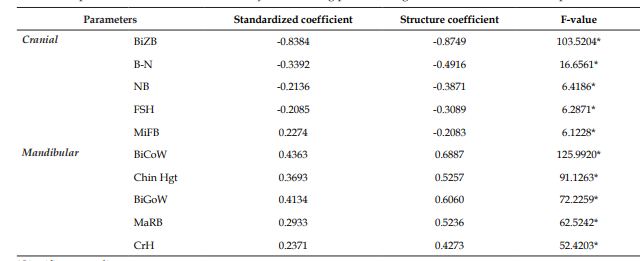
Introduction: Sex determination based on skeletal features plays a crucial role in forensic identification. There is sparse data on the metric cranial and mandibular criteria for Indians. This study aimed to establish population-specific standards for sex determination in the crania and mandibles of adults using logistic regression analysis. Materials and methods: The sample consisted of 300 participants (150 males, 150 females; age range: 18-30 yrs) of Indian origin. Fifteen standard cranial and 10 mandibular measurements were recorded on radiographic images and processed using a computer-aided drafting program (Adobe Photoshop 7 CS3 extended). To ascertain the usefulness of these parameters in sex prediction, a logistic regression analysis was performed. Results: All cranial parameters, except the upper facial height (G-ANS) and orbital measurements, showed sexual dimorphism. All mandibular parameters, except the mandibular angle, showed sexual dimorphism. The cranial measurements had a sex assessment accuracy of 86%, and the mandibular measurements had an accuracy of 82.7%. The combination of these parameters significantly improved the accuracy to 89.7%. Conclusion: This study on crania and mandibles of the Indian population clearly indicates that they have satisfactory potential for sex determination in adult Indians in forensic contexts. The width measurements, that is, bizygomatic breadth for the crania and bigonial breadth for the mandibles, were the most discriminatory.
References
- 1. Beschiu L.M., Ardelean L.C., Tigmeanu C.V., Rusu L.C. Cranial and Odontological Methods for Sex Estimation-A Scoping Review. Medicina (Kaunas). 2022; 58(9): 1273. doi: 10.3390/medicina58091273.
- 2. Mello-Gentil T., Souza-Mello V. Contributions of anatomy to forensic sex estimation: focus on head and neck bones. Forensic Sci Res. 2021; 7(1): 11-23. doi: 10.1080/20961790.2021.1889136.
- 3. Saini V., Srivastava R., Rai R.K., Shamal S.N., Singh T.B., Tripathi S.K. Mandibular ramus: an indicator for sex in fragmentary mandible. J Forensic Sci. 2011; 56 Suppl 1: S13-6. doi: 10.1111/j.1556-4029.2010.01599.x.
- 4. Williams B.A., Rogers T. Evaluating the accuracy and precision of cranial morphological traits for sex determination. J Forensic Sci. 2006; 51(4): 729-35. doi: 10.1111/j.1556- 4029.2006.00177.x.
- 5. Steyn M., İşcan M.Y. Sexual dimorphism in the crania and mandibles of South African whites. Forensic Sci Int. 1998; 98(1-2): 9-16. doi: 10.1016/s0379-0738(98)00120-0.
- 6. Durić M., Rakocević Z., Donić D. The reliability of sex determination of skeletons from forensic context in the Balkans. Forensic Sci Int. 2005; 147(2-3): 159-64. doi: 10.1016/j. forsciint.2004.09.111.
- 7. Dosi T., Vahanwala S., Gupta D. Assessment of the effect of dimensions of the mandibular ramus and mental foramen on age and gender using digital panoramic radiographs: a retrospective study. Contemp Clin Dent. 2018; 9(3): 343-8. doi: 10.4103/ccd.ccd_26_18.
- 8. Hu K.S., Koh K.S., Han S.H., Shin K.J., Kim H.J. Sex determination using nonmetric characteristics of the mandible in Koreans. J Forensic Sci. 2006; 51(6): 1376-82. doi: 10.1111/j.1556-4029.2006.00270.x.
- 9. Bidmos M.A., Gibbon V.E., Štrkalj G. Recent advances in sex identification of human skeletal remains in South Africa. S Afr J Sci. 2010; 106(11-12): 1-6. doi: 10.4102/sajs. v106i11/12.238.
- 10. Poongodi V., Kanmani R., Anandi M.S., Krithika C.L., Kannan A., Raghuram P.H. Prediction of age and gender using digital radiographic method: A retrospective study. J Pharm Bioallied Sci. 2015; 7(Suppl 2): S504-S508. doi: 10.4103/0975-7406.163518.
- 11. Martin R., Saller K. Lehrbuch der Anthropologie in Systematischer Darstellung mit Besonderer Berücksichtigung der Anthropologischen Methoden. Stuttgart, Germany: Gustav Fischer; 1957. p. 141–9. 12. Mahalakshmi I.P., David P.M. Determination of sexual dimorphism and stature using lateral cephalogram. J Indian Acad Oral Med Radiol. 2013; 25(2):116–20.
- 13. Amin Wala M. Osteometric Assessment of Various Mandibular Morphological Traits for Sexual Dimorphism in Jordanians by Discriminant Function Analysis. Int J Morphol. 2018; 36(2): 642-50. doi: 10.4067/S0717- 95022018000200642.
- 14. Loth S.R., Henneberg M. Mandibular ramus flexure: a new morphologic indicator of sexual dimorphism in the human skeleton. Am J Phys Anthropol. 1996; 99(3): 473-85. doi: 10.1002/ (SICI)1096-8644(199603)99:3<473::AIDAJPA8>3.0.CO;2-X.
- 15. Spradley M.K., Jantz R.L. Sex estimation in forensic anthropology: skull versus postcranial elements. J Forensic Sci. 2011; 56(2): 289-96. doi: 10.1111/j.1556-4029.2010.01635.x.
- 16. İşcan M.Y., Yoshino M., Kato S. Sexual dimorphism in modern Japanese crania. Am J Hum Biol. 1995; 7(4): 459-64. doi: 10.1002/ ajhb.1310070407.
- 17. Franklin D., Freedman L., Milne N. Sexual dimorphism and discriminant function sexing in indigenous South African crania. Homo. 2005; 55(3): 213-28. doi: 10.1016/j. jchb.2004.08.001.
- 18. Plotkin L.I., Bruzzaniti A., Pianeta R. Sexual Dimorphism in the Musculoskeletal System: Sex Hormones and Beyond. J Endocr Soc. 2024; 8(6):bvae153. doi: 10.1210/jendso/bvae153.
- 19. Giles E. Sex determination by discriminant function analysis of the mandible. Am J Phys Anthropol. 1964; 22(2): 129-35. doi: 10.1002/ ajpa.1330220212.
- 20. Bibby R.E. A cephalometric study of sexual dimorphism. Am J Orthod. 1979; 76(3): 256-9. doi: 10.1016/0002-9416(79)90022-8.
- 21. Chatterjee P.M., Krishan K., Singh R., Kanchan T. Sex determination by discriminant function analysis using the human tibia in a Central Indian population. Med Sci Law. 2019; 59(3): 171-9. doi: 10.1177/0025802419845821.
- 22. Dayal M.R., Spocter M.A., Bidmos M.A. An assessment of sex using the skull of black South Africans by discriminant function analysis. Homo. 2008; 59(3): 209-21. doi: 10.1016/j. jchb.2007.01.001.
- 23. Ghosh R., Chowdhuri S., Maity S. Sexual Dimorphism in Right and Left Orbital Fossa Measurements from Adult Human Skulls from an Eastern Indian Population. J Forensic Sci Med. 2019; 5(4): 173-6. doi: 10.4103/jfsm. jfsm_37_19.
Data Sharing Statement
There are no additional data available. All raw data and code are available upon request.
Funding
This research received no funding.
Author Contributions
All authors contributed significantly to the work and approve its publication.
Ethics Declaration
This article does not involve any human or animal subjects, and therefore does not require ethics approval.
Acknowledgements
We would like to express our gratitude to the patients, their families, and all those who have contributed to this study.
Conflicts of Interest
No conflicts of interest in this work.
About this article

Cite this article
Holikatti K.K., Angadi P.V., Belaldavar C. Craniofacial and Mandibular Morphometrics for Sex Determination in an Indian Population: A Radiographic Discriminant Function Analysis. Indian J Forensic Med Pathol. 2025 Oct-Dec; 18(4): 247-254.
Licence:
Attribution-Non-commercial 4.0 International (CC BY-NC 4.0)This license enables reusers to distribute, remix, adapt, and build upon the material in any medium or format for noncommercial purposes only, and only so long as attribution is given to the creator.
| Received | Accepted | Published |
|---|---|---|
| July 09, 2025 | October 03, 2025 | December 30, 2025 |
DOI: https://doi.org/10.21088/ijfmp.0974.3383.18425.6
Keywords
Sex assessmentCranial AnthropometryMandibular AnthropometryIndiansSearch for Similar Articles
Similar Articles
- Diatom Analysis in Thermophilic water bodies: A Study on Hot Water Springs of Ma...
- Morphometric Study of Supra-meatal Triangle and Mastoid process in the Adult dry...
- Histopathological Spectrum of Autopsy Cases: A One Year Retrospective Observatio...
- Forensic Differentiation of Manner of Death in Railway Fatalities: A FourCase Se...
- Understanding assault Patterns: A Cross-sectional study of Cases at Chri, Kelamb...
Article Level Metrics
Last UpdatedSunday 18 October 2026, 11:00:00 (IST)
16257
Accesses
41
3205
00
Citations
NA
NA
NA
Download citation
Article Keywords
Keyword Highlighting
Highlight selected keywords in the article text.
Timeline
| Received | July 09, 2025 |
| Accepted | October 03, 2025 |
| Published | December 30, 2025 |
licence
Attribution-Non-commercial 4.0 International (CC BY-NC 4.0)
This license enables reusers to distribute, remix, adapt, and build upon the material in any medium or format for noncommercial purposes only, and only so long as attribution is given to the creator.