Full Text (PDF)
Indian Journal of Forensic Medicine and Pathology 18(4):p 527-534, Oct. - Dec. 2025. | DOI: https://doi.org/10.21088/ijfmp.0974.3383.18425.5
Original Article
The Morphometric Variation of Human Lips: A Cheiloscopic Study in Forensic Sex Determination
Biswarup Dey, Adrita Mukherjee, Sreedatri Pal, Dibyashree Goswami, Arijit Dey, Diptendu Chatterjee
Author Information
Licence:
Attribution-Non-commercial 4.0 International (CC BY-NC 4.0)This license enables reusers to distribute, remix, adapt, and build upon the material in any medium or format for noncommercial purposes only, and only so long as attribution is given to the creator.
Indian Journal of Forensic Medicine and Pathology 18(4):p 527-534, Oct. - Dec. 2025. | DOI: https://doi.org/10.21088/ijfmp.0974.3383.18425.5
How Cite This Article:
Mukherjee A., Pal S., Goswami D., et al. The Morphometric Variation of Human Lips: A Cheiloscopic Study in Forensic Sex Determination. Indian J Forensic Med Pathol. 2025 Oct-Dec; 18(4): 239-246.Timeline
Received : July 29, 2025
Accepted : October 07, 2025
Published : December 30, 2025
Abstract
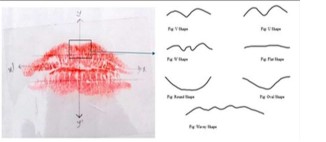
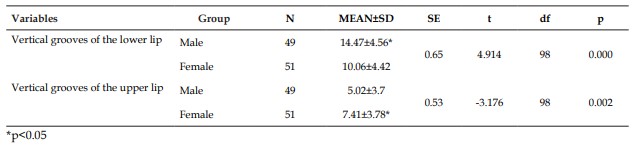
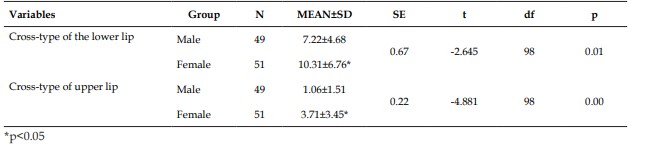
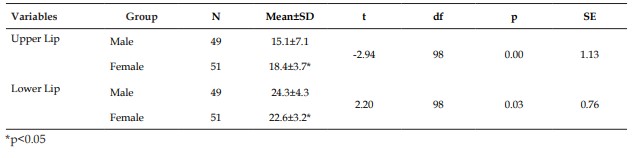
Background: Lip print is a common type of evidence found in a forensic context. The determination of the sex from an in-situ lip print is a critical job. Aim and Objectives: The present study aimed to investigate the sexual dimorphism present in lip groove patterns and Cupid’s bow morphology for sex determination. Materials and Methods: The bilateral lip prints were obtained from 100 healthy youths, including 49 males (23.82±8.52) and 51 females (22.25±7.49) from North 24 Pargana District, West Bengal. All the prints were analyzed to quantify total grooves, vertical, cross, and fork-type grooves on both upper and lower lips. Results: Males exhibited a significantly (p<0.05) higher count of vertical grooves on the lower lip, whereas females showed a significantly (p<0.05) higher count on the upper lip. However, the Cross-type grooves were significantly (p<0.05) dominant in both lips of the studied females. Total groove count across both lips was also significantly (p<0.05) higher in females. However, the fork-type grooves in the lower lip showed a significantly higher (p<0.05) count in males. Apart from those, Cupid’s bow morphology showed distinct patterns among the males and females, V-type structures significantly (p<0.05) predominated in the upper lips of males, while W-type structures were significantly (p<0.05) frequent in females. However, the lower lip showed significant (p<0.05) sexual dimorphism, with round structures significantly (p<0.05) prevalent in males and flat structures in females. Conclusion: Therefore, lip print analysis can be used as a reliable indicator for individual and gender identification in a Forensic context
References
- 1. Ahmadi A.J., Mowlavi A., Gupta S.C. The anatomy of the inferior labial artery: Implications for vermilion flap design in cleft lip repair. Ann Plast Surg. 2012; 68(3): 248–51. doi:10.1097/SAP.0b013e3182333d93.
- 2. Banerjee A.R., Sarkar S. A study of finger ridge minutiae in a group of Bengali population. J Indian Anthropol Soc. 1983; 18: 263–7.
- 3. Bindal P., Shukla S., Sharma P. A study of lip print types among North Indian population for sex identification. J Indian Acad Forensic Med. 2015; 37(2): 165–8.
- 4. Busey T.A., Mooney J.A., Kinoshita Y. Forensic identification using lip prints: Advances in technology and methodology. Forensic Sci Int. 2021; 317: 110590. doi:10.1016/j. forsciint.2020.110590.
- 5. Campon M.Z., Doucet J.C., Yoon R.S. Evaluation and management of traumatic lip lacerations: Emphasis on cosmetic outcome. J Oral Maxillofac Surg. 2019; 77(4): 722. e1–722. e6. doi:10.1016/j.joms.2018.11.004.
- 6. Christensen A.M., Passalacqua N.V., Bartelink E.J. Forensic anthropology: Current methods and practice. Waltham (MA): Academic Press; 2013.
- 7. Couly G., Coltey P., Eichmann A., Douarin M.N. The angiogenic potentials of the cephalic mesoderm and the origin of brain and head blood vessels. Mech Dev. 1992; 53(1): 97–112. doi:10.1016/0925-4773(92)90013-V.
- 8. Cummins H., Midlo C. Finger prints, palms and soles: An introduction to dermatoglyphics. New York: Dover Publications; 1961.
- 9. Center on Wrongful Convictions: Northwestern Pritzker School of Law. Lavelle Davis [Internet]. Chicago: Northwestern Pritzker School of Law; [cited 2025 Sep 9]. Available from: https:// www.law.northwestern.edu/legalclinic/ wrongfulconvictions/exonerations/il/lavelledavis.html.
- 10. Hinrichsen K. The early development of morphology and patterns of the face in the human embryo. Adv Anat Embryol Cell Biol. 1985; 98: 1–79. doi:10.1007/978-3-642-69606-1.
- 11. Houlton T.M.R., Jooste N., Steyn M. Mouth width and Cupid’s bow estimation in a Southern African population. J Forensic Sci. 2020; 65(2): 372–9. doi:10.1111/1556- 4029.14207.
- 12. Houlton T.M.R., Jooste N., Steyn M., Hemingway J. Visualising trends in dentition to lip mouth morphology using geometric morphometrics. PLoS One. 2022; 17(9): e0274127. doi:10.1371/journal.pone.0274127.
- 13. Mommaerts M.Y., Nagy K., Gooris P.J.J. Cleft lip repair and secondary correction using mucosal grafts: A 20-year experience. J Craniomaxillofac Surg. 2018; 46(8): 1318–23. doi:10.1016/j.jcms.2018.05.014.
- 15. O’Rahilly R. Guide to the staging of human embryos. Anat Anz. 1972; 130(5): 556–9. doi:10.1016/S0003-2778(72)80029-9.
- 16. Peterson J.L. Forensic identification science and the criminal justice system: The need for better data. UCLA Law Rev. 2008; 55(4): 913–68.
- 17. Prabhu R.V., Dinkar A.D., Prabhu V.D., Rao PK. Cheiloscopy: Revisited. J Forensic Dent Sci. 2012; 4(1): 47. doi:10.4103/0975-1475.99167.
- 18. Pretty I.A., Sweet D. A look at forensic dentistry – Part 1: The role of teeth in the determination of human identity. Br Dent J. 2001; 190(7): 359– 66. doi:10.1038/sj.bdj.4800972.
- 19. Saferstein R. Criminalistics: An introduction to forensic science. 12th ed. Boston: Pearson; 2019.
- 20. Shang X., Zhao Y., Zhang Y., Xu T. Structural and morphological changes in human lip vermilion with aging: Implications for forensic and clinical applications. J Forensic Leg Med. 2024; 96: 102015. doi:10.1016/j. jflm.2024.102015.
- 21. Sharma E., Sharma B., Gupta V., Vij H., Tyagi N., Singh S. Cheiloscopy: A tool for antemortem identification. Indian J Dent Sci. 2017; 9(3): 176. doi:10.4103/ijds.ijds_60_17.
- 22. Sharma P., Saxena S., Rathod V. Cheiloscopy: The study of lip prints in sex identification. J Forensic Dent Sci. 2009; 1(1): 24–7. doi:10.4103/0974-2948.50885.
- 23. Sivapathasundharam B., Prakash P.A., Sivakumar G. Lipprints (cheiloscopy). Indian J Dent Res. 2001; 12(4): 129–32. doi:10.4103/0970- 9290.33479.
- 24. Snyder L.M. Homicide investigation: Practical information for coroners, police officers, and other investigators. Springfield (IL): Charles C. Thomas Publisher; 1950.
- 25. Srivastava S., Iqbal H., Agarwal N., Sinha A, Prasad R., Agarwal S. Lip prints - an aid in individual identification: A study to assess the uniqueness of lip prints. Indian J Forensic Odontol [Internet]. 2013 [cited 2025 Sep 9]; 6(3– 4). Available from: https://www.rfppl.co.in/ subscription/upload_pdf/FO3_2965.pdf.
- 26. Suzuki K., Tsuchihashi Y. A new attempt of personal identification by means of lip print. J Indian Dent Assoc. 1970; 42: 8–9.
- 27. Suzuki K., Tsuchihashi Y. A study of lip prints. J Forensic Sci. 1970; 15(2): 197–204. doi:10.1520/ JFS11571J.
- 28. Taher A.A., Smith D.M., Becker D.B. Management of facial lacerations. Clin Plast Surg. 2007; 34(1): 43–53. doi:10.1016/j. cps.2006.11.003.
- 29. Vahanwala S.P., Parekh D.K. Study of lip prints as an aid to sex determination. Med Leg Update. 2000; 5(1): 3–5.
- 30. Wilder H.H., Wentworth B. Personal identification: Methods for the identification of individuals, living or dead. Boston: The R.G. Badger Company; 1918.
- 31. Wilson J., Tobin M.J., Gill D.S., Tomkinson A., Mercuri L.G. Three-dimensional imaging of the lip vermilion in adolescents: A study of the Avon Longitudinal Study of Parents and Children (ALSPAC) cohort. Orthod Craniofac Res. 2012; 15(3): 169–78. doi:10.1111/j.1601- 6343.2012.01544.x.
- 32. Yoon M., Park D., Park C. Development of the facial features in human embryos. Korean J Phys Anthropol. 2000; 13(3): 197–204.
Data Sharing Statement
There are no additional data available. All raw data and code are available upon request.
Funding
This research received no funding.
Author Contributions
All authors contributed significantly to the work and approve its publication.
Ethics Declaration
This article does not involve any human or animal subjects, and therefore does not require ethics approval.
Acknowledgements
We would like to express our gratitude to the patients, their families, and all those who have contributed to this study.
Conflicts of Interest
No conflicts of interest in this work.
About this article

Cite this article
Mukherjee A., Pal S., Goswami D., et al. The Morphometric Variation of Human Lips: A Cheiloscopic Study in Forensic Sex Determination. Indian J Forensic Med Pathol. 2025 Oct-Dec; 18(4): 239-246.
Licence:
Attribution-Non-commercial 4.0 International (CC BY-NC 4.0)This license enables reusers to distribute, remix, adapt, and build upon the material in any medium or format for noncommercial purposes only, and only so long as attribution is given to the creator.
| Received | Accepted | Published |
|---|---|---|
| July 29, 2025 | October 07, 2025 | December 30, 2025 |
DOI: https://doi.org/10.21088/ijfmp.0974.3383.18425.5
Keywords
Lip printGroove typeCupid’s bow structureSex determinationSearch for Similar Articles
Similar Articles
- Diatom Analysis in Thermophilic water bodies: A Study on Hot Water Springs of Ma...
- Morphometric Study of Supra-meatal Triangle and Mastoid process in the Adult dry...
- Histopathological Spectrum of Autopsy Cases: A One Year Retrospective Observatio...
- Forensic Differentiation of Manner of Death in Railway Fatalities: A FourCase Se...
- Understanding assault Patterns: A Cross-sectional study of Cases at Chri, Kelamb...
Article Level Metrics
Last UpdatedSunday 18 October 2026, 12:28:35 (IST)
16263
Accesses
48
3205
00
Citations
NA
NA
NA
Download citation
Article Keywords
Keyword Highlighting
Highlight selected keywords in the article text.
Timeline
| Received | July 29, 2025 |
| Accepted | October 07, 2025 |
| Published | December 30, 2025 |
licence
Attribution-Non-commercial 4.0 International (CC BY-NC 4.0)
This license enables reusers to distribute, remix, adapt, and build upon the material in any medium or format for noncommercial purposes only, and only so long as attribution is given to the creator.