Full Text (PDF)
Indian Journal of Forensic Medicine and Pathology 16(1):p 45-54, January-March 2023. | DOI: https://doi.org/10.21088/ijfmp.0974.3383.16123.5
Original Article
Cone Beam Computed Tomographic Evaluation of Shape, Linear Dimensions and Volume of Sella Turcica: A Retrospective Observational Study
Manjushri Waingade, Raghavendra S. Medikeri
Author Information
Licence:
Attribution-Non-commercial 4.0 International (CC BY-NC 4.0)This license enables reusers to distribute, remix, adapt, and build upon the material in any medium or format for noncommercial purposes only, and only so long as attribution is given to the creator.
Indian Journal of Forensic Medicine and Pathology 16(1):p 45-54, January-March 2023. | DOI: https://doi.org/10.21088/ijfmp.0974.3383.16123.5
How Cite This Article:
Waingade M, Medikeri RS. Cone beam computed tomographic evaluation of shape, linear dimensions and volume of sella turcica: a retrospective observational study. Indian J Forensic Med Pathol. 2023;16(1):45-54.Timeline
Received : June 29, 2022
Accepted : December 25, 2022
Published : March 30, 2023
Abstract
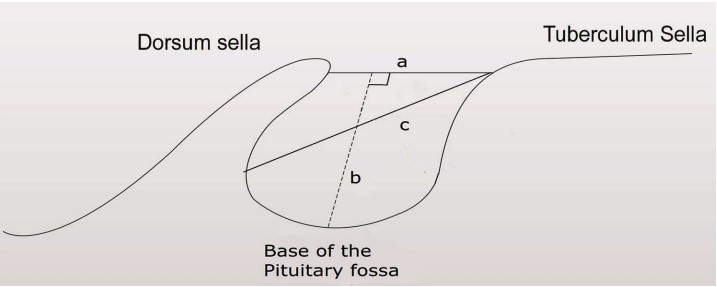
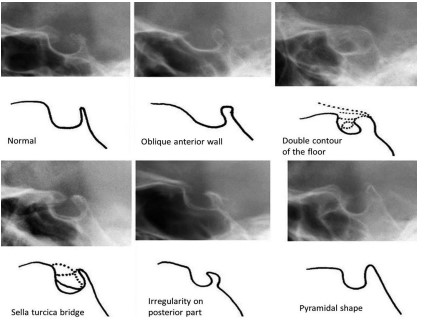
Background: Sella turcica is an important saddle shaped structure that houses the pituitary gland. Any deviation in the development of the pituitary gland may affect the size and shape of the sella turcica as well. So, the morphology of the sella turcica gains special importance in certain clinical conditions. The aim of this study was to assess the shape, linear dimensions and volume of sella turcica in healthy adults using cone beam computed tomography (CBCT). Material and Methods: This retrospective study involved CBCT images of 108 healthy adults. The sagittal, axial, and coronal slices of CBCT images were used to evaluate the shape, volume and linear dimensions. Results: The overall linear dimensions of sella turcica were length 8.59 ±1.49 mm, depth 7.27 ±1.16 mm, diameter 10.24 ±1.75 mm and volume 1499.69 ± 395.5 mm3 respectively. The length of sella turcica was higher in males than females which was statistically significant (p = 0.015) while the depth, diameter and volume reported non-significant results. The most frequent shape of sella turcica was normal and the least frequent was sella turcica bridging. The Pearson correlation co-efficient was statistically significant for the length vs diameter and volume alongwith diameter vs volume in both genders (p < 0.01). The depth was statistically correlated with length, diameter and volume in males (p <0.01). Conclusion: The sella turcica shape and dimensions can be used in forensic and medicolegal purposes. So, a thorough of knowledge about this important structure is necessary
References
- 1. Canigur Bavbek N, Dincer M. Dimensions and morphologic variations of sella turcica in type 1 diabetic patients. Am J Orthod Dentofacial Orthop. 2014 Feb;145(2):179-87. Doi: 10.1016/J. Ajodo.2013.10.011. Pmid: 24485732.
- 2. Yasa y, Bayrakdar IS, Ocak A, Duman SB, Am J Orthoddent of Acial Orthopdedeoglu N. Evaluation of sella turcica shape and dimensions in cleft subjects using cone-beam computed tomography. Med Princ Pract. 2017;26(3):280-285. Doi: 10.1159/000453526. Epub 2016 nov 16. Pmid: 27855395; pmcid: pmc5588386.
- 3. Yassir A. Yassir, Mohammed Nahidh, Hadeel A. Yousif. Size and morphology of sella turcica in iraqi adults. MDJ 2010;7(1):23-30
- 4. Luong Hm, Ahnjh, Bollu P, Chenin D, Chaudry K, Pourhamidi J. Sella turcica variations in skeletal class I, class II, and class III adult subjects: a cbct study. J Dent Oral Biol. 2016; 1(3): 1015.
- 5. Chaurasia A, Katheriya G. Morphometric evaluation of sell turcica in indian ethinicity: a cone beam computed tomography study. Indian J Forensic Odontol 201;10(1):11-19.
- 6. Magat g, ozcansener s. Morphometric analysis of the sella turcica in turkish individuals with different dentofacial skeletal patterns. Folia Morphol (Warsz). 2018;77(3):543-550. Doi: 10.5603/ Fm.A2018.0022. Epub 2018 mar 3. Pmid: 29500897.
- 7. Valizadeh S, Shahbeig S, Mohseni S, Azimi F, And Bakhshandeh H. Correlation of shape and size of sella turcica with the type of facial skeletal class in an iranian group. Iran J Radiol. 2015;12(3):E16059.Doi: 10.5812/Iranjradiol.12(3)2015.16059.
- 8. Eman A. Alkofi De. The shape and size of the sella turcica in skeletal class I, class II and class III saudi subjects. Euro J Orthodont 2007;29:457–463. Doi:10.1093/Ejo/ cjm049.
- 9. Meyer-Marcotty P, Reuther T and Stellzig-Eisenhaue A. Bridging of the sella turcica in skeletal class III subjects. Euro J Orthodont 2010;32:148–153. Doi:10. 1093/Ejo/ cjp081.
- 10. Andredaki M, Koumantanou A, Dorotheou D and Halazonetis DJ. A cephalometric morphometric study of the sella turcica. Euro J Orthodont 2007;29: 449–456. Doi:10. 1093/Ejo/ cjm048.
- 11. Axelsson S, Storhaug K, Kjær I. Post-natal size and morphology of the sella turcica. Longitudinal cephalometric standards for norwegians between 6 and 21 years of age. Euro j orthodont. 2004;26(6):597-604.
- 12. Sathyanarayana HP, Kailasam V, Chitharanjan AB. The size and morphology of sella turcica in different skeletal patterns among south indian population: a lateral cephalometric study. Jind Orthodont Soc. 2013;47(4_ Suppl1):266-271. Doi:10.5005/Jpjournals-10021-1171.
- 13. Chaitanya B, Pai Km, Chhaparwal Y. Evaluation of the effect of age, gender, and skeletal class on the dimensions of sella turcica using lateral cephalogram. Contemp Clin Dent 2018; 9:195-9.
- 14. Taner L, Denizuzuner F, Demirel O, Güngor K. Volumetric and three-dimensional examination of sella turcica by cone-beam computed tomography: reference data for guidance to pathologic pituitary morphology. Folia Morphol (Warsz). 2019;78 (3):517-523. Doi: 10.5603/ Fm.A2018.0106. Epub 2018 nov 16. Pmid: 30444524.
- 15. Kjaeri. Sellat urcica morphology and the pituitary gland – a new contribution to craniofacial diagnostics basedon histology and neuroradiology. Euro j Orthodont 2015: 28-36. Doi:10.1093/ Ejo/cjs091.
- 16. Kumar TS, Govindraju P. Relationship between the morphological variation of sella turcica with age and gender: a digital radiographic study. J Indian Acad Oral Med Radiol 2017;29:164-9.
- 17. Subhadra Devi V, Baburao S. Age and sex related morphology and morphometry of sellar region of sphenoid in prenatal and postnatal human cadavers. Int J Res Dev Health. 2013; 1(3):141-148.
- 18. JU KS, Bae HG, Park HK, Chang JC, Choi SK, Sim KM. Morphometric study of the korean adult pituitary glands and the diaphragma sellae. J Korean Neurosurgsoc 2010; 47:42-47.
- 19. Ongeti K, Hemed El-Busaid, Nelson Fundi. Reappraisal of the domensions of the diaphragm sellae. Anat J Africa 2012; 1(1):24-27.
- 20. Pigolkin Y, Corro M. Age–related changes of the sella turcica morphometry in adults older than 20-25 years. World academy of science, engineering and technology, international journal of law and political sciences, 2016:10(9); 595 - 599.
- 21. Paknahad M, Shahidi S & Khaleghi I. A cone beamcomputed tomographic evaluation of the size of the sella turcica in patients with cleft lip and palate. J Orthodont 2017.Doi: 10.1080/14653125.2017.1343221.
- 22. Silverman FN. Roentgen standards fo-size of the pituitary fossa from infancy through adolescence. Am J Roentgenol Radium Ther Nucl Med 1975; 78:451– 460.
- 23. Kisling E 1966 Cranial morphology in down’s syndrome. A comparative roentgen cephalometric study in adult males. Munksgaard, copenhagen.
- 24. Hasan Ha, Alam Mk, Yusof A4), Mizushima H, Kida A and Osuga N. Size and morphology of sella turcica in malay populations: a 3D CT study. Journal of Hard Tissue Biology 2016; 25[3]:313-320.
- 25. Islam M, Alam Mk, Yusof A, Kato I, Honda Y, Kubo K et al. 3D CT study of morphological shape and size of sella turcica in bangladeshi population. J Hard Tiss Biol 2017;26: 1- 6.
- 26. Srinivas Mr, Vedaraju KS, Vijay Kumar Kr, Deepashri B. Morphometry of sella turcica in an indian population using computed tomography. Internatjanat, Radiol Surg 2017;6(1): ro06-ro11.
- 27. Shah Am, Bashir U, Ilyas T. The shape and size of the sella turcica in skeletal class I, II & III in patients presenting at Islamic International Dental Hospital, Islamabad. Pakistan Oral & Dental Journal 2011;31:104- 110.
- 28. Haas LL. The size of the sella turcica by age and sex. Am J Roentgenol Radium The Rnucl Med 1954;72:754-61.
- 29. Tetradis S, Kantor ML. Prevalence of skeletal and dental anomalies and normal variants seen in cephalometric and other radiographs of orthodontic patients. Am J Orthod Dentofacial Orthop 1999; 116:572-77.
- 30. Diri H, Tanriverdi F, Karaca Z, et.al. Extensive investigation of 114 patients with sheehan’s syndrome: a continuing disorder. Eur j endocrinol 2014; 171:311–318 doi:10.1530/Eje- 14-0244.
- 31. Gordon MB, Bell AL. A roentgenographic study of the sella turcica in normal children. New York State J Med 1922; 22:54-59.
- 32. Davidoff LM, Epstein Bs. The abnormal pneumoence phalogram. Philadelphia: lea and febiger; 195.
- 33. Camp JD. The normal and pathological anatomy of the sella turcica as revealed by roentgenograms. Am J Roentgenol 1924; 12:143-56.
- 34. Teal JS. Radiology of the adult sella turcica. Bull Los Angeles Neurol Soc 1977;42:111-74.
- 35. Isman O, Kayar S, Aktan AM. Cbct evaluation of variations in the sella turcica in a Turkish population. Folia Morphol (Warsz). 2020;79(1):46- 50. Doi: 10.5603/Fm.A2019.0042.
- 36. Scribantea, Sfondrini Mf, Cassani M, Fraticelli D, Beccari S & Gandini P. Sellat urcica bridging and dental anomalies: is there an association? Internat j paediat Dent 2017; 27:568– 573.
- 37. Kucia A, Jankowski T, Siewniak M, Janiszewska-Olszowska J, Grocholewicz K, Szych Z, Wilk G. Sellat urcica anomalies on lateral cephalometric radiographs of polish children. Dentomaxillofac Radiol 2014; 43: 20140165
Data Sharing Statement
There are no additional data available. All raw data and code are available upon request.
Funding
This research received no funding.
Author Contributions
All authors contributed significantly to the work and approve its publication.
Ethics Declaration
This article does not involve any human or animal subjects, and therefore does not require ethics approval.
Acknowledgements
We would like to express our gratitude to the patients, their families, and all those who have contributed to this study.
Conflicts of Interest
No conflicts of interest in this work.
About this article

Cite this article
Waingade M, Medikeri RS. Cone beam computed tomographic evaluation of shape, linear dimensions and volume of sella turcica: a retrospective observational study. Indian J Forensic Med Pathol. 2023;16(1):45-54.
Licence:
Attribution-Non-commercial 4.0 International (CC BY-NC 4.0)This license enables reusers to distribute, remix, adapt, and build upon the material in any medium or format for noncommercial purposes only, and only so long as attribution is given to the creator.
| Received | Accepted | Published |
|---|---|---|
| June 29, 2022 | December 25, 2022 | March 30, 2023 |
DOI: https://doi.org/10.21088/ijfmp.0974.3383.16123.5
Keywords
Sella Turcicacone-beam computed tomographymorphologyshapeSearch for Similar Articles
Similar Articles
- Diatom Analysis in Thermophilic water bodies: A Study on Hot Water Springs of Ma...
- Morphometric Study of Supra-meatal Triangle and Mastoid process in the Adult dry...
- Histopathological Spectrum of Autopsy Cases: A One Year Retrospective Observatio...
- Forensic Differentiation of Manner of Death in Railway Fatalities: A FourCase Se...
- Understanding assault Patterns: A Cross-sectional study of Cases at Chri, Kelamb...
Article Level Metrics
Last UpdatedSunday 18 October 2026, 14:54:03 (IST)
16276
Accesses
21
3209
00
Citations
NA
NA
NA
Download citation
Article Keywords
Keyword Highlighting
Highlight selected keywords in the article text.
Timeline
| Received | June 29, 2022 |
| Accepted | December 25, 2022 |
| Published | March 30, 2023 |
licence
Attribution-Non-commercial 4.0 International (CC BY-NC 4.0)
This license enables reusers to distribute, remix, adapt, and build upon the material in any medium or format for noncommercial purposes only, and only so long as attribution is given to the creator.