Full Text (PDF)
Indian Journal of Anatomy 13(4):p 141-146, October - December 2024. | DOI: https://doi.org/10.21088/ija.2320.0022.13424.2
Original Article
Comprehensive Morphological Analysis of Psoas Minor Muscle: Insight From Cadaveric Studies And Clinical Relevance
Sharada B Menasinkai null, Sharada B Menasinkai null
Author Information
Licence:
Attribution-Non-commercial 4.0 International (CC BY-NC 4.0)This license enables reusers to distribute, remix, adapt, and build upon the material in any medium or format for noncommercial purposes only, and only so long as attribution is given to the creator.
Indian Journal of Anatomy 13(4):p 141-146, October - December 2024. | DOI: https://doi.org/10.21088/ija.2320.0022.13424.2
How Cite This Article:
Darshan MA, Menasinka SB. Comprehensive morphological analysis of psoas minor muscle: insight from cadaveric studies and clinical relevance. Indian J Anat. 2024;13(4):141-146.Timeline
Received : November 22, 2024
Accepted : December 28, 2024
Published : January 30, 2025
Abstract
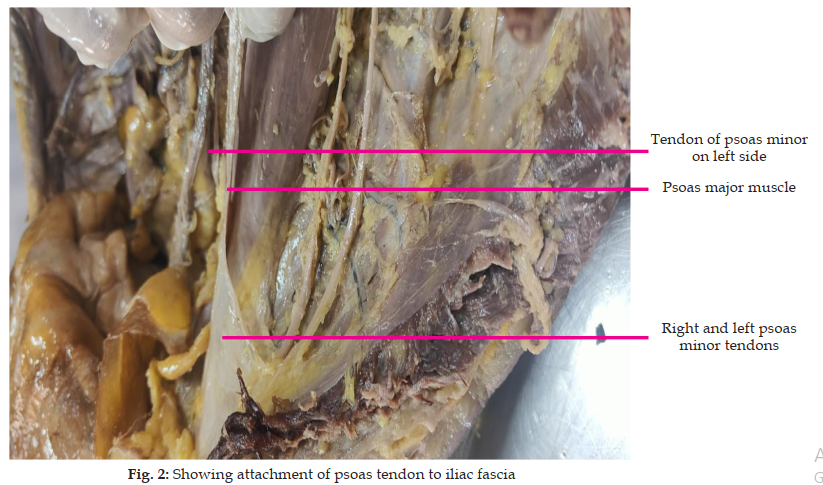
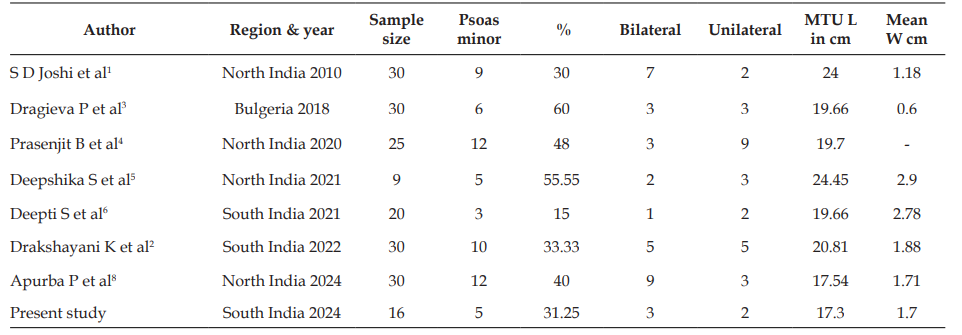
Introduction: The psoas muscle group, including the major and minor muscles, shows variability among individuals. The psoas major is consistently present, while the psoas minor has a higher absence rate (40-60%). Evolution has influenced its absence in humans due to upright posture and bipedal gait. Objectives: This study aims to provide insights into the incidence and morphology of the psoas minor in the South Indian population, addressing literature gaps and discussing its clinical significance. Methods: Conducted at the Department of Anatomy, Adichunchanagiri Institute of Medical Sciences, B.G. Nagara, Karnataka, the study analyzed 16 cadavers. Measurements included muscle and tendon length, muscle width, origin, and insertion points. Results: The psoas minor was found in 5 of the 16 cadavers, with unilateral and bilateral occurrences in 2 and 3 cadavers, respectively. The mean lengths of the muscle and tendon were 8.5 cm and 8.8 cm, respectively. The origin was from the body of T12 and L1 vertebrae, including adjoining vertebral discs, with variable insertion points. The mean muscle width was 1.70 cm. Conclusion: Despite its vestigial and variable nature, the psoas minor was observed in 31.25% of the population studied. Its presence, though infrequent, may play a role in conditions like psoas minor syndrome, where muscle stiffness can occur. Detailed knowledge of the psoas minor is crucial for proper diagnosis and treatment.
References
- 1. Joshi SD, Joshi SS, Dandekar UK, Daini SR. Morphology of Psoas minor and Psoas accessories. J Anat Soc India. 2010;59(1):31-34.
- 2. Kokati DB, Jayaprakash B, Smitha M, Eligar R. A cadaveric study on incidence and morphology of psoas minor muscle in South Indian population. Int J Anat Radiol Surg. 2022;11(4):A029-A032.
- 3. Dragieva P, Zaharieva M, Kojhuharov Y, et al. Psoas minor muscle: A cadaveric morphometric study. Cureus. 2018;10(4):e2447.
- 4. Bose P, Singh B, Singh MB, Singh R. A cadaveric study on the morphology of psoas minor and psoas accessorius muscle. Indian J Anat Surg Head Neck Brain. 2020;6(3):100-103.
- 5. Singh D, Agarwal S. Morphological study of psoas minor muscles with embryological basis and clinical insights. J Clin Diagn Res. 2021;15(4):AC10-AC14.
- 6. Simhadri D, Navakalyani T, Susheelamma D. A study of psoas minor muscle morphology. Indian J Clin Anat Physiol. 2021;8(3):166-169.
- 7. Merrighi APL, Atakiama VT, de Lima FFB. Occurrence of the psoas minor muscle: A literature review. Quest J Med Dent Sci Res. 2021;8(2):47-51.
- 8. Patra A, Asghar A, Pushpa NB, et al. Reappraisal of the morphological and morphometric study of the psoas minor muscle with clinical and developmental insights: cadaveric study. Folia Morphol. 2024 Apr 11. [Epub ahead of print].
- 9. Neumann DA, Garceau LR. A proposed novel function of psoas minor revealed through cadaver dissection. Clin Anat. 2015;28:243-252.
- 10. Gupta T, Motwani R, Kaliappan A, et al. Bilateral Psoas minor: A case report with clinical, embryological and evolutionary insights. J Anat Soc India. 2024;73:82-85.
- 11. Tufo A, Desai GJ, Cox WJ. Psoas syndrome: A frequently missed diagnosis. J Osteopath Med. 2012;112(8):522-528.
- 12. Darwin C. The Origin of Species. London: John Murray; 1859. Chapter 13.
- 13. Grgić V. [Iliopsoas muscle syndrome. Functional disorders: Shortening, spasm and weakness of a structurally unchanged muscle]. Lijec Vjesn. 2009;131(3-4):81-86. Croatian.
Data Sharing Statement
There are no additional data available. All raw data and code are available upon request.
Funding
This research received no funding.
Author Contributions
Whether all authors contributed significantly to the work and approve its publication.
Ethics Declaration
This article does not involve any human or animal subjects, and therefore does not require ethics approval.
Acknowledgements
We would like to express our gratitude to the patients, their families, and all those who have contributed to this study.
Conflicts of Interest
The authors report no conflicts of interest in this work.
About this article

Cite this article
Darshan MA, Menasinka SB. Comprehensive morphological analysis of psoas minor muscle: insight from cadaveric studies and clinical relevance. Indian J Anat. 2024;13(4):141-146.
Licence:
Attribution-Non-commercial 4.0 International (CC BY-NC 4.0)This license enables reusers to distribute, remix, adapt, and build upon the material in any medium or format for noncommercial purposes only, and only so long as attribution is given to the creator.
| Received | Accepted | Published |
|---|---|---|
| November 22, 2024 | December 28, 2024 | January 30, 2025 |
DOI: https://doi.org/10.21088/ija.2320.0022.13424.2
Keywords
BilateralMajorUnilateralVariationMinor.MajorUnilateralVariationMinor.Search for Similar Articles
Similar Articles
- Supernumerary Pulmonary Vein: A Rare Anatomical Variation Observed During Cadave...
- Elongated Styloid Process: Anatomical Variations and Their Clinical Relevance: A...
- Bridging the Gap Between Dissection and Surgery: The Role of Soft Embalming in M...
- A Cadaveric Study of Retro Hepatic Segment of Inferior Vena Cava and Ostia Venae...
- Estimation of Stature from Forearm Length in Medical Undergraduate Students of a...
Article Level Metrics
Last UpdatedTuesday 22 September 2026, 02:44:46 (IST)
5059
Accesses
16
655
00
Citations
NA
NA
NA
Download citation
Article Keywords
Keyword Highlighting
Highlight selected keywords in the article text.
Timeline
| Received | November 22, 2024 |
| Accepted | December 28, 2024 |
| Published | January 30, 2025 |
licence
Attribution-Non-commercial 4.0 International (CC BY-NC 4.0)
This license enables reusers to distribute, remix, adapt, and build upon the material in any medium or format for noncommercial purposes only, and only so long as attribution is given to the creator.