Full Text (PDF)
Indian Journal of Forensic Medicine and Pathology 11(3):p 179-182, Jul-Sep 2018. | DOI: 10.21088/ijfmp.0974.3383.11318.5
Original Article
Burns in Married Women: An Autopsy Based Study
Vijaya N.M , Vijaya N.M. , Rajesh Sangram
Author Information
Licence:
Attribution-Non-commercial 4.0 International (CC BY-NC 4.0)This license enables reusers to distribute, remix, adapt, and build upon the material in any medium or format for noncommercial purposes only, and only so long as attribution is given to the creator.
Indian Journal of Forensic Medicine and Pathology 11(3):p 179-182, Jul-Sep 2018. | DOI: 10.21088/ijfmp.0974.3383.11318.5
How Cite This Article:
Timeline
Received : May 10, 2018
Accepted : May 22, 2018
Published : June 30, 2018
Abstract
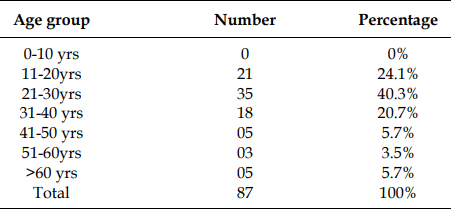
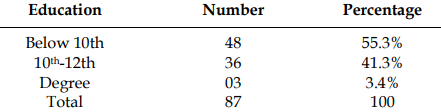
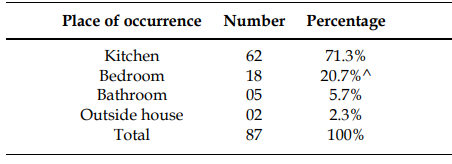
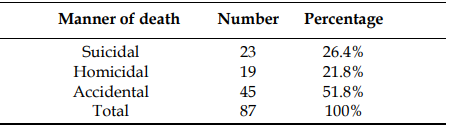
Background: Burns are a global public health problem, accounting for an estimated 265,000 deaths annually.Most of these happen in low- and middle-income countries and nearly half happen in the WHO South-East Asia region. Burn injuries involve both developing and developed nation. Goldman describes burns as “the silent epidemic”. Material & Methods: A Prospective study was conducted from Jan 2013 to December 2013 in which 87 autopsy cases of burn deaths were taken out of 976 autopsies conducted in the mortuary of Raichur institute of medical sciences, Raichur. Results: The maximum incidences of burn deaths in married females were in 21-30 years age group (40.3%). Majority of the victims were educated below 10th (55.3%). The most common place of death was kitchen (71.3%) and the most common manner of death was accidental (51.8%). Conclusion: Burns represent an extreme stressful experience and are complex devastating conditions. Public awareness should be increased regarding the social problem and importance should be given to education which can be achieved by different medias of mass communication.
References
- 1. World Health Organization. Burns [Internet]. Geneva: World Health Organization; 2018 [updated 2023 Oct 17
- 2. Goldman AS, Larson DL, Abston S. The silent epidemic. JAMA. 1972;221(4):403.
- 3. Batra AK. Burn mortality: recent trends and sociocultural determinants in rural India. Burns. 2003;29(3):270-5.
- 4. Reddy KSN. The essentials of forensic medicine and toxicology. 31st ed. Hyderabad: Medical Book Company; 2012. p. 296-306.
- 5. Piyush T, Paria M, Roychowdhury UB. A study of burn deaths in a tertiary care hospital of West Bengal. J Indian Acad Forensic Med. 2017;39(2):131-5.
- 6. Ambade VN, Godbole HV. Study of burn deaths in Nagpur, Central India. Burns. 2006;32(7):902-8.
- 7. Sharma BR, Harish D, Singh VP, Bangar S. Septicemia as a cause of death in burns: an autopsy study. Burns. 2006;32(5):545-9.
- 8. Agarwal S, Agarwal SN. Analysis of causes of fatal burns. J Indian Acad Forensic Sci. 1967;6:40-3.
- 9. Dasgupta SM, Tripathi CB. Burnt wife syndrome. Ann Acad Med Singap. 1984;13(1):37-42.
- 10. Kumar V, Tripathi CB, Kanth S. Burnt wives: a circumstantial approach. J Forensic Med Toxicol. 2001;18(3):9-14.
- 11. Jha SS. Burns mortality in Bombay. Burns. 1981;8(2):118-22.
- 12. Kumar V, Tripathi CB, Kanth S. Burnt wives: a sociological study. Int J Med Toxicol Leg Med. 1999;2(2):24-7.
- 13. Shaha KK, Mohanty S. Alleged dowry death: a study of homicidal burns. Med Sci Law. 2006;46(2):105-10.
- 14. Bhullar DS. Profile of unnatural female deaths between 18-30 years of age. J Forensic Med Toxicol. 1997;13(3):5-8.
Data Sharing Statement
There are no additional data available. All raw data and code are available upon request.
Funding
This research received no funding.
Author Contributions
Whether all authors contributed significantly to the work and approve its publication.
Ethics Declaration
This article does not involve any human or animal subjects, and therefore does not require ethics approval.
Acknowledgements
We would like to express our gratitude to the patients, their families, and all those who have contributed to this study.
Conflicts of Interest
The authors report no conflicts of interest in this work.
About this article

Cite this article
Licence:
Attribution-Non-commercial 4.0 International (CC BY-NC 4.0)This license enables reusers to distribute, remix, adapt, and build upon the material in any medium or format for noncommercial purposes only, and only so long as attribution is given to the creator.
| Received | Accepted | Published |
|---|---|---|
| May 10, 2018 | May 22, 2018 | June 30, 2018 |
DOI: 10.21088/ijfmp.0974.3383.11318.5
Keywords
BurnsMarried WomenManner of DeathSearch for Similar Articles
Similar Articles
- Diatom Analysis in Thermophilic water bodies: A Study on Hot Water Springs of Ma...
- Morphometric Study of Supra-meatal Triangle and Mastoid process in the Adult dry...
- Histopathological Spectrum of Autopsy Cases: A One Year Retrospective Observatio...
- Forensic Differentiation of Manner of Death in Railway Fatalities: A FourCase Se...
- Understanding assault Patterns: A Cross-sectional study of Cases at Chri, Kelamb...
Article Level Metrics
Last UpdatedSunday 18 October 2026, 12:27:07 (IST)
16263
Accesses
8
3205
00
Citations
NA
NA
NA
Download citation
Article Keywords
Keyword Highlighting
Highlight selected keywords in the article text.
Timeline
| Received | May 10, 2018 |
| Accepted | May 22, 2018 |
| Published | June 30, 2018 |
licence
Attribution-Non-commercial 4.0 International (CC BY-NC 4.0)
This license enables reusers to distribute, remix, adapt, and build upon the material in any medium or format for noncommercial purposes only, and only so long as attribution is given to the creator.