Full Text (PDF)
Indian Journal of Obstetrics and Gynecology 10(3):p 138-143, July-September 2022. | DOI: https://doi.org/10.21088/ijog.2321.1636.10322.16
Original Article
Association of Maternal Factors with Perinatal outcome of Growth Restricted Fetuses: with Reference to Doppler Studies
Mahima R. Arya, Tushar M Panchanadikar
Author Information
Licence:
Attribution-Non-commercial 4.0 International (CC BY-NC 4.0)This license
enables reusers to distribute, remix, adapt, and build upon the material in any
medium or format for noncommercial purposes only, and only so long as
attribution is given to the creator.
Indian Journal of Obstetrics and Gynecology 10(3):p 138-143, July-September 2022. | DOI: https://doi.org/10.21088/ijog.2321.1636.10322.16
How Cite This Article:
Mahima R. Arya, Tushar M. Panchanadikar /Association of Maternal Factors with Perinatal outcome of Growth Restricted Fetuses: with Reference to Doppler Studies/Indian J Obstet Gynecol. 2022;10(3):138–143.Timeline
Received : February 18, 2022
Accepted : March 24, 2022
Published : September 30, 2022
Abstract
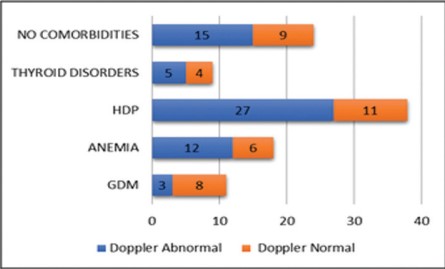
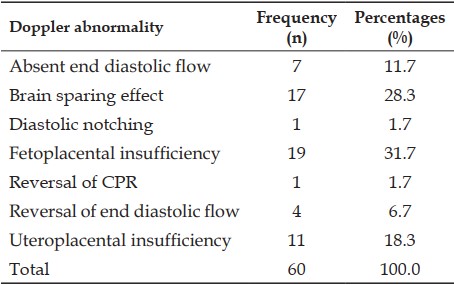
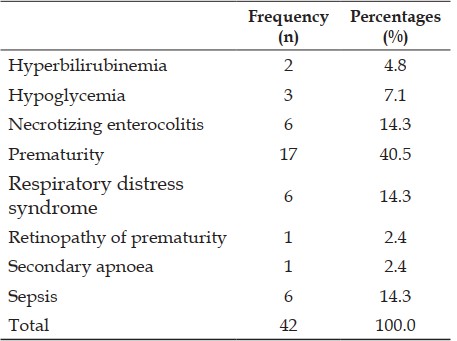
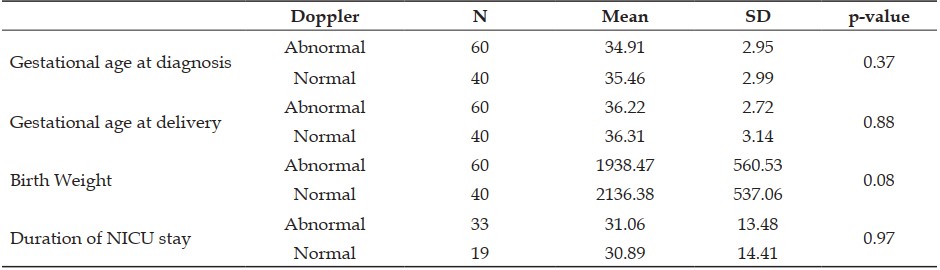
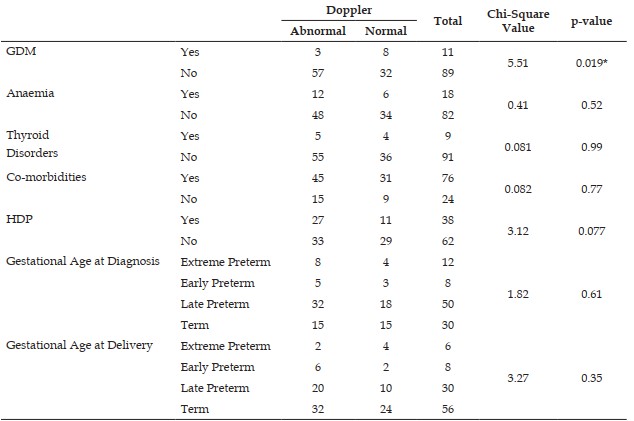
Context: Fetal Growth Restriction (FGR) is the single largest contributing factor to perinatal morbidity in nonanomalous foetuses. This research was conducted in the Department of Obstetrics and Gynaecology in a tertiary care teaching Hospital which included 100 singleton pregnant women with FGR. Aims: 1. To evaluate the maternal risk factors as possible contributors to FGR and related perinatal mortality. 2. To establish the decision-to-delivery time interval in growth restricted fetuses in correlation to gestational age and doppler examination. Methods and Material: Socio-demographic, maternal risk, Diagnosis- delivery interval in FGR and neonatal morbidities were studied. Serial deciding doppler were considered for evaluation of the perinatal outcome and mode of delivery. Statistical Analysis used: The association between doppler category and maternal risk factors was assessed by Chi-square test. The continuous variables were presented as mean ± standard deviation (SD) and the difference between the means was calculated by student’s ‘t’ test. Results: 76% women suffered concomitant comorbidities which could possibly contribute to the genesis of fetal growth restriction. 38% women had hypertensive disorders of pregnancy. Majority of women with FGR ~ 72% delivered by caesarean section. The doppler findings were abnormal among 60 subjects with preterm intervention and poor perinatal outcome. Conclusions: Obstetric Doppler has helped in early detection and timely intervention in babies with FGR with significant improvements in perinatal outcomes. Key Messages: The relevance of doppler in Obstetrics has shown utmost importance as a diagnostic tool in detection of fetal compromise and aiding for optimization for timing of intervention. This tool of Obstetric doppler has enhanced tremendous surveillance to growth restricted fetuses
References
- 1. Romo A, Carceller R, Tobajas J. Intrauterine growth retardation (IUGR): epidemiology and etiology. Pediatr Endocrinol Rev. 2009;6(Suppl 3):332-6
- 2. Baschat AA. Doppler application in the delivery timing of the preterm growth- restricted fetus: another step in the right direction. Ultrasound in Obstetrics and Gynecology:The Official Journal of the International Society of Ultrasound in Obstetrics and Gynecology. 2004;23(2):111-8.
- 3. Vandenbosche RC, Kirchner JT. Intrauterine growth retardation. Am Fam Physician. 1998 Oct 15;58(6):1384-90, 1393-4. PMID: 9803202.
- 4. Saleem T, Sajjad N, Fatima S, Habib N, Ali SR, Qadir M. Intrauterine growth retardation--small events, big consequences. Ital J Pediatr. 2011;37:41. Published 2011 Sep 7. doi:10.1186/1824-7288-37-41
- 5. Sharma D, Shastri S, Sharma P. Intrauterine Growth Restriction: Antenatal and Postnatal Aspects. Clin Med Insights Pediatr. 2016;10:67-83. Published 2016 Jul 14.
- 6. Ashwani N, NeelaAruna Rekha, Babu M.S, C. Suresh Kumar, O. Tejo Pratap. Maternal risk factors associated with intrauterine growth restriction: hospital based study. Int J Med Res Rev 2016;4(12):2125-2129.doi:10.17511/ijmrr.2016. i12.08.
- 7. Saleem T, Sajjad N, Fatima S, Habib N, Ali SR, Qadir M. Intrauterine growth retardation--small events, big consequences. Ital J Pediatr. 2011;37:41. Published 2011 Sep 7. doi:10.1186/1824-7288-37-41
Data Sharing Statement
There are no additional data available. All raw data and code are available upon request.
Funding
This research received no funding.
Author Contributions
All authors contributed significantly to the work and approve its publication.
Ethics Declaration
This article does not involve any human or animal subjects, and therefore does not require ethics approval.
Acknowledgements
We would like to express our gratitude to the patients, their families, and all those who have contributed to this study.
Conflicts of Interest
No conflicts of interest in this work.
About this article

Cite this article
Mahima R. Arya, Tushar M. Panchanadikar /Association of Maternal Factors with Perinatal outcome of Growth Restricted Fetuses: with Reference to Doppler Studies/Indian J Obstet Gynecol. 2022;10(3):138–143.
Licence:
Attribution-Non-commercial 4.0 International (CC BY-NC 4.0)This license
enables reusers to distribute, remix, adapt, and build upon the material in any
medium or format for noncommercial purposes only, and only so long as
attribution is given to the creator.
| Received | Accepted | Published |
|---|---|---|
| February 18, 2022 | March 24, 2022 | September 30, 2022 |
DOI: https://doi.org/10.21088/ijog.2321.1636.10322.16
Keywords
Maternal age Weight FGR Birth weightSearch for Similar Articles
Similar Articles
- Fibromyoma: A Clinical Dilemma
- Optimizing Obstetric Care: A Review of Indications and Outcomes for First-Time C...
- A Rare Case of Geriatric Endometrial Adenocarcinoma Presenting with Nonpuerperal...
- Relationship between Hypothyroidism and Gestational Diabetes Mellitus: A Prospec...
- Influence of Maternal Anthropometry and Hemoglobin on Neonatal Anthropometry
Article Level Metrics
Last UpdatedWednesday 09 September 2026, 21:04:44 (IST)
3515
Accesses
10
590
00
Citations
NA
NA
NA
Download citation
Article Keywords
Keyword Highlighting
Highlight selected keywords in the article text.
Timeline
| Received | February 18, 2022 |
| Accepted | March 24, 2022 |
| Published | September 30, 2022 |
licence
Attribution-Non-commercial 4.0 International (CC BY-NC 4.0)
This license
enables reusers to distribute, remix, adapt, and build upon the material in any
medium or format for noncommercial purposes only, and only so long as
attribution is given to the creator.