Full Text (PDF)
Indian Journal of Obstetrics and Gynecology 14(2):p 56-60, May-August 2026. | DOI: https://doi.org/10.21088/ijog.2321.1636.14226.3
Review Article
A Rare Case of Geriatric Endometrial Adenocarcinoma Presenting with Nonpuerperal Uterine Inversion
Joylene Dalmeida, Akshitha Kothuru, Edlyn Grace Jacob, Harshal Shailen Mehta, Aaron Jerome Augustine, Elroy Saldanha
Author Information
Licence:
Attribution-Non-commercial 4.0 International (CC BY-NC 4.0)This license enables reusers to distribute, remix, adapt, and build upon the material in any medium or format for noncommercial purposes only, and only so long as attribution is given to the creator.
Indian Journal of Obstetrics and Gynecology 14(2):p 56-60, May-August 2026. | DOI: https://doi.org/10.21088/ijog.2321.1636.14226.3
How Cite This Article:
Joylene Dalmeida, Akshitha Kothuru, Edlyn Grace Jaco et. al, A Rare Case of Geriatric Endometrial Adenocarcinoma Presenting with Nonpuerperal Uterine Inversion. Indian J Obstet Gynecol. 2026; 14(2): 56-60.Timeline
Received : June 16, 2026
Accepted : July 15, 2026
Published : August 30, 2026
Abstract
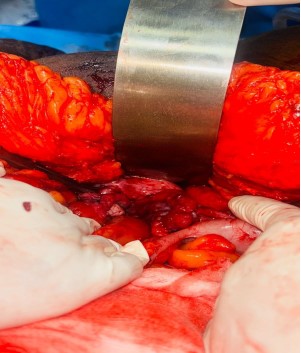
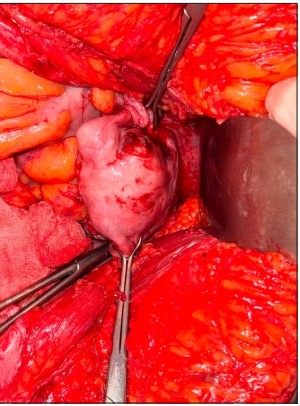
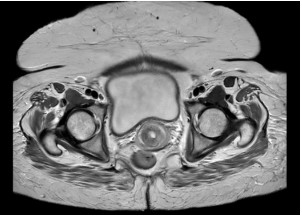
Background: Non-puerperal uterine inversion (NPUI) is a rare gynecological condition, most commonly associated with benign fundal leiomyomas. Its occurrence secondary to endometrial carcinoma is exceptionally uncommon and poses significant diagnostic and management challenges due to its nonspecific clinical presentation. Case Presentation: A 75-year-old multiparous postmenopausal woman presented with excessive vaginal bleeding, a protruding vaginal mass, lower abdominal pain, fever, and urinary retention. She had previously undergone polypectomy for a prolapsing vaginal mass, the histopathological examination of which revealed Grade 1 endometrioid adenocarcinoma. Clinical examination demonstrated a longitudinal growth protruding through the cervical os with distortion of normal cervical anatomy. Ultrasonography and contrast-enhanced computed tomography suggested uterine inversion with a uterine mass occupying the vaginal canal. Following multidisciplinary evaluation and optimization, exploratory laparotomy was performed. Intraoperatively, a completely inverted uterus with inflamed cervix and enlarged pelvic lymph nodes was identified. Manual vaginal reduction was followed by radical hysterectomy with bilateral salpingo-oophorectomy, bilateral pelvic lymphadenectomy, omentectomy, and appendicectomy. Histopathological examination demonstrated well-differentiated endometrioid carcinoma (FIGO Grade 1) with greater than 50% myometrial invasion and involvement of the lower uterine segment. All lymph nodes, adnexal structures, omentum, appendix, and peritoneal cytology were negative for malignancy. The final diagnosis was FIGO Stage IB (pT1bN0) endometrioid carcinoma presenting as non-puerperal uterine inversion. Conclusion: Non-puerperal uterine inversion secondary to endometrial adenocarcinoma is an exceptionally rare clinical entity. The condition may mimic other gynecological pathologies and often presents with vaginal bleeding and a protruding vaginal mass. Early recognition through careful clinical assessment and appropriate imaging is essential for accurate diagnosis and surgical planning. This case highlights the importance of considering underlying uterine malignancy in patients presenting with atypical vaginal bleeding and uterine inversion and emphasizes the role of histopathology in guiding definitive oncologic management.
References
- 1. Fofie CO, Baffoe P. Non-puerperal uterine inversion: a case report. Ghana Med J. 2010;44(2).
- 2. Anitha GS, Manjulatha VR, Ramaiah R. Nonpuerperal uterine inversion: a case report. Int J Reprod Contracept Obstet Gynecol. 2015;4(4):1223-7.
- 3. Shasindran R, Dharshini N, Aruku N, Sasikala A, Nadaraja D. Exploring non-puerperal uterine inversion: a case series. Cureus. 2024;16(1).
- 4. Oguri H, Maeda N, Yamamoto Y, Wakatsuki A, Fukaya T. Non-puerperal uterine inversion associated with endometrial carcinoma—a case report. Gynecol Oncol. 2005;97(3):973-5.
- 5. Wendel MP, Shnaekel KL, Magann EF. Uterine inversion: a review of a life-threatening obstetrical emergency. Obstet Gynecol Surv. 2018;73(7):411-7.
- 6. Sasotya RS, Rinaldi A, Achmad ED, Ma’soem AP, Praharsini K, Imantika E, Wulandari F, Nathania N, Tjandraprawira KD. Diagnostics and management challenges of nonpuerperal uterine inversions–case series. Int J Womens Health. 2024;16:1425-35.
- 7. Kouamé A, Koffi SV, Adjoby R, Diomandé FA, Effoh D, Oussou C, Kouakou F. Non-puerperal uterine inversion in a young woman: a case report. J West Afr Coll Surg. 2015;5(3):78-86.
- 8. Sunanda N, Lokeshchandra HC, Sudha R, Sharma KD. Chronic non puerperal uterine inversion secondary to uterine leiomyoma misdiagnosed as advanced cervical cancer: a rare case report. Int J Reprod Contracept Obstet Gynecol. 2017;6(1):344-8.
- 9. Jenkins H, Everett J. Atypical Presentation of Endometrial Adenocarcinoma as NonPuerperal Uterine Inversion in a Young Patient. Am J Clin Pathol. 2025;164(Suppl 1):aqaf121-179.
Data Sharing Statement
There are no additional data available. All raw data and code are available upon request.
Funding
This research received no funding.
Author Contributions
All authors contributed significantly to the work and approve its publication.
Ethics Declaration
This article does not involve any human or animal subjects, and therefore does not require ethics approval.
Acknowledgements
We would like to express our gratitude to the patients, their families, and all those who have contributed to this study.
Conflicts of Interest
No conflicts of interest in this work.
About this article

Cite this article
Joylene Dalmeida, Akshitha Kothuru, Edlyn Grace Jaco et. al, A Rare Case of Geriatric Endometrial Adenocarcinoma Presenting with Nonpuerperal Uterine Inversion. Indian J Obstet Gynecol. 2026; 14(2): 56-60.
Licence:
Attribution-Non-commercial 4.0 International (CC BY-NC 4.0)This license enables reusers to distribute, remix, adapt, and build upon the material in any medium or format for noncommercial purposes only, and only so long as attribution is given to the creator.
| Received | Accepted | Published |
|---|---|---|
| June 16, 2026 | July 15, 2026 | August 30, 2026 |
DOI: https://doi.org/10.21088/ijog.2321.1636.14226.3
Keywords
Non-puerperal uterine inversionEndometrioid adenocarcinomaEndometrial carcinomaPostmenopausal bleedingUterine inversionSearch for Similar Articles
Similar Articles
- A Cross Sectional Study on Prevalence of Bacterial Vaginosis in Preterm and Term...
- Altered Placental Insulin Signaling in the Absence of Systemic Insulin Resistanc...
- Maternal and Perinatal Outcome in Severe Pre-eclampsia in a Tertiary Care Center
- Fibromyoma: A Clinical Dilemma
- Optimizing Obstetric Care: A Review of Indications and Outcomes for First-Time C...
Article Level Metrics
Last UpdatedTuesday 20 October 2026, 04:50:07 (IST)
5487
Accesses
41
652
00
Citations
NA
NA
NA
Download citation
Article Keywords
Keyword Highlighting
Highlight selected keywords in the article text.
Timeline
| Received | June 16, 2026 |
| Accepted | July 15, 2026 |
| Published | August 30, 2026 |
licence
Attribution-Non-commercial 4.0 International (CC BY-NC 4.0)
This license enables reusers to distribute, remix, adapt, and build upon the material in any medium or format for noncommercial purposes only, and only so long as attribution is given to the creator.