Full Text (PDF)
Indian Journal of Forensic Medicine and Pathology 13(1 (Special Issue)):p 171-176, January-March 2020. | DOI: 10.21088/ijfmp.0974.3383.13120.22
Original Article
Analyzes of the Patients Admitted to an Academic Emergency Department with Acute Toxic Exposure
Author Information
Licence:
Attribution-Non-commercial 4.0 International (CC BY-NC 4.0)This license enables reusers to distribute, remix, adapt, and build upon the material in any medium or format for noncommercial purposes only, and only so long as attribution is given to the creator.
Indian Journal of Forensic Medicine and Pathology 13(1 (Special Issue)):p 171-176, January-March 2020. | DOI: 10.21088/ijfmp.0974.3383.13120.22
How Cite This Article:
Vural S. Analyzes of the Patients Admitted to an Academic Emergency Department with Acute Toxic Exposure. Indian Journal of Forensic Medicine & Pathology. 2020;13(1 Special):171–176.Timeline
Received : January 02, 2020
Accepted : February 02, 2020
Published : March 30, 2020
Abstract
Background: The aim of the study was to report the pattern of patients with acute intoxication in an academic emergency department (ED). Method: The study included 180 patients with acute intoxication who admitted to the Research Hospital of Yozgat Bozok University in Yozgat. Turkey between January 2018 and January 2019. The demographic features, arrival mode, intoxication type, intent status, requested consultations, and disposition forms were retrospectively evaluated based on the patient files.
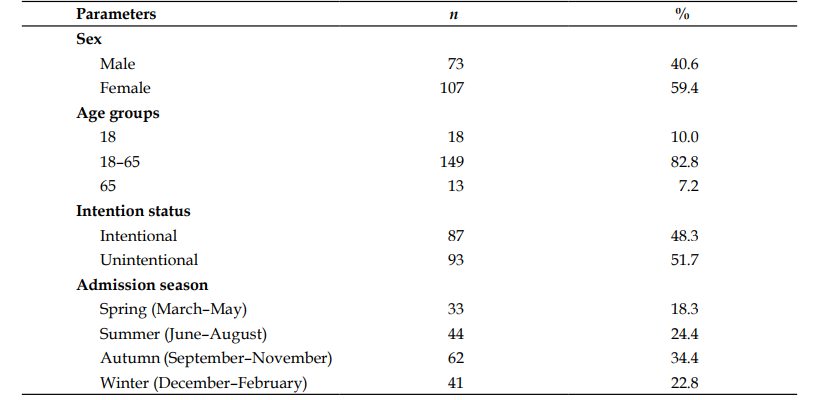
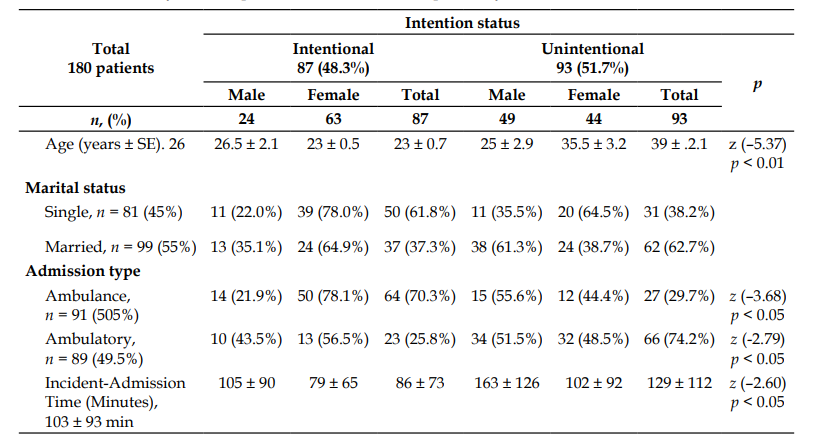
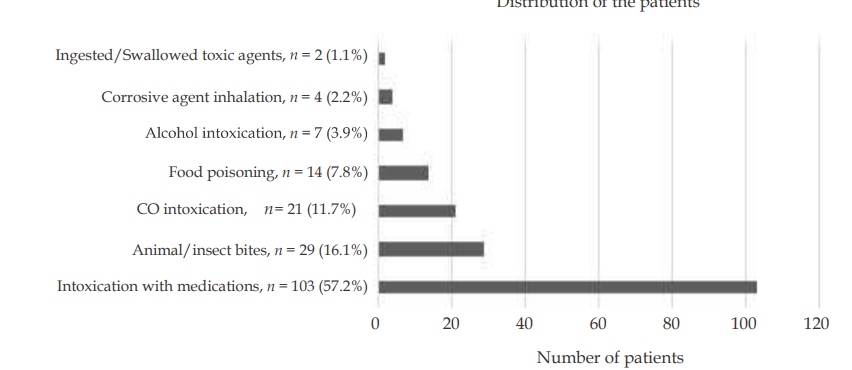
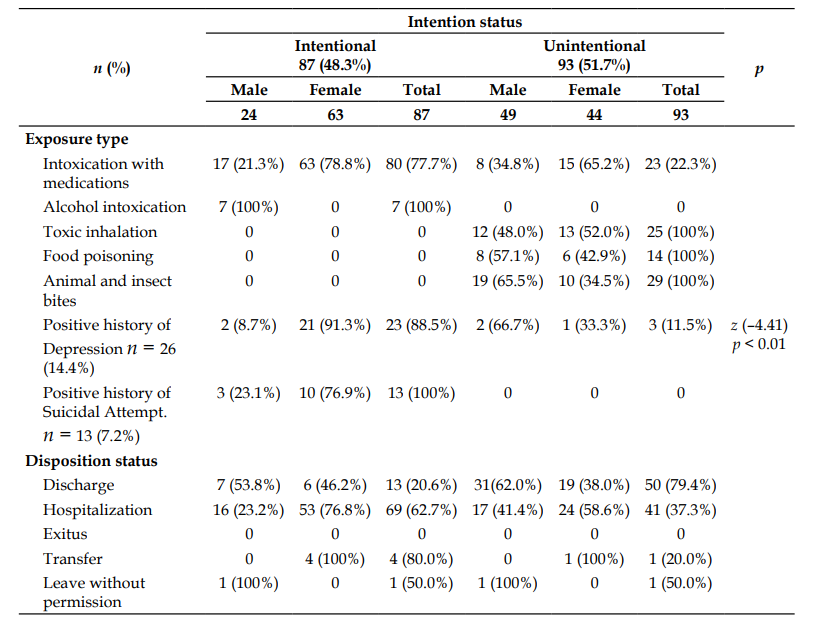
Results: Acute toxic exposure was detected in a total of 180 patients during the study period. The male/female ratio was 0.68 (73/107). The median age was 26 ranging between 3 and 89. The most common acute toxic exposure presentations were due to drugs (57.2%, n = 103), venomous animal/insect bites (16.1%, n = 29) and toxic gas inhalation (13.9%, n = 25). Toxic gas inhalation included inhalations of carbon monoxide (11.7%, n = 21) and vapor of hydrochloric acid (2.2%, n = 4). The rest of the presentations (19.4%, n = 35) were due to food poisoning (7.8%, n = 14), alcohol intoxication (3.9%, n = 7) and ingested toxic agents (1.1%, n = 2). No illicit drug use was observed. Almost half of the toxic exposures (51.7%, n = 93) were considered as unintentional whereas 77.7% (n = 93) of drug intoxication cases were intentional suicidal attempts. At least one consultation was requested for 126 patients. Two or more consultations were performed for 19 patients. The most consulted division was Internal medicine (48.9%, n = 115). The most common drug intoxications were due to analgesics (24.3%, n = 25) and antidepressants (23.3%, n = 24).
Conclusion: Acute toxicity is not limited to drug poisoning. It is not a rare reason for ED admission with its many sub-headings
References
- 1. International Union of Pure and Applied Chemistry. Compendium of Chemical Terminology (
- 2. World Health Organization. The Global Burden of Disease: 2004 Update. 2008.
- 3. Sorodoc V, Jaba IM, Lionte C, et al. Epidemiology of acute drug poisoning in a tertiary center from Iasi County, Romania. Human & Experimental Toxicology. 2011;30(12):1896–903.
- 4. Lund C, Teige B, Drottning P, et al. A one-year observational study of all hospitalized and fatal acute poisonings in Oslo: epidemiology, intention and follow-up. BMC Public Health. 2012;12(1):858.
- 5. Klobučar I, Potočnjak I, Dumančić J, et al. Acute poisonings in Croatia: differences in epidemiology, associated comorbidities and final outcomes – a single-centre 15-year follow-up. Clinical Toxicology. 2019;57(3):181–8.
- 6. Sorge M, Weidhase L, Bernhard M, et al. Self-poisoning in acute care medicine 2005–2012. Der Anaesthesist. 2015;64(6):456–62.
- 7. Jang H-S, Kim J-Y, Choi S-H, et al. Comparative analysis of acute toxic poisoning in 2003 and 2011: analysis of 3 academic hospitals. Journal of Korean Medical Science. 2013;28(10):1424–30.
- 8. Germano LC, Alonzo HGA. Descriptive study of hospital care on toxicological events in a municipality of São Paulo State, Brazil, 2012. Epidemiologia e Serviços de Saúde. 2017;26(3):545–56.
- 9. Hendrix L, Verelst S, Desruelles D, et al. Deliberate self-poisoning: characteristics of patients and impact on the emergency department of a large university hospital. Emergency Medicine Journal. 2013;30(1):e9.
- 10. Yoon Y-H, Kim J-Y, Choi S-H. Analysis of Patients with Acute Toxic Exposure between 2009 and 2013: Data from the Korea Health Insurance Review and Assessment Service and the National Emergency Department Information System. Journal of Korean Medical Science. 2018;33(39):e254.
- 11. Azekour K, Belamalem S, Soulaymani A, et al. Epidemiological Profile of Drug Overdose Reported in South-East Morocco from 2004 to 2016. Drugs - Real World Outcomes. 2019;6(1):11–7.
- 12. Kaya E, Yilmaz A, Saritas A, et al. Acute intoxication cases admitted to the emergency department of a university hospital. World Journal of Emergency Medicine. 2015;6(1):54.
- 13. Lee J, Fan N-C, Yao T-C, et al. Clinical spectrum of acute poisoning in children admitted to the pediatric emergency department. Pediatrics & Neonatology. 2019;60(1):59–67.
- 14. Yilmaz GR, Buzgan T, Irmak H, et al. The epidemiology of Crimean-Congo hemorrhagic fever in Turkey, 2002–2007. International Journal of Infectious Diseases. 2009;13(3):380–6.
- 15. Kayaalp C, Ersan V, Yilmaz S. Acute liver failure in Turkey: a systematic review. Turkish Journal of Gastroenterology. 2014;25(1):35–40.
- 16. Juarez-Aragon G, Castanon-Gonzalez J, Perez-Morales A, Montoya MC. Clinical and epidemiological characteristics of severe poisoning in an adult population admitted to an intensive care unit. Gaceta Médica de México. 1999;135(6):669–75.
- 17. Baydin A, Yardan T, Aygun D, et al. Retrospective evaluation of emergency service patients with poisoning: A 3-year study. Advances in Therapy. 2005;22(6):650–8.
- 18. Satar S, Seydaoglu G. Analysis of acute adult poisoning in a 6-year period and factors affecting the hospital stay. Advances in Therapy. 2005;22(2):137–47.
- 19. Litovitz T, Whitaker N, Clark L, et al. Emerging battery-ingestion hazard: clinical implications. Pediatrics. 2010;125(6):1168–77.
- 20. Pinzaru I, Manceva T, Sircu R, Bahnarel I, Sanduleac E. Acute chemical poisonings in the republic of Moldova: 5 years review. Chemistry Journal of Moldova. 2017;12(1):29–36.
Data Sharing Statement
There are no additional data available. All raw data and code are available upon request.
Funding
This research received no funding.
Author Contributions
Whether all authors contributed significantly to the work and approve its publication.
Ethics Declaration
This article does not involve any human or animal subjects, and therefore does not require ethics approval.
Acknowledgements
We would like to express our gratitude to the patients, their families, and all those who have contributed to this study.
Conflicts of Interest
The authors report no conflicts of interest in this work.
About this article

Cite this article
Vural S. Analyzes of the Patients Admitted to an Academic Emergency Department with Acute Toxic Exposure. Indian Journal of Forensic Medicine & Pathology. 2020;13(1 Special):171–176.
Licence:
Attribution-Non-commercial 4.0 International (CC BY-NC 4.0)This license enables reusers to distribute, remix, adapt, and build upon the material in any medium or format for noncommercial purposes only, and only so long as attribution is given to the creator.
| Received | Accepted | Published |
|---|---|---|
| January 02, 2020 | February 02, 2020 | March 30, 2020 |
DOI: 10.21088/ijfmp.0974.3383.13120.22
Keywords
IntoxicationPoisoningOverdoseEnvironmentalDrugSearch for Similar Articles
Similar Articles
- Diatom Analysis in Thermophilic water bodies: A Study on Hot Water Springs of Ma...
- Morphometric Study of Supra-meatal Triangle and Mastoid process in the Adult dry...
- Histopathological Spectrum of Autopsy Cases: A One Year Retrospective Observatio...
- Forensic Differentiation of Manner of Death in Railway Fatalities: A FourCase Se...
- Understanding assault Patterns: A Cross-sectional study of Cases at Chri, Kelamb...
Article Level Metrics
Last UpdatedSunday 18 October 2026, 19:57:07 (IST)
16289
Accesses
12
3209
00
Citations
NA
NA
NA
Download citation
Article Keywords
Keyword Highlighting
Highlight selected keywords in the article text.
Timeline
| Received | January 02, 2020 |
| Accepted | February 02, 2020 |
| Published | March 30, 2020 |
licence
Attribution-Non-commercial 4.0 International (CC BY-NC 4.0)
This license enables reusers to distribute, remix, adapt, and build upon the material in any medium or format for noncommercial purposes only, and only so long as attribution is given to the creator.