Full Text (PDF)
Indian Journal of Forensic Medicine and Pathology 19(1):p 41-46, Jan - March 2026. | DOI: https://doi.org/ijfmp.0974.3383.19126.6
Original Article
An Observational Study on Medicolegal Evaluation of Cause of Death in Unidentified Cadavers: An Autopsy Based Prospective Study at SMS Hospital, Jaipur During 2023-24
R.K Punia,, Shweta Goel, Surya Bhan Kushwaha
Author Information
Licence:
Attribution-Non-commercial 4.0 International (CC BY-NC 4.0)This license enables reusers to distribute, remix, adapt, and build upon the material in any medium or format for noncommercial purposes only, and only so long as attribution is given to the creator.
Indian Journal of Forensic Medicine and Pathology 19(1):p 41-46, Jan - March 2026. | DOI: https://doi.org/ijfmp.0974.3383.19126.6
How Cite This Article:
Shweta G, Punia RK, Kushwaha SB. An Observational Study on Medicolegal Evaluation of Cause of Death in Unidentified Cadavers: An Autopsy Based Prospective Study at SMS Hospital, Jaipur During 2023-24. Indian J Forensic Med Pathol. 2026;19(1):41-46.Timeline
Received : October 24, 2025
Accepted : December 16, 2025
Published : March 30, 2026
Abstract
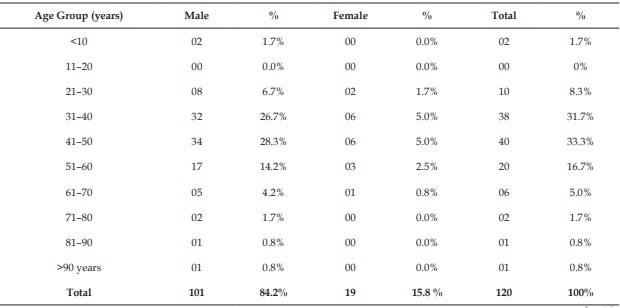
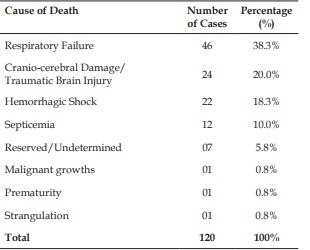
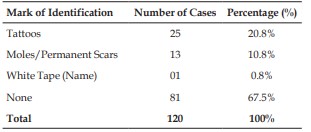
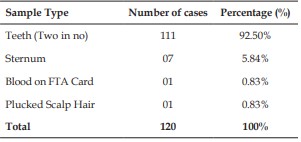
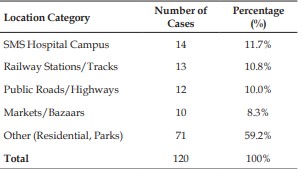
Background: Identifying unknown dead bodies is an essential part of forensic medicine and plays a major role in both legal and humanitarian matters. In urban areas, where migration and homelessness are common, the number of unidentified bodies is increasing. These cases present serious challenges in terms of medicolegal procedures and public health responsibilities. Aim: To study the demographic and medico-legal profile of unidentified dead bodies at SMS Hospital, Jaipur, including cause and manner of death, seasonal trends, and identification methods. Methods: This hospital-based observational study was conducted over one year, from October 2023 to November 2024 at Mortuary Department of Forensic Medicine, S.M.S. Medical College and Hospitals. Out of 5052 total autopsies, 718 were categorized as unknown, and 120 unidentified bodies were selected for detailed analysis. Data were collected using police inquest reports, autopsy findings, and a structured proforma. The data were analysed using SPSS version 30. Observation & Results: Out of 120 unidentified bodies, 84.2% were male. Most were aged between 31 to 50 years. Respiratory failure (38.3%) was the leading cause of death, followed by head injury (20%) and haemorrhagic shock (18.3%). Natural deaths made up 49.2%, and accidental deaths accounted for 40.8%. Identifiable features like tattoos or scars were seen in only one-third of cases. DNA samples, mostly teeth, were preserved in over 90% of cases. A seasonal rise in deaths was seen during the summer. Most bodies were found in public places, and 83.3% were disposed of within two weeks of recovery. Conclusion: The study highlights the urgent need for improved identification systems, better forensic tools, and coordination between government departments. It also suggests welfare programs for vulnerable populations to reduce the number of unidentified deaths in urban areas.
References
- 1. Reddy K.S.N. The Essentials of Forensic Medicine and Toxicology. 34th ed. Hyderabad: K. Suguna Devi; 2017. pp. 63-70.
- 2. Nandy A. Principles of Forensic Medicine. 4th ed. Kolkata: New Central Book Agency; 2013. pp. 92-97.
- 3. National Missing and Unidentified Persons System (NamUs). U.S. Department of Justice [Internet]. [cited 2025 Jul 9]. Available from: https://namus.nij.ojp.gov/
- 4. National Crime Records Bureau. Accidental Deaths and Suicides in India 2023. Ministry of Home Affairs, Government of India; 2024.
- 5. Indian Council of Medical Research. Ethical Guidelines for Biomedical Research on Human Participants. New Delhi: ICMR; 2017.
- 6. Ritter N. Missing persons and unidentified remains: the nation’s silent mass disaster. NIJ Journal. 2007; 256: 2-7.
- 7. Saukko P., Knight B. Knight’s Forensic Pathology. 4th ed. CRC Press; 2015. pp. 65-84.
- 8. Kumar A., Aggarwal A., Nagesh K.R. Profile of unidentified dead bodies–A three-year study. J Indian Acad Forensic Med. 2011; 33(1): 31–33.
- 9. Lad K.S., Ninama G., Solanki D.M. Demographic profile of unknown dead bodies in Bhavnagar region: A three-year study. J Indian Acad Forensic Med. 2013; 35(1): 40–42.
- 10. Sakthimani M., Peranantham S. Epidemiological and medico-legal profile of unidentified dead bodies brought for postmortem in Coimbatore Medical College. J Med Sci Clin Res. 2016; 4(9): 12370–76.
- 11. Karmakar J., Das I., Das A. Medico-legal study of unknown dead bodies at a tertiary care hospital in Assam. Int J Med Sci Public Health. 2017; 6(3): 538–41.
- 12. Chikhalkar B.G., Selvamani M., Rathod D. Profile of unidentified dead bodies and causes of death in Mumbai region. Med Leg J. 2016; 84(3): 137–42.
- 13. Gitanjali D. Retrospective study of unclaimed dead bodies at a tertiary hospital in North Tamil Nadu (2012–2015). Int J Forensic Med Invest. 2017; 3(1): 12–17.
- 14. Bardale R.V., Dixit P.G. Analysis of unidentified cadavers in a tertiary hospital of Maharashtra: A two-year study. J Forensic Leg Med. 2019; 61: 49–52.
Data Sharing Statement
There are no additional data available. All raw data and code are available upon request.
Funding
This research received no funding.
Author Contributions
All authors contributed significantly to the work and approve its publication.
Ethics Declaration
This article does not involve any human or animal subjects, and therefore does not require ethics approval.
Acknowledgements
We would like to express our gratitude to the patients, their families, and all those who have contributed to this study.
Conflicts of Interest
No conflicts of interest in this work.
About this article

Cite this article
Shweta G, Punia RK, Kushwaha SB. An Observational Study on Medicolegal Evaluation of Cause of Death in Unidentified Cadavers: An Autopsy Based Prospective Study at SMS Hospital, Jaipur During 2023-24. Indian J Forensic Med Pathol. 2026;19(1):41-46.
Licence:
Attribution-Non-commercial 4.0 International (CC BY-NC 4.0)This license enables reusers to distribute, remix, adapt, and build upon the material in any medium or format for noncommercial purposes only, and only so long as attribution is given to the creator.
| Received | Accepted | Published |
|---|---|---|
| October 24, 2025 | December 16, 2025 | March 30, 2026 |
DOI: https://doi.org/ijfmp.0974.3383.19126.6
Keywords
Unidentified bodiesAutopsyForensic identificationUrban deathsMigrant mortalitySearch for Similar Articles
Similar Articles
- Diatom Analysis in Thermophilic water bodies: A Study on Hot Water Springs of Ma...
- Morphometric Study of Supra-meatal Triangle and Mastoid process in the Adult dry...
- Histopathological Spectrum of Autopsy Cases: A One Year Retrospective Observatio...
- Forensic Differentiation of Manner of Death in Railway Fatalities: A FourCase Se...
- Understanding assault Patterns: A Cross-sectional study of Cases at Chri, Kelamb...
Article Level Metrics
Last UpdatedSunday 18 October 2026, 06:31:29 (IST)
16248
Accesses
43
3204
00
Citations
NA
NA
NA
Download citation
Article Keywords
Keyword Highlighting
Highlight selected keywords in the article text.
Timeline
| Received | October 24, 2025 |
| Accepted | December 16, 2025 |
| Published | March 30, 2026 |
licence
Attribution-Non-commercial 4.0 International (CC BY-NC 4.0)
This license enables reusers to distribute, remix, adapt, and build upon the material in any medium or format for noncommercial purposes only, and only so long as attribution is given to the creator.