Full Text (PDF)
Indian Journal of Forensic Medicine and Pathology 11(4):p 229-235, Oct-Dec 2018. | DOI: 10.21088/ijfmp.0974.3383.11418.2
Original Article
An Autopsy Based Retrospective Analytical Study about Demographic Profile of Decomposed Bodies at Raigarh (C.G.) Region
Author Information
Licence:
Attribution-Non-commercial 4.0 International (CC BY-NC 4.0)This license enables reusers to distribute, remix, adapt, and build upon the material in any medium or format for noncommercial purposes only, and only so long as attribution is given to the creator
Indian Journal of Forensic Medicine and Pathology 11(4):p 229-235, Oct-Dec 2018. | DOI: 10.21088/ijfmp.0974.3383.11418.2
How Cite This Article:
Timeline
Received : November 19, 2018
Accepted : November 26, 2018
Published : December 30, 2018
Abstract
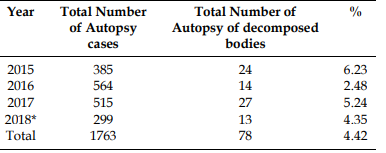
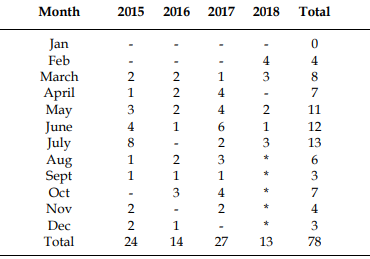
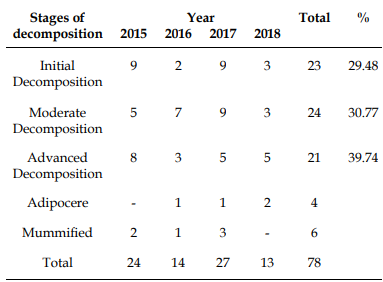
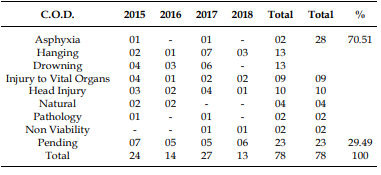
Introduction: Medico-legal autopsy of decomposed bodies are the most hectic task for an autopsy surgeonsince he/she is liable to provide data for fixation of P.M.I, Type of injury, C.O.D, etc. These datas are crucial for the purpose of administration of justice. Once upon a time autopsy of decomposed bodies were known as most unrewarding one, but due to improvement in scientific techniques, such situation had been partially over come. An attempt has been made in survey form of cases autopsized in K.G.H. mortuary at Raigarh to examine the feasibility to overcome the effect of above obstacles in recent situation. Aims & Objectives: In order to assess whether it is easy to find out injuries, cause of death, pattern of changes after death etc. in decomposed bodies and to assess the extent of certainty, three years and seven months study had been conducted. Further it is also aimed at to study the age, sex and season wise incidents of cases, cause of death etc. Materials & Methods: 78 decomposed bodies were autopsized out of total 1763 autopsy cases during the period from Jan 2015 to July 2018 in KGH mortuary at Raigarh, Chhattisgarh. Observations and results: Main points of discussion confined to (i) Season, (ii) Identity, (iii) Age group, (iv) Sex, (v) C.O.D. Maximum cases (48.72%) were found in summer. In total autopsized cases male predominance (80.76%) was found with M:F= 4.2:1. Maximum number of deceased persons were found in adult age group (21-60) [71.79%] and maximum cases were found in advanced stage of decomposition (39.74%). The C.O.D was determined in 70.51% of cases.
References
- 1. Biswas G. Review of forensic medicine & toxicology. 2nd ed. New Delhi: Jaypee Brothers Medical Publishers; 2012. p. 27.
- 2. Aggrawal A. Textbook of forensic medicine and toxicology. New Delhi: Avichal Publishing Company; 2015. p. 183.
- 3. Gordon I, Shapiro HA, Berson SD. Forensic medicine: a guide to principles. 3rd ed. Edinburgh: Churchill Livingstone; 1988. p. 43-4.
- 4. Kannan K, Mathiharan K, editors. Modi: a textbook of medical jurisprudence and toxicology. 24th ed. New Delhi: LexisNexis; 2013. p. 350.
- 5. Kulshrestha P, Satpathy DK. Forensic entomology analysis in Karnataka case. J Indian Acad Forensic Med. 2005;27(2):117.
- 6. Hitosugi M, et al. The importance of collecting live fly larvae from a severely decomposed human cadaver in winter: a case report. Rom J Leg Med. 2014;22:253-6.
- 7. Singh H. Use of maggots for the estimation of time since death. J Punjab Acad Forensic Med Toxicol. 2014;14(1):22-4.
- 8. Aggrawal A. Textbook of forensic medicine and toxicology. New Delhi: Avichal Publishing Company; 2015. p. 188.
- 9. Kannan K, Mathiharan K, editors. Modi: a textbook of medical jurisprudence and toxicology. 24th ed. New Delhi: LexisNexis; 2013. p. 317–21.
- 10. Job C. Determination of cause of death in decomposed bodies: a regional study. J Indian Acad Forensic Med. 2009;31(1):11–8.
- 11. Singh BK, Rastogi AK, Dadu SK, Jaiswal S, Gawali D. An autopsy based study about demographic profile and cause of death of decomposed body in Indore (MP) region. J Forensic Med Toxicol. 2015;32(2):46–8.
- 12. Lessig R, Grundmann C, Dahlmann F, Rötzscher K, Edelmann J, Schneider PM. Tsunami 2004 – a review of one year of continuous forensic medical work for victim identification. EXCLI J. 2006;5:128-39.
- 13. Mukhopadhyay S, Datta SS, Ghosh K, Biswas S, Shee B, Sukul B. A case report on revenge murder. IOSR J Dent Med Sci. 2014;13(7):26-9.
- 14. Ambade VN, Keoliya AN, Deokar RB, Dixit PG. Decomposed bodies—still an unrewarding autopsy? J Forensic Leg Med. 2011;18(3):101-6.
- 15. Galloway A, Birkby WH, Jones AM, Henry TE, Parks BO. Decay rates of human remains in an arid environment. J Forensic Sci. 1989;34(3):607-16.
- 16. Deoskar AS, Dutta A. Training notes on forensic entomology. Indian Police J. 2009;56(1):12.
- 17. Criminal Appeal No. 562 of 2012. Madras High Court. 2016 Feb 1.
- 18. Criminal Appeal No. 720 of 2016. Supreme Court of India. 2018 Mar 12.
- 19. 2007 (2) BLJR 2641. Criminal Appeal No. 259 of 2009. [Court Name Unknown]. 2014 Jan 20.
Data Sharing Statement
There are no additional data available. All raw data and code are available upon request.
Funding
This research received no funding.
Author Contributions
Whether all authors contributed significantly to the work and approve its publication.
Ethics Declaration
This article does not involve any human or animal subjects, and therefore does not require ethics approval.
Acknowledgements
We would like to express our gratitude to the patients, their families, and all those who have contributed to this study.
Conflicts of Interest
The authors report no conflicts of interest in this work.
About this article

Cite this article
Licence:
Attribution-Non-commercial 4.0 International (CC BY-NC 4.0)This license enables reusers to distribute, remix, adapt, and build upon the material in any medium or format for noncommercial purposes only, and only so long as attribution is given to the creator
| Received | Accepted | Published |
|---|---|---|
| November 19, 2018 | November 26, 2018 | December 30, 2018 |
DOI: 10.21088/ijfmp.0974.3383.11418.2
Keywords
DecompositionAutopsyMortuaryIdentityC.O.DSearch for Similar Articles
Similar Articles
- Diatom Analysis in Thermophilic water bodies: A Study on Hot Water Springs of Ma...
- Morphometric Study of Supra-meatal Triangle and Mastoid process in the Adult dry...
- Histopathological Spectrum of Autopsy Cases: A One Year Retrospective Observatio...
- Forensic Differentiation of Manner of Death in Railway Fatalities: A FourCase Se...
- Understanding assault Patterns: A Cross-sectional study of Cases at Chri, Kelamb...
Article Level Metrics
Last UpdatedSunday 18 October 2026, 15:38:28 (IST)
16277
Accesses
11
3209
00
Citations
NA
NA
NA
Download citation
Article Keywords
Keyword Highlighting
Highlight selected keywords in the article text.
Timeline
| Received | November 19, 2018 |
| Accepted | November 26, 2018 |
| Published | December 30, 2018 |
licence
Attribution-Non-commercial 4.0 International (CC BY-NC 4.0)
This license enables reusers to distribute, remix, adapt, and build upon the material in any medium or format for noncommercial purposes only, and only so long as attribution is given to the creator