Full Text (PDF)
Indian Journal of Forensic Medicine and Pathology 11(4):p 245-249, Oct-Dec 2018. | DOI: 10.21088/ijfmp.0974.3383.11418.4
Original Article
A Profile of Fatal Snakebite Cases in Rural Mandya: A Retrospective Study
Kumar U , Vinay J. , M.G. Shivaramu , Vijay Kumar A.G.
Author Information
Licence:
Attribution-Non-commercial 4.0 International (CC BY-NC 4.0)This license enables reusers to distribute, remix, adapt, and build upon the material in any medium or format for noncommercial purposes only, and only so long as attribution is given to the creator
Indian Journal of Forensic Medicine and Pathology 11(4):p 245-249, Oct-Dec 2018. | DOI: 10.21088/ijfmp.0974.3383.11418.4
How Cite This Article:
Timeline
Received : November 15, 2018
Accepted : November 28, 2018
Published : December 30, 2018
Abstract
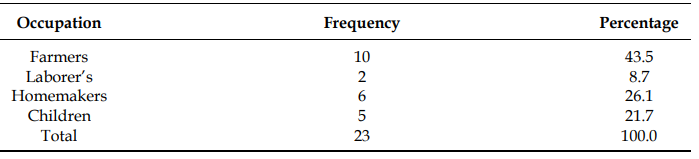
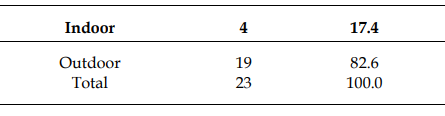
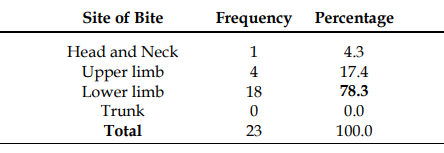
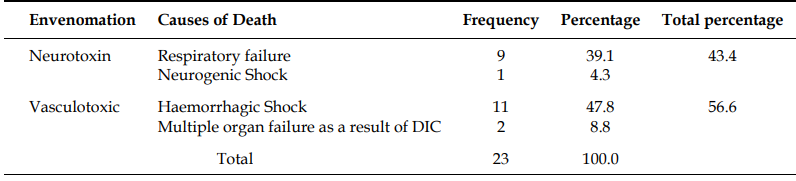
Introduction: Deaths resulting from snake envenomation is a public health problem particularly in rural India. Varieties of venomous snakes inhabit in India which take thousands of human lives every year. Establishing the accurate database of snakebite in humans from rural areas of India lackcertainty due to difficulty in the accessibility to health care, lack of proper reporting system, management of snakebite cases by untrained quacks and deaths prior to reaching hospital. Snakebite deaths are routinely subjected to autopsy for compensatory claims from the government as wild animal attacks. The WHO reported that in some countries the degree of under-reporting is greater than 70% especially in rural areas with poor infrastructure. In this context the present study was undertaken in our setup to see the extension of problem incorporated in our area. Materials and Methods: This is a retrospective descriptive study conducted from January 2014 to December 2017 at the Department of Forensic Medicine, Adichunchanagiri Institute of Medical Sciences, B G Nagara, Mandya district, Karnataka. The incidence and determinants of snakebite related mortality with reference to sex, age, occupation, season, time, place, site of bite, envenomation type and hospital treatment, history prior to the death and cause of death were recorded and the data was analyzed by using Excel 2010 and SPSS (Version 23) software and the results were expressed in percentages. Results: Amongst 23 fatal snakebite cases, 52.2% were males, the vulnerable age group were those in 31-60 years age group, farmers (43.5%) weremostly commonly affected, maximum number of deaths reported during rainy season (39.1%)and occurred during morning hours (30.5%) and most cases (82.6%) suffered outdoor bites. The lower limb (78.3%) was themost common site of biteand most common type of envenomation was vasculotoxic (56.6%). Haemorrhagic shock (47.8%)was the most common cause of death and only 56.5% received treatment in hospital. Conclusion: Snakebite is invariably an accident. As it is an accident, it can be avoided in many cases, but need some judicious, timely precautions to avoid the risk of snakebite and mortality associated with it. People should be made aware of such preventive measures by educating them.
References
- 1. Fernando R. Management of poisoning. 4th ed. Colombo: The Medical Defence Organisation; 2011.
- 2. Reddy KSN. The essentials of forensic medicine and toxicology. 33rd ed. Hyderabad: Jaypee Brothers Medical Publishers; 2014.
- 3. World Health Organization. Snakebite envenoming: prevalence of snakebite envenoming [Internet]. Geneva: World Health Organization; Mohapatra B, Warrell DA, Suraweera W, Bhatia P, Dhingra N, Jotkar R, et al. Snakebite mortality in India: a nationally representative mortality survey. PLoS Negl Trop Dis. 2011;5(4):e1018.
- 4. Hati AK, Mandal M, De MK, Mukherjee H, Hati RN. Epidemiology of snakebite in the district of Burdwan, West Bengal. J Indian Med Assoc. 1992;90(6):145-7.
- 5. Kumar VAG, Kumar ATS, Hallikeri VR. Study of incidence of fatal snake bites in Belgaum, Karnataka. Indian J Forensic Med Toxicol. 2011;5(2):131-7.
- 6. Chattopadhyay S, Sukul B. A profile of fatal snakebite cases in the Bankura district of West Bengal. J Forensic Leg Med. 2011;18(1):18–20.
- 7. Aramani CS, Kumar VAG, Aramani SS, Patil DT, et al. Snake bite cases in Karad. Sch J App Med Sci. 2014;2(5C):1675-6.
- 8. Ministry of Health & Family Welfare. Standard treatment guidelines: management of snake bite (quick reference guide). New Delhi: Government of India; 2015 Dec 22. p. 53.
Data Sharing Statement
There are no additional data available. All raw data and code are available upon request.
Funding
This research received no funding.
Author Contributions
Whether all authors contributed significantly to the work and approve its publication.
Ethics Declaration
This article does not involve any human or animal subjects, and therefore does not require ethics approval.
Acknowledgements
We would like to express our gratitude to the patients, their families, and all those who have contributed to this study.
Conflicts of Interest
The authors report no conflicts of interest in this work.
About this article

Cite this article
Licence:
Attribution-Non-commercial 4.0 International (CC BY-NC 4.0)This license enables reusers to distribute, remix, adapt, and build upon the material in any medium or format for noncommercial purposes only, and only so long as attribution is given to the creator
| Received | Accepted | Published |
|---|---|---|
| November 15, 2018 | November 28, 2018 | December 30, 2018 |
DOI: 10.21088/ijfmp.0974.3383.11418.4
Keywords
SnakebiteRural AreaDeathSearch for Similar Articles
Similar Articles
- Diatom Analysis in Thermophilic water bodies: A Study on Hot Water Springs of Ma...
- Morphometric Study of Supra-meatal Triangle and Mastoid process in the Adult dry...
- Histopathological Spectrum of Autopsy Cases: A One Year Retrospective Observatio...
- Forensic Differentiation of Manner of Death in Railway Fatalities: A FourCase Se...
- Understanding assault Patterns: A Cross-sectional study of Cases at Chri, Kelamb...
Article Level Metrics
Last UpdatedSunday 18 October 2026, 14:41:39 (IST)
16274
Accesses
12
3209
00
Citations
NA
NA
NA
Download citation
Article Keywords
Keyword Highlighting
Highlight selected keywords in the article text.
Timeline
| Received | November 15, 2018 |
| Accepted | November 28, 2018 |
| Published | December 30, 2018 |
licence
Attribution-Non-commercial 4.0 International (CC BY-NC 4.0)
This license enables reusers to distribute, remix, adapt, and build upon the material in any medium or format for noncommercial purposes only, and only so long as attribution is given to the creator