Full Text (PDF)
Indian Journal of Anatomy 11(1):p 15-22, January-March 2022. | DOI: https://doi.org/10.21088/ija.2320.0022.11122.2
Original Article
A Cadaveric Study of Variant Morphology of Gall Bladder and its Clinical Significance
Sharad kumar Pralhad Sawant null, 1Sharad Kumar Pralhad Sawant null, 2Shaheen Rizvi null
Author Information
Licence:
Indian Journal of Anatomy 11(1):p 15-22, January-March 2022. | DOI: https://doi.org/10.21088/ija.2320.0022.11122.2
How Cite This Article:
Sharad Kumar Pralhad Sawant, Shaheen Rizvi/A Cadaveric Study of Variant Morphology of Gall Bladder and its Clinical Significance/Indian J Anat. 2022;11(1):15-22.
Timeline
Received : January 05, 2022
Accepted : January 31, 2022
Published : February 25, 2022
Abstract
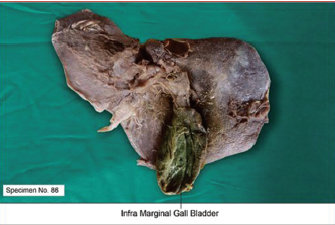
Introduction: As gall bladder is often a common site of open and laparoscopic procedures, the aim of the study was to note the different congenital anomalies of Gall bladder in the adult cadavers which can provide relevant information to the surgeons and radiologists performing diagnostic and therapeutic interventions at this region. The embryological basis and clinical implications of variations are discussed. Materials and Methods: Study was carried out on 75 gall bladders of formalin fixed cadavers in department of Anatomy at K.J. Somaiya Medical College, Sion, Mumbai. The studies were carried out in the period from July 2019 to August 2021. Following parameters were noted: 1) shape 2) external morphology 3) dimensions of gall bladder which included measurement of length and breadth. Transverse diameter at the level of body of gall bladder and length from the tip of fundus to the neck of gall bladder. Observation and Discussion: In 48 specimens, gall bladder was pear shaped. Other shapes observed were Cylindrical, Hourglass, Flask shaped and Irregular. In 1 specimen, the gall bladder was partially intrahepatic. A very prominent Hartmann’s pouch was observed in 22 specimens. Length of Gall bladder ranged between 5.3 cms to 10.2 cms and transverse diameter ranged between 2.8 cms and 5 cms. Different positions of the fundus in relation to inferior border of liver were also noted. Conclusion: Anatomical variations of Gall bladder become vital during surgical settings. Congenital anomalies and anatomical variations related to the gallbladder and extra hepatic biliary tree though not common but can be of clinical importance as failure to recognize them during operative procedures may lead to inadvertent complications. It is of greatest importance to laparoscopic surgeons during cholecystectomy to prevent alarming consequences as failure to recognise them can lead to iatrogenic injuries and increase morbidity and mortality. Every surgeon should assess for these anomalies before any operative procedures
References
No records found.
Data Sharing Statement
There are no additional data available. All raw data and code are available upon request.
Funding
This research received no funding.
Author Contributions
All authors contributed significantly to the work and approve its publication.
Ethics Declaration
Provide information related to the Ethics Committee approval with approval number OR write This article does not involve any human or animal subjects, and therefore does not require ethics approval.
Acknowledgements
We would like to express our gratitude to the patients, their families, and all those who have contributed to this study.
Conflicts of Interest
The authors report no conflicts of interest in this work.
About this article

Cite this article
Sharad Kumar Pralhad Sawant, Shaheen Rizvi/A Cadaveric Study of Variant Morphology of Gall Bladder and its Clinical Significance/Indian J Anat. 2022;11(1):15-22.
Licence:
| Received | Accepted | Published |
|---|---|---|
| January 05, 2022 | January 31, 2022 | February 25, 2022 |
DOI: https://doi.org/10.21088/ija.2320.0022.11122.2
Keywords
Gall bladderfundusintrahepaticsurgeonsradiologistslaparoscopic cholecystectomy.fundusintrahepaticsurgeonsradiologistslaparoscopic cholecystectomy.Search for Similar Articles
Similar Articles
- Supernumerary Pulmonary Vein: A Rare Anatomical Variation Observed During Cadave...
- Elongated Styloid Process: Anatomical Variations and Their Clinical Relevance: A...
- Bridging the Gap Between Dissection and Surgery: The Role of Soft Embalming in M...
- A Cadaveric Study of Retro Hepatic Segment of Inferior Vena Cava and Ostia Venae...
- Estimation of Stature from Forearm Length in Medical Undergraduate Students of a...
Article Level Metrics
Last UpdatedSunday 20 September 2026, 22:42:47 (IST)
5038
Accesses
15
601
00
Citations
NA
NA
NA
Download citation
Article Keywords
Keyword Highlighting
Highlight selected keywords in the article text.
Timeline
| Received | January 05, 2022 |
| Accepted | January 31, 2022 |
| Published | February 25, 2022 |