Full Text (PDF)
Indian Journal of Forensic Medicine and Pathology 18((2 Suppl)):p 210-217, April-June 2025. | DOI: https://doi.org/10.21088/ijfmp.0974.3383.18225.21
Original Article
Virtual Reality in Forensic Investigation: Exploring Applications and Advancements
Vinny Sharma, Aditya Kumar, Sudhir Kumar, Arvind Kumar
Author Information
Licence:
Attribution-Non-commercial 4.0 International (CC BY-NC 4.0)This license enables reusers to distribute, remix, adapt, and build upon the material in any medium or format for noncommercial purposes only, and only so long as attribution is given to the creator.
Indian Journal of Forensic Medicine and Pathology 18((2 Suppl)):p 210-217, April-June 2025. | DOI: https://doi.org/10.21088/ijfmp.0974.3383.18225.21
How Cite This Article:
Kumar A, Sharma V, Kumar S, et al. Virtual Reality in Forensic Investigation: Exploring Applications and Advancements. Indian J Forensic Med Pathol. 2025;18(2 Suppl):210-217.Timeline
Received : June 26, 2024
Accepted : June 22, 2025
Published : June 30, 2025
Abstract
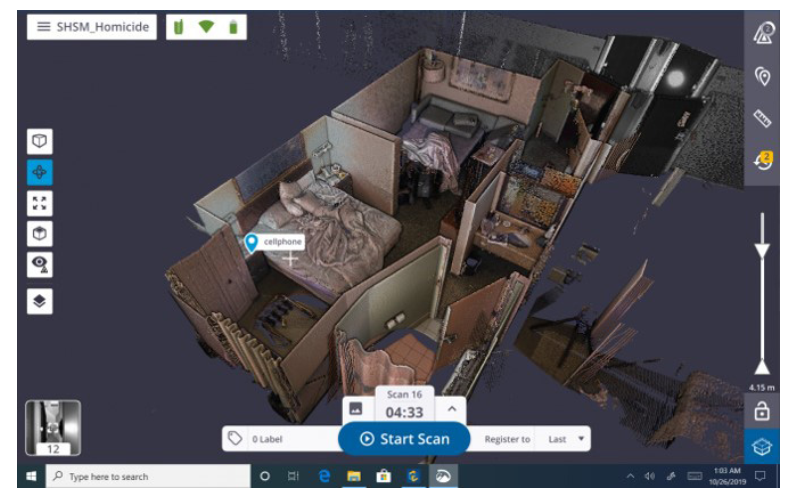
At the present time, there is a growing body of scholarly study focused on the development of virtual worlds and scenarios that have the potential to provide entirely sensory-rich alternative adventures that incorporate tangible, visual, and audio aspects. Once implemented properly, these kinds of efforts have the potential to be quite effective. Through a comprehensive analysis of realistic virtual reality and its technological ingredients, the present investigation intends to investigate appropriate approaches for effectively recreating virtual crime scenes. In the area of forensic examination, the re-enactment of the scene of an incident is a crucial procedure that helps determine the order in which events occurred. Enhancing comprehension and achieving straightforward, high-quality monitoring are the main goals of legal criminal investigation documentation. However, traditional methods are not adequate regarding it thorough recreation for entire scene of crime. The incorporation of methods for visualising information in multiple dimensions facilitates the thorough analysis of various types of proof gathered at the scene of crime, hence aiding in the development of a cohesive story. Rather of being displayed on traditional computer screens, the content is delivered via immersive virtual reality (VR). A thorough recreation of a crime scene is made possible by the links between different evidence chains. This is achieved by the application of forensic tools and specialist knowledge to examine the sources of harm and identify those who may be at fault. When multidimensional imaging techniques are used to many kinds of criminal situations, it becomes possible to conduct a more thorough investigation and perform a range of insightful analyses, including accurate measurement.
References
- 1. Black S., Wall M., Abboud R., Baker R, Stebbins J. Forensic gait analysis: A primer for courts. United Kingdom: The Royal Society, 2017. 33 p. (Primers for Courts).
- 2. Dath C. Crime scenes in Virtual Reality: A user centered study, 2017.
- 3. Dormehl L. Virtual Reality Milestones That Took It from Sci-Fi to Your Living Room.
- 4. Berger C., Bauer M., Wittig H., Scheurer E., Lenz C. Post mortem brain temperature and its influence on quantitative MRI of the brain. Magnetic Resonance Materials in Physics, Biology and Medicine. 2021: 1-3.
- 5. Buck U., Buße K., Campana L., Schyma C. Validation and evaluation of measuring methods for the 3D documentation of external injuries in the field of forensic medicine. International journal of legal medicine. 2018 Mar; 132: 551-61.
- 6. Busch J.R., Lundemose S.B., Lynnerup N., Jacobsen C., Jørgensen M.B., Banner J. Post-mortem MRI-based volumetry of the hippocampus in forensic cases of decedents with severe mental illness. Forensic Science, Medicine and Pathology. 2019 Jun 14; 15: 213-7.
- 7. Bardi, J. What is Virtual Reality. Online Available at: https://www.marxentlabs.com/ what-is-virtual- reality/ Accessed 29 March 2020.
- 8. Mazuryk, T. & Gervautz, M. History,Applications, Technology and Future. Virtual Reality, 2019, pp. 1-72.
- 9. Baier W., Warnett J.M., Payne M., Williams M.A. Introducing 3D printed models as demonstrative evidence at criminal trials. Journal of forensic sciences. 2018 Jul; 63(4): 1298-302.
- 10. Grabherr S., Baumann P., Minoiu C., Fahrni S., Mangin P. Post-mortem imaging in forensic investigations: current utility, limitations, and ongoing developments. Research and Reports in Forensic Medical Science. 2016 Mar 16: 25- 37.
- 11. Galligan A.A., Fries C., Melinek J. Gunshot wound trajectory analysis using forensic animation to establish relative positions of shooter and victim. Forensic science international. 2017 Feb 1; 271: e8-13.
- 12. Galvin R. Crime Scene Documentation: Preserving the Evidence and the Growing Role of 3D Laser Scanning. CRC Press; 2020 Dec 10.
- 13. Garland J., Ondruschka B., Stables S., Morrow P., Kesha K., Glenn C., Tse R. Identifying fatal head injuries on postmortem computed tomography using convolutional neural network/deep learning: a feasibility study. Journal of forensic sciences. 2020 Nov; 65(6): 2019-22.
- 14. Harris E.J., Khoo I.H., Demircan E. A survey of human gait-based artificial intelligence applications. Frontiers in Robotics and AI. 2022 Jan 3; 8: 749274.
- 15. Home P.H., Norman D.G., Williams M.A. Software for the trajectory analysis of blooddrops: a systematic review. Forensic Science International. 2021 Nov 1; 328: 110992.
- 16. Hwang J., Jung M.C. Age and sex differences in ranges of motion and motion patterns. International Journal of Occupational Safety and Ergonomics. 2015 Apr 3; 21(2): 173-86.
- 17. Jakobsen L.S., Lundemose S., Banner J., Lynnerup N., Jacobsen C. Forensic postmortem computed tomography: volumetric measurement of the heart and liver. Springer US; 2016 Dec.
- 18. Maneli M.A., Isafiade O.E. 3D forensic crime scene reconstruction involving immersive technology: A systematic literature review. IEEE Access. 2022 Aug 17; 10: 88821-57.
- 19. Mohammad N., Ahmad R., Kurniawan A., Mohd Yusof M.Y. Applications of contemporary artificial intelligence technology in forensic odontology as primary forensic identifier: A scoping review. Frontiers in artificial intelligence. 2022 Dec 6; 5: 1049584.
- 20. Neeter, E. Exploring Virtual Reality as a Forensic Tool. 1 ed. s.l.: Evidence Technology Magazine. 2018.
- 21. Norberti N., Tonelli P., Giaconi C., Nardi C, Focardi M., Nesi G., Miele V., Colagrande S. State of the art in post-mortem computed tomography: a review of current literature. Virchows Archiv. 2019 Aug 1; 475: 139-50.
- 22. Olver A.M., Guryn H., Liscio E. The effects of camera resolution and distance on suspect height analysis using PhotoModeler. Forensic Science International. 2021 Jan 1; 318: 110601.
Data Sharing Statement
There are no additional data available. All raw data and code are available upon request.
Funding
This research received no funding.
Author Contributions
All authors contributed significantly to the work and approve its publication.
Ethics Declaration
This article does not involve any human or animal subjects, and therefore does not require ethics approval.
Acknowledgements
We would like to express our gratitude to the patients, their families, and all those who have contributed to this study.
Conflicts of Interest
No conflicts of interest.
About this article

Cite this article
Kumar A, Sharma V, Kumar S, et al. Virtual Reality in Forensic Investigation: Exploring Applications and Advancements. Indian J Forensic Med Pathol. 2025;18(2 Suppl):210-217.
Licence:
Attribution-Non-commercial 4.0 International (CC BY-NC 4.0)This license enables reusers to distribute, remix, adapt, and build upon the material in any medium or format for noncommercial purposes only, and only so long as attribution is given to the creator.
| Received | Accepted | Published |
|---|---|---|
| June 26, 2024 | June 22, 2025 | June 30, 2025 |
DOI: https://doi.org/10.21088/ijfmp.0974.3383.18225.21
Keywords
Crime sceneVirtual realityInvestigationEvidence reconstruction3-DForensic scienceSearch for Similar Articles
Similar Articles
- Diatom Analysis in Thermophilic water bodies: A Study on Hot Water Springs of Ma...
- Morphometric Study of Supra-meatal Triangle and Mastoid process in the Adult dry...
- Histopathological Spectrum of Autopsy Cases: A One Year Retrospective Observatio...
- Forensic Differentiation of Manner of Death in Railway Fatalities: A FourCase Se...
- Understanding assault Patterns: A Cross-sectional study of Cases at Chri, Kelamb...
Article Level Metrics
Last UpdatedSunday 18 October 2026, 15:53:20 (IST)
16279
Accesses
70
3209
00
Citations
NA
NA
NA
Download citation
Article Keywords
Keyword Highlighting
Highlight selected keywords in the article text.
Timeline
| Received | June 26, 2024 |
| Accepted | June 22, 2025 |
| Published | June 30, 2025 |
licence
Attribution-Non-commercial 4.0 International (CC BY-NC 4.0)
This license enables reusers to distribute, remix, adapt, and build upon the material in any medium or format for noncommercial purposes only, and only so long as attribution is given to the creator.