Full Text (PDF)
New Indian Journal of Surgery 15(3):p 119-121, July-September 2024. | DOI: https://dx.doi.org/10.21088/nijs.0976.4747.15324.5
Original Article
Use of Three Layered Regenerative Scaffold Dressing in the Wound Bed Preparation of Second Degree Scald Burns
Ravi Kumar Chittoria, Viswak M, Amrutha J S
Author Information
Licence:
Attribution-Non-commercial 4.0 International (CC BY-NC 4.0)This license enables reusers to distribute, remix, adapt, and build upon the material in any medium or format for noncommercial purposes only, and only so long as attribution is given to the creator.
New Indian Journal of Surgery 15(3):p 119-121, July-September 2024. | DOI: https://dx.doi.org/10.21088/nijs.0976.4747.15324.5
How Cite This Article:
Viswak M, Chittoria RK, Amrutha JS. Use of three layered regenerative scaffold dressing in the wound bed preparation of second degree scald burns. New Indian J Surg. 2024;15(3):119-121. doi:10.21088/nijs.0976.4747.15324.5Timeline
Received : July 23, 2024
Accepted : September 12, 2024
Published : September 30, 2024
Abstract
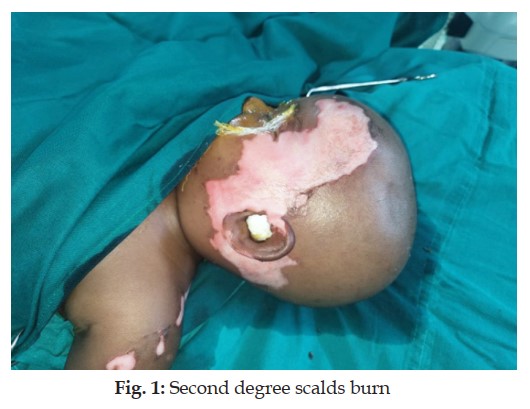
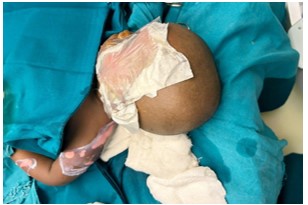
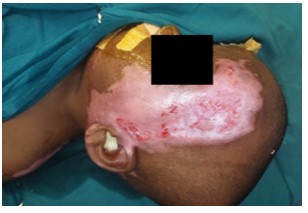
Burns are one of the most common injuries among the children, which are due to thermal, scald, electrical burn injuries. Scald injuries tend to be the most common type of burn injury under the age of five, accounting for over 65% of the cases.In current scenario, various scaffolds are used to improve the quality of healing process and reduce the scar formation. Collagen acts as a scaffold through which regeneration of tissues occurs and also helps in new vessel formation. Other scaffolds like amniotic membrane which has unique antiinflammatory, bacteriostatic property helps in proper epithelization and reduces scarring and silicone gel sheets has hydrophobic property, which reduces scarring and provides analgesia. In this study we attempted three layered scaffold dressing for an second degree scald burn pediatric patient.
References
- 1. Lazovic G, Colic M, Grubor M, Jovanovic M. The application of collagen sheet in open wound healing*. Ann Burns Fire Disasters. 2005 Sep 30;18(3):151-6.
- 2. Bose B. Burn wound dressing with human amniotic membrane. Ann R Coll Surg Engl. 1979 Nov;61(6):444-7.
- 3. Lucattelli E, Cipriani F, Pascone C, Di Lonardo A. Non-Healing Burn Wound Treatment With A Sterile Silicone Gel. Ann Burns Fire Disasters. 2021 Mar and 31;34(1):53-57.
- 4. Frame JD, Still J, Lakhel-LeCoadou A, Carstens MH, Lorenz C, Orlet H, et al. Use of dermal regeneration template in contracture release procedures: a multicenter evaluation. PlastReconstrSurg 2004; 113:1330-8.
- 5. Moiemen NS, Staiano JJ, Ojeh NO, Thway Y, Frame JD. Reconstructive surgery with a dermal regeneration template: clinical and histologic study. Plast Reconstr Surg 2001; 108:93-103.
Data Sharing Statement
There are no additional data available.
Funding
This research received no funding.
Author Contributions
All authors contributed significantly to the work and approve its publication.
Ethics Declaration
This article does not involve any human or animal subjects, and therefore does not require ethics approval
Acknowledgements
Information Not Provided
Conflicts of Interest
No conflicts of interest in this work.
About this article

Cite this article
Viswak M, Chittoria RK, Amrutha JS. Use of three layered regenerative scaffold dressing in the wound bed preparation of second degree scald burns. New Indian J Surg. 2024;15(3):119-121. doi:10.21088/nijs.0976.4747.15324.5
Licence:
Attribution-Non-commercial 4.0 International (CC BY-NC 4.0)This license enables reusers to distribute, remix, adapt, and build upon the material in any medium or format for noncommercial purposes only, and only so long as attribution is given to the creator.
| Received | Accepted | Published |
|---|---|---|
| July 23, 2024 | September 12, 2024 | September 30, 2024 |
DOI: https://dx.doi.org/10.21088/nijs.0976.4747.15324.5
Keywords
Three layer scaffoldRegenerativePediatricSecond degree scald burnsSearch for Similar Articles
Similar Articles
- Laparoscopy-Guided Bilateral Oblique Subcostal Transversus Abdominis Plane Bloc...
- Recognizing the Columnar Cell Subtype of Papillary Thyroid Carcinoma: A Case Rep...
- Randomized Controlled Study To Compare Intraperitoneal Plus Port-Site Instillat...
- Single Preoperative Dose Versus Conventional Multidose Antibiotic Prophylaxis In...
- To Compare the Dissection of Gallbladder by Ultrasonic Harmonic Scalpel Versus...
Article Level Metrics
Last UpdatedTuesday 29 September 2026, 09:24:56 (IST)
5221
Accesses
7
437
00
Citations
NA
NA
NA
Download citation
Article Keywords
Keyword Highlighting
Highlight selected keywords in the article text.
Timeline
| Received | July 23, 2024 |
| Accepted | September 12, 2024 |
| Published | September 30, 2024 |
licence
Attribution-Non-commercial 4.0 International (CC BY-NC 4.0)
This license enables reusers to distribute, remix, adapt, and build upon the material in any medium or format for noncommercial purposes only, and only so long as attribution is given to the creator.