Full Text (PDF)
Indian Journal of Library and Information Sciences 20(3):p 263-273, September-December 2026. | DOI: https://doi.org/10.21088/ijlis.0973.9548.20326.2
Original Article
Transforming Classrooms: The Role of AI in Indian Education
Author Information
Licence:
Attribution-Non-commercial 4.0 International (CC BY-NC 4.0)This license enables reusers to distribute, remix, adapt, and build upon the material in any medium or format for noncommercial purposes only, and only so long as attribution is given to the creator.
Indian Journal of Library and Information Sciences 20(3):p 263-273, September-December 2026. | DOI: https://doi.org/10.21088/ijlis.0973.9548.20326.2
How Cite This Article:
Debdas Mondal. Transforming Classrooms: The Role of AI in Indian Education. Ind J Lib Inf Sci 2026; 20 (3): 263–273Timeline
Received : July 20, 2026
Accepted : August 28, 2026
Published : December 30, 2026
Abstract
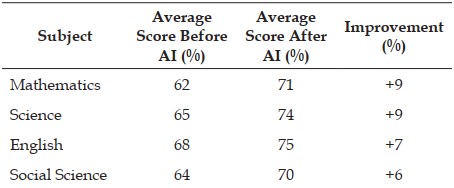
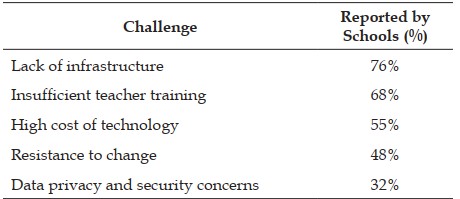
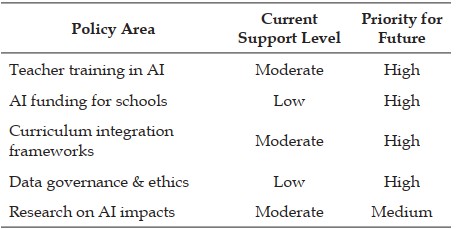
Artificial Intelligence (AI) is increasingly influencing educational practices worldwide, offering new possibilities for personalised learning, adaptive assessment, and enhanced classroom engagement. In India, where the education system faces challenges related to diversity, scale, and unequal access to resources, AI has the potential to play a transformative role. The present study examines the extent and impact of AI integration in Indian classrooms, focusing on adoption levels, types of AI tools used, perceptions of teachers and students, academic performance outcomes, implementation challenges, and policy priorities. The study adopts a descriptive and analytical research design, using primary data collected through structured questionnaires administered to teachers, students, and school administrators, complemented by secondary data from policy documents and scholarly literature. Data were analyzed using percentage and comparative methods and presented through tabular representations. The findings reveal that while a majority of schools have initiated AI adoption, advanced integration remains limited. Adaptive learning platforms are the most widely used AI tools, and both teachers and students generally perceive AI as enhancing personalized learning and student engagement. The study also indicates measurable improvements in academic performance, particularly in Mathematics and Science. However, significant challenges persist, including inadequate infrastructure, insufficient teacher training, high costs, and limited policy support. The study concludes that AI holds considerable promise for transforming Indian classrooms, but its effective and equitable implementation requires coordinated policy initiatives, sustained investment, teacher capacity building, and robust ethical and data governance frameworks.
References
- 1. Chen, X., Y. Xiong, and C. Liu. Machine Learning in Education: Foundations and Applications. Educational Technology Review, 2020.
- 2. Davuluri, M. “AI in Education: Personalized Learning Pathways Using Machine Learning Algorithms.” International Meridian Journal, vol. 3, no. 3, 2021, https://meridianjournal.in/ index.php/IMJ/article/view/90.
- 3. Falkuti, T. S. C., and H. Norman. “Teachers’ Perceptions about the Use of Artificial Intelligence (AI) in Teaching at the Middle School Level.” Jurnal Pendidikan Bitara UPSI, vol. 17, no. 2, 2024, pp. 150–157. https://doi. org/10.37134/bitara.vol17.2.13.2024.
- 4. Gokula Krishnan, B., and P.J.K. Reddy. “Perception of Adaptive Teaching Learning Systems with AI-Powered Pedagogical Approaches among B.Ed. Student Teachers.” Research Inspiration, vol. 10, no. 4, 2025, pp. 21–33. https://doi.org/10.53724/inspiration/ v10n4.04.
- 5. Gupta, T., et al. “Adaptive Learning Systems: Harnessing AI to Personalize Educational Outcomes.” International Journal for Research in Applied Science and Engineering Technology (IJRASET), 2024. https://doi.org/10.22214/ ijraset.2024.65088.
- 6. Juniarni, C., et al. “Transforming Teaching and Learning with Artificial Intelligence (AI): Personalized Education, Adaptive Learning, and Intelligent Tutoring Systems.” Education Studies and Teaching Journal (EDUTECH), vol. 1, no. 3, 2024, pp. 368–386. https://doi. org/10.62207/c97e7356.
- 7. Kang, P. K. “AI in Education: Personalized Learning through Adaptive Systems.” International Journal of Machine Learning and Artificial Intelligence, vol. 4, no. 4, 2023, https:// jmlai.in/index.php/ijmlai/article/view/51.
- 8. Kim, N. J., and M. K. Kim. “Teachers’ Perceptions of Using an Artificial IntelligenceBased Educational Tool for Scientific Writing.” Frontiers in Education, 2022. https://doi. org/10.3389/feduc.2022.755914.
- 9. Liu, V., E. Latif, and X. Zhai. “Advancing Education through Tutoring Systems: A Systematic Literature Review.” 2025.
- 10. Luckin, R., et al. Intelligence Unleashed: An Argument for AI in Education. Pearson, 2016. “Systematic Review of Artificial Intelligence in Education: Trends, Benefits, and Challenges.” Multidisciplinary Digital Publishing Institute, 2025, https://www.mdpi.com/2414-4088/9/ 8/84.
- 11. “Systematic Review: Artificial Intelligence in Adaptive Education.” Discover Education, 2025. https://doi.org/10.1007/s44217-025-00908-6.
- 12. Singh, P. R. “AI Driven Adaptive Learning System for Personalised Education.” International Journal of Machine Learning and Artificial Intelligence, vol. 5, no. 5, 2024, https:// jmlai.in/index.php/ijmlai/article/view/67.
- 13. Shoaib Lodhi, S., and S. Lodhi. “Integration of AI in STEM Education, Addressing Ethical Challenges in K-12 Settings.” 2025.
- 14. Woolf, B. P. Building Intelligent Interactive Tutors: Student-Centred Strategies for Revolutionizing E-Learning. Morgan Kaufmann, 2010.
Data Sharing Statement
There are no additional data available. All raw data and code are available upon request.
Funding
This research received no funding.
Author Contributions
All authors contributed significantly to the work and approve its publication.
Ethics Declaration
This article does not involve any human or animal subjects, and therefore does not require ethics approval.
Acknowledgements
We would like to express our gratitude to the patients, their families, and all those who have contributed to this study.
Conflicts of Interest
No conflicts of interest in this work.
About this article

Cite this article
Debdas Mondal. Transforming Classrooms: The Role of AI in Indian Education. Ind J Lib Inf Sci 2026; 20 (3): 263–273
Licence:
Attribution-Non-commercial 4.0 International (CC BY-NC 4.0)This license enables reusers to distribute, remix, adapt, and build upon the material in any medium or format for noncommercial purposes only, and only so long as attribution is given to the creator.
| Received | Accepted | Published |
|---|---|---|
| July 20, 2026 | August 28, 2026 | December 30, 2026 |
DOI: https://doi.org/10.21088/ijlis.0973.9548.20326.2
Keywords
Artificial IntelligencePersonalised LearningEducational TechnologyTeacher PerceptionStudent EngagementAI IntegrationDigital LearningEducational PolicySearch for Similar Articles
Similar Articles
- Newspaper Reading Habits among Undergraduate Students: A Case Study
- Research Excellence on ChatGPT Literature in Medicine: A Scientometric Sketch
- Information Seeking Behavior of Legal Practitioners in the Digital Era: A Review...
- Assessment of Library Collection and Services in Automated System in Institute o...
- Prospective Approaches for Artificial Intelligence Integration in Indian School...
Article Level Metrics
Last UpdatedThursday 12 November 2026, 18:56:46 (IST)
5970
Accesses
2
1004
00
Citations
NA
NA
NA
Download citation
Article Keywords
Keyword Highlighting
Highlight selected keywords in the article text.
Timeline
| Received | July 20, 2026 |
| Accepted | August 28, 2026 |
| Published | December 30, 2026 |
licence
Attribution-Non-commercial 4.0 International (CC BY-NC 4.0)
This license enables reusers to distribute, remix, adapt, and build upon the material in any medium or format for noncommercial purposes only, and only so long as attribution is given to the creator.