Full Text (PDF)
Indian Journal of Library and Information Sciences 18(2):p 145-153, May - August 2024. | DOI: https://doi.org/10.21088/ijlis.0973.9548.18224.6
Original Article
Prospective Approaches for Artificial Intelligence Integration in Indian School Libraries
Jaypalsinh A. Gohil, Devyaniba R. Jadeja
Author Information
Licence:
Attribution-Non-commercial 4.0 International (CC BY-NC 4.0)This license enables reusers to distribute, remix, adapt, and build upon the material in any medium or format for noncommercial purposes only, and only so long as attribution is given to the creator.
Indian Journal of Library and Information Sciences 18(2):p 145-153, May - August 2024. | DOI: https://doi.org/10.21088/ijlis.0973.9548.18224.6
How Cite This Article:
Devyaniba R. Jadeja, Jaypalsinh A. Gohil. Prospective Approaches for Artificial Intelligence Integration in Indian School Libraries. Ind J Lib Inf Sci 2024;18 (2):145–153.Timeline
Received : March 16, 2024
Accepted : May 22, 2024
Published : August 25, 2024
Abstract
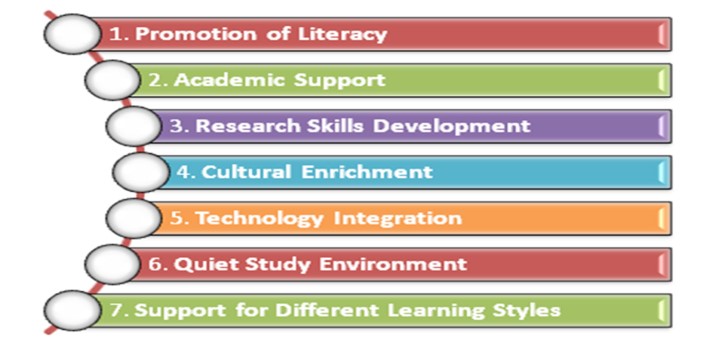
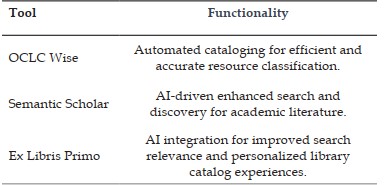
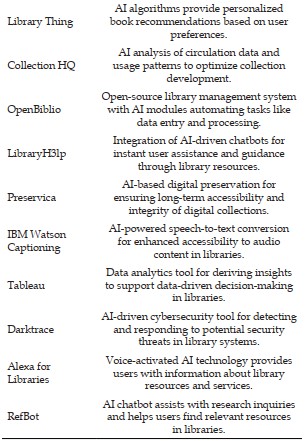
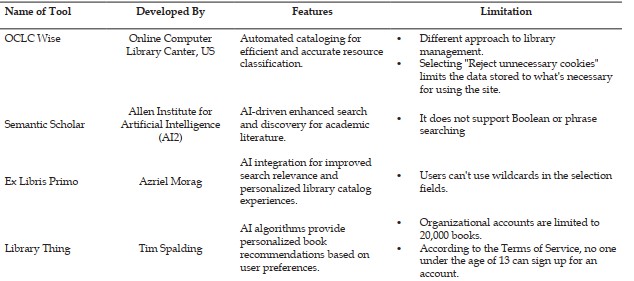
School libraries play a crucial role in the educational ecosystem, offering a variety of resources and services that contribute significantly to students’ academic success, personal development, and lifelong learning.The integration of Artificial Intelligence (AI) in school libraries brings about several benefits and opportunities, enhancing the overall learning experience for students and streamlining library operations.Libraries are dynamic institutions, and their tools need to evolve to keep pace with technological advancements and changing user expectations. Regular assessments, feedback from users, and collaboration with the broader library community can help identify areas for improvement and guide the development of more effective library science tools.While libraries can function without incorporating AI, certain challenges and limitations may arise in the absence of AI technologies. In this paper, we focus on AI research in the field of library science is essential for leveraging technology to its fullest potential, improving efficiency, enhancing user experiences, and ensuring that libraries remain dynamic and relevant in the digital age. It allows libraries to adapt to changing user needs and technological advancements, ultimately contributing to the overall effectiveness and impact of library services.
References
- 1. C. Kuhlthau, “Guided Inquiry: School Libraries in the 21st Century,” Sch. Libr. Worldw., pp. 1–12, Oct. 2001, doi: 10.29173/slw6797.
- 2. B. D. Lund and T. Wang, “Chatting about ChatGPT: how may AI and GPT impact academia and libraries?,” Libr. Hi Tech News, vol. 40, no. 3, pp. 26–29, May 2023, doi: 10.1108/LHTN-01-2023- 0009.
- 3. R. O. Okunlaya, N. Syed Abdullah, and R. A. Alias, “Artificial intelligence (AI) library services innovative conceptual framework for the digital transformation of university education,” Libr. Hi Tech, vol. 40, no. 6, pp. 1869–1892, Dec. 2022, doi: 10.1108/LHT-07-2021-0242.
- 4. M. Y. Ali, S. Bin Naeem, and R. Bhatti, “Artificial intelligence tools and perspectives of university librarians: An overview,” Bus. Inf. Rev., vol. 37, no. 3, pp. 116–124, Sep. 2020, doi: 10.1177/0266382120952016.
- 5. A. Asemi and A. Asemi, “Artificial intelligence(AI) application in library systems in Iran: A taxonomy study,” Libr. Philos. Pract., vol. 2019, 2019.
- 6. B. D. Lund, I. Omame, S. Tijani, and D. Agbaji, “Perceptions toward artificial intelligence among academic library employees and alignment with the diffusion of innovations’ adopter categories,” Coll. Res. Libr., vol. 81, no. 5, pp. 865–882, 2020, doi: 10.5860/crl.81.5.865.
- 7. A. M. Cox, S. Pinfield, and S. Rutter, “The intelligent library: Thought leaders’ views on the likely impact of artificial intelligence on academic libraries,” Libr. Hi Tech, vol. 37, no. 3, pp. 418–435, 2019, doi: 10.1108/LHT-08-2018-0105.
- 8. T. I. Yusuf, O. A. Adebayo, L. A. Bello, and J. O. Kayode, “Adoption of Artificial Intelligence for Effective Library Service Delivery in Academic Libraries in Nigeria,” Libr. Philos. Pract., no. January, pp. 1–13, 2022.
- 9. S. Hervieux and A. Wheatley, “Perceptions of artificial intelligence: A survey of academic librarians in Canada and the United States,” J. Acad. Librariansh., vol. 47, no. 1, p. 102270, 2021, doi: 10.1016/j.acalib.2020.102270.
- 10. M. O. Ragunathan, “Artificial Intelligence and Multimedia Facilities in School Libraries : Possibilities for the Future,” 2023.
- 11. A. Wheatley and S. Hervieux, “Artificial intelligence in academic libraries: An environmental scan,” Inf. Serv. Use, vol. 39, no. 4, pp. 347–356, 2020, doi: 10.3233/ISU-190065.
Data Sharing Statement
There are no additional data available. All raw data and code are available upon request.
Funding
This research received no funding.
Author Contributions
All authors contributed significantly to the work and approve its publication.
Ethics Declaration
This article does not involve any human or animal subjects, and therefore does not require ethics approval.
Acknowledgements
We would like to express our gratitude to the patients, their families, and all those who have contributed to this study.
Conflicts of Interest
No conflicts of interest in this work.
About this article

Cite this article
Devyaniba R. Jadeja, Jaypalsinh A. Gohil. Prospective Approaches for Artificial Intelligence Integration in Indian School Libraries. Ind J Lib Inf Sci 2024;18 (2):145–153.
Licence:
Attribution-Non-commercial 4.0 International (CC BY-NC 4.0)This license enables reusers to distribute, remix, adapt, and build upon the material in any medium or format for noncommercial purposes only, and only so long as attribution is given to the creator.
| Received | Accepted | Published |
|---|---|---|
| March 16, 2024 | May 22, 2024 | August 25, 2024 |
DOI: https://doi.org/10.21088/ijlis.0973.9548.18224.6
Keywords
Artificial Intelligence (AI)School LibraryLibrary Management System (LMS)LibrariansLibrary ToolsSearch for Similar Articles
Similar Articles
- Information Seeking Behavior of Legal Practitioners in the Digital Era: A Review...
- Assessment of Library Collection and Services in Automated System in Institute o...
- COVID – 19 Pandemic and Readiness on Provision of Library Services in Selected A...
- Digital Library A Channel to Achieve Sustainable Information Society
- Scientometric Analysis and Mapping of Scientific Articles on Green Libraries
Article Level Metrics
Last UpdatedWednesday 21 October 2026, 07:43:15 (IST)
5253
Accesses
13
835
00
Citations
NA
NA
NA
Download citation
Article Keywords
Keyword Highlighting
Highlight selected keywords in the article text.
Timeline
| Received | March 16, 2024 |
| Accepted | May 22, 2024 |
| Published | August 25, 2024 |
licence
Attribution-Non-commercial 4.0 International (CC BY-NC 4.0)
This license enables reusers to distribute, remix, adapt, and build upon the material in any medium or format for noncommercial purposes only, and only so long as attribution is given to the creator.