Full Text (PDF)
Indian Journal of Library and Information Sciences 18(2):p 155-164, May - August 2024. | DOI: https://doi.org/10.21088/ijlis.0973.9548.18224.7
Original Article
Assessment of Library Collection and Services in Automated System in Institute of Wood Science and Technology: Issues and Challenges
Naseem Eqbal, Mehtab Alam Ansari
Author Information
Licence:
Attribution-Non-commercial 4.0 International (CC BY-NC 4.0)This license enables reusers to distribute, remix, adapt, and build upon the material in any medium or format for noncommercial purposes only, and only so long as attribution is given to the creator.
Indian Journal of Library and Information Sciences 18(2):p 155-164, May - August 2024. | DOI: https://doi.org/10.21088/ijlis.0973.9548.18224.7
How Cite This Article:
Naseem Eqbal, Mehtab Alam Ansari Assessment of Library Collection and Services in Automated System in Institute of Wood Science and Technology: Issues and Challenges. Ind J Lib Inf Sci 2024;18(2):155–164.Timeline
Received : May 22, 2024
Accepted : July 13, 2024
Published : August 25, 2024
Abstract
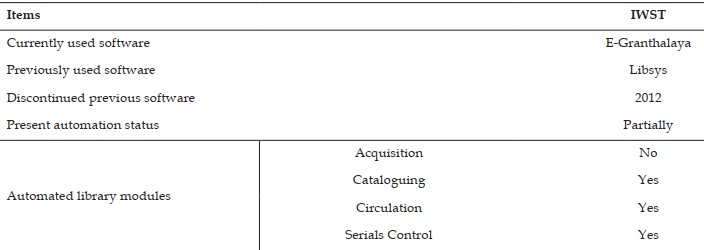
The present study aims to determine the implications and challenges of library automation in the Institute of Wood Science and Technology (IWST) at Bengaluru in Karnataka. This study employed a questionnaire-based survey to collect data. The questionnaires were framed and undergone through the pilot test. MS Excel was used for data tabulation, analysis and interpretation. The result reveals that the IWST library had started its automation with Libsys but could not continue due to high AMC. Subsequently, the library migrated to E-granthalaya software. The findings of this study suggest that users are satisfied with the behaviour of library staff. However, a large number of users, particularly students wished to extend library opening hours.
References
- 1. Ajani, F. O. &Buraimo, O. (2022). “Perceived impact of automation on university library services by library personnel in South West, Nigeria”, Information Development, 38(2), 179–191. https:// doi.org/10.1177/0266666921992089.
- 2. Al-Ansari, H. (2011). “Application of information and communication technologies in special libraries in Kuwait”, The Electronic Library, 29(4),457-469. https://doi.org/10.1108/02640471111156731
- 3. Albee, B. and Chen, H. L. (2014). “Public library staff’s perceived value and satisfaction of an open source library system”, The Electronic Library, 32(3),390-402. https://doi.org/10.1108/ EL-03-2012-0024.
- 4. Anas, M., Iqbal, J. and Ahmad, P. (2014). “Impact of automation on library services in selected management institutes at Aligarh: A survey”, The Electronic Library, 32(3), 296-307. https:// doi.org/10.1108/EL-11-2011-0157
- 5. Ansari,MehtabAlamand Fatima,Shehwar. (2018). Modernisation of Serials Control Systems in Higher Learning Indian Institutes, Serials Review. DOI: 10.1080/00987913.2018.1522183
- 6. Ansari,MehtabAlam(2019). Collection building in academic libraries in India: status, challenges and way forward, Collection and Curation, 38(4), 103-111. https://doi.org/10.1108/CC-09-2017-0043
- 7. Ansari,MehtabAlam, Gautam J. N. and Fatima,Shehwar. (2017). Library Automation in Indian Central Universities: Issues and Challenges, Cataloging& Classification Quarterly, 55(4), 247- 265. DOI: 10.1080/01639374.2017.1302541
- 8. Ansari, MehtabAlam, Gautam, J.N. and Fatima, Shehwar. (2016). Automated Circulation System in Indian Higher Institutional Learning. Indian Journal of Library and Information Science, 10(3), 245-253.
- 9. Asim, M. and Mairaj, M.I. (2019). “Librarians’ perceptions about adoption and uses of the Koha integrated library software in Punjab, Pakistan”, The Electronic Library, 37(4), 624-635. https://doi. org/10.1108/EL-11-2018-0224
- 10. Chaputula, A. and Kanyundo, A. (2019). “Use of Koha-integrated library system by higher education institutions in Malawi”, Digital Library Perspectives, 35(3/4),117-141. https://doi. org/10.1108/DLP-07-2019-0028
- 11. Clayton, M. (2018). Managing Library Automation (2nd ed.). New York: Routledge.
- 12. Egunjobi, R.A. and Awoyemi, R.A. (2012). “Library automation with Koha”, Library Hi Tech News, 29(3),12-15. https://doi. org/10.1108/07419051211241868
- 13. Hopkinson, A. (2009). “Library Automation in Developing Countries: the last 25 years”, Information Development, 25(4), 304-312. https:// doi.org/10.1177/0266666909349678
- 14. Institute of Wood Science and Technology (IWST) – ICFRE. (2024). https://www.icfre.org/instituteof-wood-science-and-technology Accessed on 16.03.2024
- 15. Iqbal, M., Khan, M.K. and Sheikh, A. (2023). “Use of software for automation of academic libraries in Sialkot”, Information Discovery and Delivery, Vol. ahead-of-print No. ahead-of-print. https://doi. org/10.1108/IDD-08-2022-0081.
- 16. Kari, K. Hudron and Baro, E. Emmanuel. (2014). “The use of library software in Nigerian University Libraries and challenges”, Library Hi Tech News, 2014, 31(3), 15-20. https://doi.org/10.1108/ LHTN-09-2013-0053
- 17. Khan, S.A. and Ayesha, G. (2022). “Key features of information management systems (IMSs) for automation in university libraries: a view point of information professionals in Pakistan”, Library Hi Tech, 40(6), 1606-1626. https://doi.org/10.1108/ LHT-04-2020-0087.
- 18. Kolawole, L. Folasade&Oladokun, Taofeek A. (2021). “Utilisation of Open Source Software in Nigeria Academic Libraries: Matters Arising”, Cataloging& Classification Quarterly, 59(4), 399- 407, DOI: 10.1080/01639374.2021.1919268.
- 19. Komolafe-Opadeji, Helen &Ojo, Reuben Abiodun. (2019). “A Survey Study on the Adoption and Implementation of Automation Projects in Federal University Libraries in the South-West of Nigeria”, International Information & Library Review, 51(2),194-201, DOI: 10.1080/10572317.2019.1600784
- 20. Library, Institute of Wood Science and Technology IWST. (2024). https://iwst.icfre.gov.in/library. html Accessed on 16.03.2024.
- 21. Ponelis, S. R., &Adoma, P. (2018). Diffusion of open source integrated library systems in academic libraries in Africa: The case of Uganda. Library Management, 39(6–7), 430–448. https:// doi.org/10.1108/
Data Sharing Statement
There are no additional data available. All raw data and code are available upon request.
Funding
This research received no funding.
Author Contributions
All authors contributed significantly to the work and approve its publication.
Ethics Declaration
This article does not involve any human or animal subjects, and therefore does not require ethics approval.
Acknowledgements
We would like to express our gratitude to the patients, their families, and all those who have contributed to this study.
Conflicts of Interest
No conflicts of interest in this work.
About this article

Cite this article
Naseem Eqbal, Mehtab Alam Ansari Assessment of Library Collection and Services in Automated System in Institute of Wood Science and Technology: Issues and Challenges. Ind J Lib Inf Sci 2024;18(2):155–164.
Licence:
Attribution-Non-commercial 4.0 International (CC BY-NC 4.0)This license enables reusers to distribute, remix, adapt, and build upon the material in any medium or format for noncommercial purposes only, and only so long as attribution is given to the creator.
| Received | Accepted | Published |
|---|---|---|
| May 22, 2024 | July 13, 2024 | August 25, 2024 |
DOI: https://doi.org/10.21088/ijlis.0973.9548.18224.7
Keywords
Library AutomationLibrary SoftwareAutomated Library systemsForest LibraryICTICFRESearch for Similar Articles
Similar Articles
- Information Seeking Behavior of Legal Practitioners in the Digital Era: A Review...
- Prospective Approaches for Artificial Intelligence Integration in Indian School...
- COVID – 19 Pandemic and Readiness on Provision of Library Services in Selected A...
- Digital Library A Channel to Achieve Sustainable Information Society
- Scientometric Analysis and Mapping of Scientific Articles on Green Libraries
Article Level Metrics
Last UpdatedWednesday 21 October 2026, 07:46:59 (IST)
5253
Accesses
10
835
00
Citations
NA
NA
NA
Download citation
Article Keywords
Keyword Highlighting
Highlight selected keywords in the article text.
Timeline
| Received | May 22, 2024 |
| Accepted | July 13, 2024 |
| Published | August 25, 2024 |
licence
Attribution-Non-commercial 4.0 International (CC BY-NC 4.0)
This license enables reusers to distribute, remix, adapt, and build upon the material in any medium or format for noncommercial purposes only, and only so long as attribution is given to the creator.