Full Text (PDF)
Indian Journal of Forensic Medicine and Pathology 13(1 (Special Issue)):p 139-143, January-March 2020. | DOI: 10.21088/ijfmp.0974.3383.13120.18
Original Article
Toxicology of the Various Elements in the Decoction Samples of Lemon Balm and Sage Species
Cennet Yaman, Vugar Ali Turksoy
Author Information
Licence:
Attribution-Non-commercial 4.0 International (CC BY-NC 4.0)This license enables reusers to distribute, remix, adapt, and build upon the material in any medium or format for noncommercial purposes only, and only so long as attribution is given to the creator
Indian Journal of Forensic Medicine and Pathology 13(1 (Special Issue)):p 139-143, January-March 2020. | DOI: 10.21088/ijfmp.0974.3383.13120.18
How Cite This Article:
Yaman C, Turksoy VA. Toxicology of the Various Elements in the Decoction Samples of Lemon Balm and Sage Species. Indian J Forensic Med Pathol. 2020;13(1 Special):139–143.Timeline
Received : January 02, 2020
Accepted : February 02, 2020
Published : March 30, 2020
Abstract
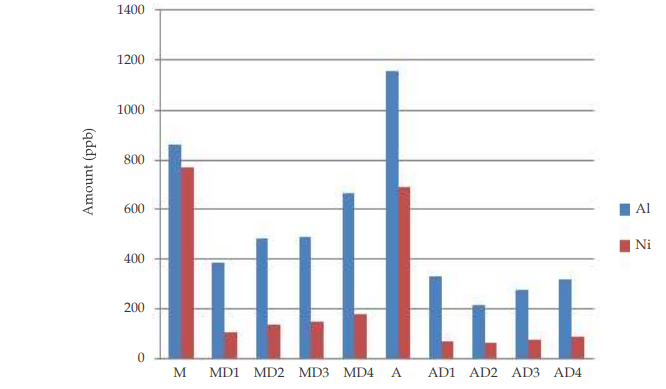
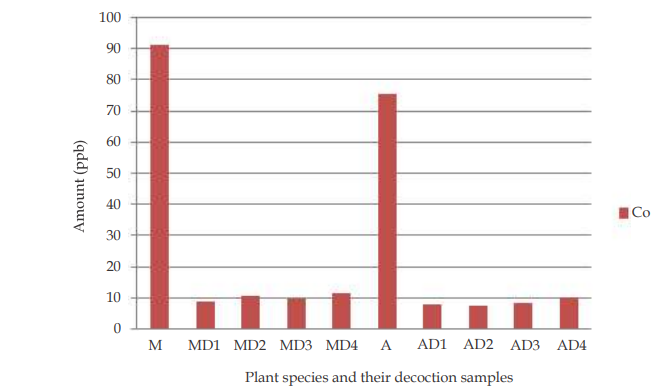
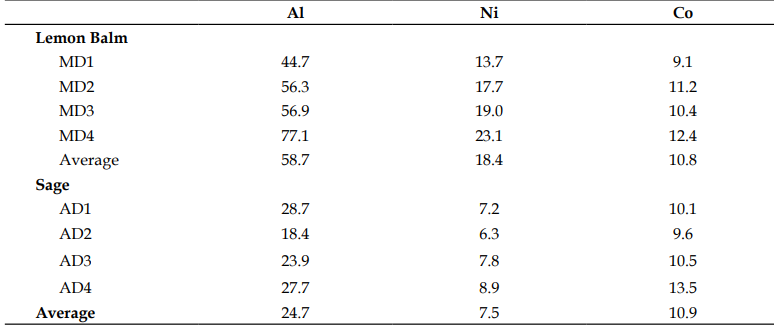
Plants are used for many purposes from past to present. One of them is consumed by people for therapeutic purposes. Some compounds or excessive heavy metal intake during consumption can be harmful to human health. In this study, the amount of Aluminum (Al), Nickel (Ni) and Cobalt (Co), which are toxic elements in the decoction samples obtained with different sample amount (g) and decoction time (min) of Melissa officinalis L. (lemon balm) and Salvia officinalis L. (sage) were investigated. All elements were analyzed by Inductive Coupled Plasma-Mass Spectrophotometer (ICP-MS) at Yozgat Bozok University Science and Technology Application and Research Center. The calibration curve was plotted with 11 points. In both species, the amount of Al was observed to be higher than the other elements. The highest amount of Al was observed in sage plant (1155.6 ppb), while the highest amount of Ni was found in lemon balm (771.3 ppb). In contrast, the maximum amount of Ni and Al was found in the decoction samples of the lemon balm. There was no statistically significant difference between the amounts of Co element in lemon balm and sage decoction samples. In general, increased amount and increased application time of lemon balm plant were found to cause an increase in Al and Ni amounts. As a result, toxicological evaluation of such plants used for their therapeutic properties is important for human and public health.
References
- 1. Alamgir ANM. Therapeutic Use of Medicinal Plants and their Extracts: Volume 2. Phytochemistry and Bioactive Compounds. Springer. Progress in Drug Research Volume 74. 2018.
- 2. Anwar J, Spanevello M, Thomé G, et al. Effects of caffeic acid on behavioral parameters and on the activity of acetylcholinesterase in different tissues from adult rats. Pharmacol Biochem Behav. 2012 Dec;103(2):386–94.
- 3. Baydar H. Tıbbi, Aromatik ve Keyf Bitkileri Bilimi ve Teknolojisi [Science and Technology of Medicinal, Aromatic and Pleasure Plants]. Isparta: Süleyman Demirel Üniversitesi Yayınları; 2005. No: 51.
- 4. Farhat MB, Chaouch-Hamada R, Sotomayor JA, et al. Antioxidant potential of Salvia officinalis L. residues as affected by the harvesting time. Ind Crop Prod. 2014;54:78–85.
- 5. Fecka I, Turek S. Determination of Water-Soluble Polyphenolic Compounds in Commercial Herbal Teas from Lamiaceae: Peppermint, Melissa, and Sage. J Agric Food Chem. 2007;55(26):10908–917.
- 6. Fuh CB, Lin H, Tsai H. Determination of lead, cadmium, chromium, and arsenic in 13 herbs of tocolysis formulation using atomic absorption spectrometry. Journal of Food and Drug Analysis. 2003;11:39–45.
- 7. Fujimoto A, Masuda T. Antioxidation mechanism of rosmarinic acid, identification of an unstable quinone derivative by the addition of odourless thiol. Food Chem. 2012;132:901–06.
- 8. Hernandez-Saavedra D, Perez-Ramirez IF, Ramos-Gomez M, et al. Phytochemical characterization and effect of Calendula officinalis, Hypericum perforatum, and Salvia officinalis infusions on obesity associated cardiovascular risk. Med Chem Res. 2016;25:163–172.
- 9. Isemura M. Catechin in Human Health and Disease. Molecules. 2019 Feb;24(3):528.
- 10. Lima CF, Valentao PC, Andrade PB, et al. Water and methanolic extracts of Salvia officinalis protect HepG2 cells from t-BHP induced oxidative damage. Chem Biol Interact. 2007;167(2):107–115.
- 11. Pereira RP, Boligon AA, Appel AS, et al. Chemical composition, antioxidant and anticholinesterase activity of Melissa officinalis. Ind Crops Prod. 2014;53:34–45.
- 12. Schilcher H (Ed). Leitfaden Phytotherapie. 5th edn. München: Elsevier, Urban & Fischer Verlag; 2016. pp. 224–225.
- 13. Sun ZK, Yang HQ, Chen SD. Traditional Chinese medicine: a promising candidate for the treatment of Alzheimer's disease. Transl Neurodegener. 2013;2(1):1–7.
Data Sharing Statement
There are no additional data available. All raw data and code are available upon request.
Funding
This research received no funding.
Author Contributions
Whether all authors contributed significantly to the work and approve its publication.
Ethics Declaration
This article does not involve any human or animal subjects, and therefore does not require ethics approval.
Acknowledgements
We would like to express our gratitude to the patients, their families, and all those who have contributed to this study.
Conflicts of Interest
The authors report no conflicts of interest in this work.
About this article

Cite this article
Yaman C, Turksoy VA. Toxicology of the Various Elements in the Decoction Samples of Lemon Balm and Sage Species. Indian J Forensic Med Pathol. 2020;13(1 Special):139–143.
Licence:
Attribution-Non-commercial 4.0 International (CC BY-NC 4.0)This license enables reusers to distribute, remix, adapt, and build upon the material in any medium or format for noncommercial purposes only, and only so long as attribution is given to the creator
| Received | Accepted | Published |
|---|---|---|
| January 02, 2020 | February 02, 2020 | March 30, 2020 |
DOI: 10.21088/ijfmp.0974.3383.13120.18
Keywords
SageLemon balmToxicologyICP-MSDecoctionSearch for Similar Articles
Similar Articles
- Diatom Analysis in Thermophilic water bodies: A Study on Hot Water Springs of Ma...
- Morphometric Study of Supra-meatal Triangle and Mastoid process in the Adult dry...
- Histopathological Spectrum of Autopsy Cases: A One Year Retrospective Observatio...
- Forensic Differentiation of Manner of Death in Railway Fatalities: A FourCase Se...
- Understanding assault Patterns: A Cross-sectional study of Cases at Chri, Kelamb...
Article Level Metrics
Last UpdatedMonday 19 October 2026, 17:55:08 (IST)
16352
Accesses
12
3216
00
Citations
NA
NA
NA
Download citation
Article Keywords
Keyword Highlighting
Highlight selected keywords in the article text.
Timeline
| Received | January 02, 2020 |
| Accepted | February 02, 2020 |
| Published | March 30, 2020 |
licence
Attribution-Non-commercial 4.0 International (CC BY-NC 4.0)
This license enables reusers to distribute, remix, adapt, and build upon the material in any medium or format for noncommercial purposes only, and only so long as attribution is given to the creator