Full Text (PDF)
Journal of Orthopedic Education 9(1):p 9-13, January – April 2023. | DOI: 10.21088/joe.2454.7956.9123.1
Original Article
To Study the use of Zoledronic Acid Injection in Senile Osteoporosis
Aditya Agrawal, Narayan Masand, Pradeep Choudhari
Author Information
Licence:
Attribution-Non-commercial 4.0 International (CC BY-NC 4.0)This license enables reusers to distribute, remix, adapt, and build upon the material in any medium or format for noncommercial purposes only, and only so long as attribution is given to the creator.
Journal of Orthopedic Education 9(1):p 9-13, January – April 2023. | DOI: 10.21088/joe.2454.7956.9123.1
How Cite This Article:
Masand N, Agrawal A, Choudhari P. To study the use of zoledronic acid injection in senile osteoporosis. J Orth Edu. 2023;9(1):9–13.Timeline
Received : November 29, 2022
Accepted : December 16, 2022
Published : February 28, 2023
Abstract
Background: Senile osteoporosis is seen in people of age more than 70 years. Senescent bone formation and senile osteoporosis are caused by the differentiation of bone marrow cells into adipocytes, which occurs more frequently than osteoblasts. To identify osteoporosis, a Dual Energy X-ray Absorptiometry (DEXA) scan is employed. T-score and Z-score are used to describe the outcomes. Osteoporosis is defined as a T-score of -2.5 or lower. The bisphosphonate zoledronic acid has demonstrated efficacy in the management of hypercalcemia in multiple myeloma and prostate cancer patients. In the current study, we assess the efficacy of an annual injection of zoledronic acid in treatment of senile osteoporotic patients.
Methodology: The current prospective study was carried out on patients with senile osteoporosis from April 2021 to September 2022 at the Department of Orthopedics, Sri Aurobindo Medical College & Postgraduate Institute, Indore (M.P.). 50 patients with senile osteoporosis 65 years of age and older were enrolled in the study. These individuals were all T-score -2.5 on DEXA scans. After being hydrated with 500ml of intravenous saline solution, these patients received an injection of Zoledronic acid (5mg in 10ml ready to infuse solution). Patients were monitored and assessed for a full year. At each follow-up, the T-score and Z-score were recorded. To determine if the T and Z-scores have improved, the paired "t" test was used. Statistical significance was set at a P value of less than 0.05.
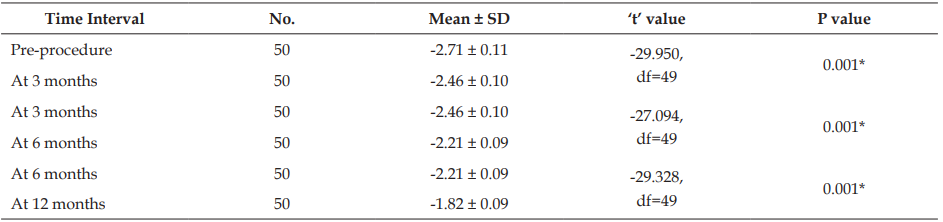
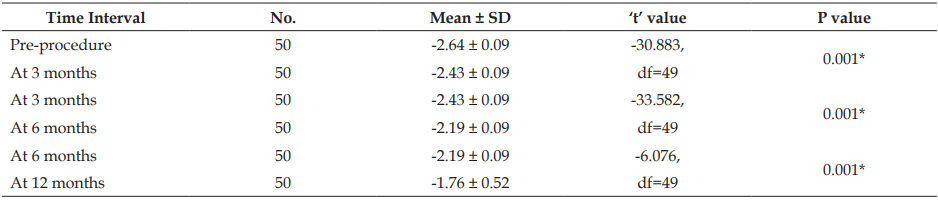
Result: 50 senile osteoporotic patients were included. 52% of them were women and 48% were men. The mean age of the patients was 70.12 ± 5.99 years, ranging from the youngest at 61 to the oldest at 83. In our investigation, we observed diabetes mellitus (36%), hypertension (32%), and asthma (2%). All of the patients had osteoporosis before to receiving the injection, and after 12 months, all of the patients exhibited T-scores indicative of osteopenia. Over the course of a year, there was a noticeable improvement in both the T and Z-scores.
Conclusion: The bone density of patients with senile osteoporosis greatly improved by the once-yearly injection of zoledronic acid. Given that the medication was administered only once a year, patient compliance was likewise very high. For senile osteoporotic patients, we advise using zoledronic acid.
References
- 1. Qadir A, Liang S, Wu Z, Chen Z, Hu L, Qian A. Senile osteoporosis: the involvement of differentiation and senescence of bone marrow stromal cells. Int J Mol Sci. 2020;21(1):349.
- 2. Chadha M, Chaddha R, Divakar H, Kalyan H, Seth S, Shah P. Osteoporosis: epidemiology, pathogenesis, evaluation and treatment. Open J Orthop. 2022;12(4):153–82.
- 3. Heidari B, Khashayar P, Rezai Homami M, Pajouhi A, Soltani A, Larijani B. Dual-energy X-ray absorptiometry diagnostic discordance between Z-scores and T-scores in a young Iranian population. Med J Islam Repub Iran. 2014;28:151.
- 4. WebMD. Bone density scans and bone health screenings [Internet]. WebMD; c2022 [cited 2022 Nov 25].
- 5. Zhang DM, Cui DX, Xu RS, Zhou YC, Zheng LW, Liu P, et al. Phenotypic research on senile osteoporosis caused by SIRT6 deficiency. Int J Oral Sci. 2016;8(2):84–92.
- 6. Fan JB, Tan Y, Tang XS, Dong ZB, Yang L. Rehabilitation assessment and treatment research for senile osteoporosis patients after total knee arthroplasty. Chin J Osteoporos. 2014;20(10):1207–11.
- 7. Gu T, Lawrence E, Stephenson DF, Yu JJ. Physicians’ perspectives on the treatment of osteoporosis patients with bisphosphonates. Clin Interv Aging. 2016;11:1189–94.
- 8. Kennel KA, Drake MT. Adverse effects of bisphosphonates: implications for osteoporosis management. Mayo Clin Proc. 2009;84(7):632–8.
- 9. Kong L, Zuo K, Ma L. Clinical effect of zoledronic acid in the treatment of senile osteoporosis. Pak J Med Sci. 2020;36(7):1703–7.
- 10. Hirsh V, Major PP, Lipton A, Cook RJ, Langer CJ, Smith MR, et al. Zoledronic acid and survival in patients with metastatic bone disease from lung cancer and elevated markers of osteoclast activity. J Thorac Oncol. 2008;3(3):228–36.
- 11. Al Adawi RM, Khanjar I. Assess utility of once yearly IV injection of zoledronic acid 5 mg in treatment of osteoporosis. J Basic Clin Pharm. 2017;8:251–4.
- 12. Wu H, Zheng S, Tian Y, Zhang E, Xing R, Hossain MS, et al. Orthopaedic surgical intervention and type I osteoporosis are risk factors for acute febrile reaction after zoledronic acid treatment for osteoporosis: a case-control study [Preprint]. Research Square; 2021 [cited 2026 Feb 10Liu Z, Li CW, Mao YF, Liu K, Liang BC, Wu LG, et al. Study on zoledronic acid reducing acute bone loss and fracture rates in elderly postoperative patients with intertrochanteric fractures. Orthop Surg. 2019;11(3):380–5.
Data Sharing Statement
There are no additional data available. All raw data and code are available upon request.
Funding
This research received no funding.
Author Contributions
Whether all authors contributed significantly to the work and approve its publication.
Ethics Declaration
This article does not involve any human or animal subjects, and therefore does not require ethics approval.
Acknowledgements
We would like to express our gratitude to the patients, their families, and all those who have contributed to this study.
Conflicts of Interest
The authors report no conflicts of interest in this work.
About this article

Cite this article
Masand N, Agrawal A, Choudhari P. To study the use of zoledronic acid injection in senile osteoporosis. J Orth Edu. 2023;9(1):9–13.
Licence:
Attribution-Non-commercial 4.0 International (CC BY-NC 4.0)This license enables reusers to distribute, remix, adapt, and build upon the material in any medium or format for noncommercial purposes only, and only so long as attribution is given to the creator.
| Received | Accepted | Published |
|---|---|---|
| November 29, 2022 | December 16, 2022 | February 28, 2023 |
DOI: 10.21088/joe.2454.7956.9123.1
Keywords
Senile osteoporosisInjection zoledronic acidZ-scoreDEXA scanSearch for Similar Articles
Similar Articles
- Management of Complex Pelvic Injury: Bilateral Acetabular Fractures with Sacroi...
- Multidisciplinary Management of Acute Knee Pain: Case Report
- A Rare Case of Tenosynovial Giant Cell Tumor of the Thumb: Case Report
- A Rare Case Report: Supracondylar Fracture of Humerus Associated with Vaters Syn...
- Managing Irreparable Radial Head Fracture with Monopolar Radial Head Prosthesis:...
Article Level Metrics
Last UpdatedWednesday 29 July 2026, 00:26:59 (IST)
1568
Accesses
12
129
00
Citations
NA
NA
NA
Download citation
Article Keywords
Keyword Highlighting
Highlight selected keywords in the article text.
Timeline
| Received | November 29, 2022 |
| Accepted | December 16, 2022 |
| Published | February 28, 2023 |
licence
Attribution-Non-commercial 4.0 International (CC BY-NC 4.0)
This license enables reusers to distribute, remix, adapt, and build upon the material in any medium or format for noncommercial purposes only, and only so long as attribution is given to the creator.