Full Text (PDF)
Indian Journal of Anatomy 13(3):p 93-99, July - Sept. 2024. | DOI: https://doi.org/10.21088/ija.2320.0022.13324.1
Original Article
To Analyze Year One Medical Students’ Perceptions Towards Communication Skills at Subbaiah Institute of Medical Sciences
Author Information
Licence:
Attribution-Non-commercial 4.0 International (CC BY-NC 4.0)This license enables reusers to distribute, remix, adapt, and build upon the material in any medium or format for noncommercial purposes only, and only so long as attribution is given to the creator.
Indian Journal of Anatomy 13(3):p 93-99, July - Sept. 2024. | DOI: https://doi.org/10.21088/ija.2320.0022.13324.1
How Cite This Article:
Rao S, D’Sa DS, Rao A, et al. To Analyze Year One Medical Students’ Perceptions towards Communication Skills at Subbaiah Institute of Medical Sciences. Indian J Anat. 2024; 13(3): 93-99.Timeline
Received : August 27, 2024
Accepted : October 05, 2024
Published : November 30, 2024
Abstract
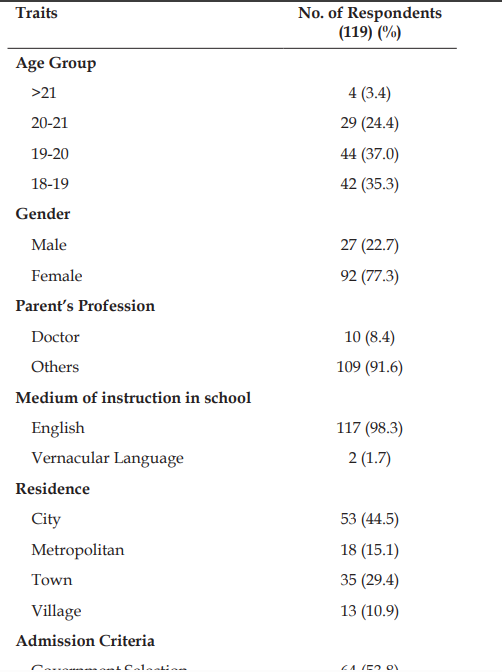
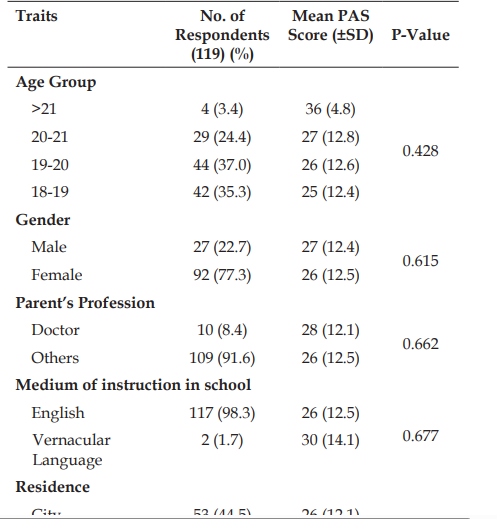
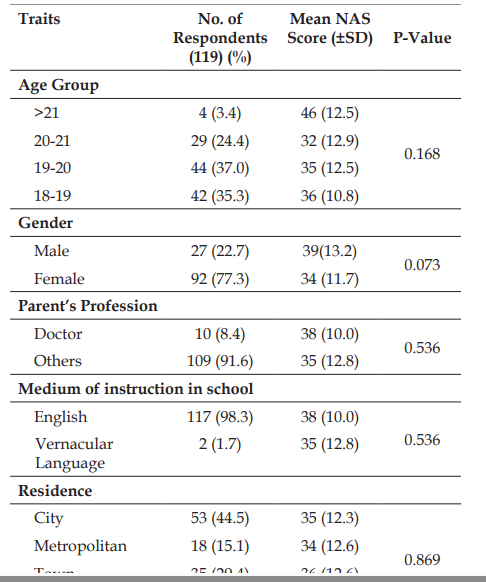
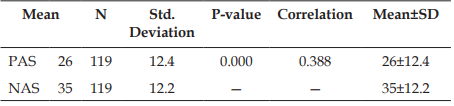
Objectives: The purpose of the current study was to ascertain the knowledge, attitudes, and behaviors of first-year medical students at Subbaiah Institute of Medical Sciences regarding communication abilities. Methods: The Subbaiah Institute of Medical Sciences’ first-year medical students participated in the study. These students study the fundamental scientific courses in an integrated, competency-based curriculum while enrolled in the preclinical part of their program. Recorded were the respondents’ age, gender, and occupation as well as the parents’ jobs, the school’s medium of instruction, their attitude towards communication skills, and their self-evaluation of their communication skills. Appropriate statistical tests (p<0.05) were used to examine the association between the positive and negative attitudes and these variables. Results: A total of 119 students participated in the study; 27(22.7%) were male, and 92(77.3%) are female. 64(53.8%) were government funded and 55(46.2%) were self-funded. The median positive attitude score was 26±12.4. The mean negative attitude scale score was 35±12.2. A highly significant association was noted with attitude towards communication skills (p<0.000). Conclusions: Communication skills training should be modified and strengthened. Regular workshops, and training session on communication skills should be part of ongoing professional development for all the medical students.
References
- 1. Morgan, W. L., & Engel, G. L. (1969). The clinical approach to the patient. Philadelphia: WB Saunders.
- 2. Hargie, O., et al. (1998). A survey of communication skills training in UK schools of medicine. Medical Education, 32, 25–34.
- 3. Novack, D. H., et al. (1993). Medical interviewing and interpersonal skills teaching in US medical schools. JAMA, 269, 2101–2105.
- 4. Benbassat, J., & Baumal, R. (2001). Teaching doctor-patient interviewing skills using an integrated learner and teacher-centred approach. Am J Med Sci, 322, 349–357.
- 5. Batenburg, V., & Smal, J. A. (1997). Does a communication skills course influence medical students’ attitudes? Medical Teacher, 19, 263–269.
- 6. De Monchy, C. (1992). Professional attitudes of doctors and medical teaching. Medical Teacher, 14, 327–331.
- 7. Marteau, T. M., et al. (1991). Factors influencing the communication skills of first-year medical students. Medical Education, 25, 127–134.
- 8. Walker, L. G., et al. (1981). A medical curriculum: evaluation by final-year students. Medical Education, 15, 377–382.
- 9. Rosenthal, J., & Ogden, J. (1998). Changes in medical education: the beliefs of medical students. Medical Education, 32, 127–132.
- 10. Rees, C. E., & Garrud, P. (2001). Identifying undergraduate medical students’ attitudes towards communication skills learning: a pilot study. Medical Teacher, 23, 400–406.
- 11. Rees, C. E., & Sheard, C. (2002). The relationship between medical students’ attitudes towards communication skills learning and their characteristics. Medical Education, 36, 1017–1027.
- 12. Clack, G. B., et al. (2004). Personality differences between doctors and their patients. Medical Education, 38, 177–186.
- 13. Doherty, E., et al. (1992). Communications skills training in undergraduate medicine: attitudes and attitude change. Irish Med J, 85, 104–107.
- 14. Knox, J. D., & Boucher, I. A. (1985). Communication skills teaching, learning and assessment. Medical Education, 19, 285–289.
- 15. Towle, A., & Hoffman, J. (2002). An advanced communication skills course for fourth-year, post-clerkship students. Academic Medicine, 77, 1165–1166.
- 16. De Haes, J. C. J. M., et al. (2001). Assessment of medical students’ communicative behaviour and attitudes. Patient Educ Couns, 45, 35–42.
- 17. Aspegren, K. (1999). BEME guide no. 2: Teaching and learning communication skills in medicine. Medical Teacher, 21, 563–570.
- 18. Rees, C. E., et al. (2002b). A qualitative study to explore undergraduate medical students’ attitudes towards communication skills learning. Medical Teacher, 24, 289–293.
- 19. Wiskin, C. M. D., et al. (2004). Gender as a variable in the assessment of final year degree-level communication skills. Medical Education, 38, 129–137.
Data Sharing Statement
There are no additional data available. All raw data and code are available upon request.
Funding
This research received no funding.
Author Contributions
Whether all authors contributed significantly to the work and approve its publication
Ethics Declaration
This article does not involve any human or animal subjects, and therefore does not require ethics approval.
Acknowledgements
We would like to express our gratitude to the patients, their families, and all those who have contributed to this study.
Conflicts of Interest
The authors report no conflicts of interest in this work.
About this article

Cite this article
Rao S, D’Sa DS, Rao A, et al. To Analyze Year One Medical Students’ Perceptions towards Communication Skills at Subbaiah Institute of Medical Sciences. Indian J Anat. 2024; 13(3): 93-99.
Licence:
Attribution-Non-commercial 4.0 International (CC BY-NC 4.0)This license enables reusers to distribute, remix, adapt, and build upon the material in any medium or format for noncommercial purposes only, and only so long as attribution is given to the creator.
| Received | Accepted | Published |
|---|---|---|
| August 27, 2024 | October 05, 2024 | November 30, 2024 |
DOI: https://doi.org/10.21088/ija.2320.0022.13324.1
Keywords
CommunicationKnowledgeAttitudeBehaviorLearningTrainingSearch for Similar Articles
Similar Articles
- Supernumerary Pulmonary Vein: A Rare Anatomical Variation Observed During Cadave...
- Elongated Styloid Process: Anatomical Variations and Their Clinical Relevance: A...
- Bridging the Gap Between Dissection and Surgery: The Role of Soft Embalming in M...
- A Cadaveric Study of Retro Hepatic Segment of Inferior Vena Cava and Ostia Venae...
- Estimation of Stature from Forearm Length in Medical Undergraduate Students of a...
Article Level Metrics
Last UpdatedTuesday 22 September 2026, 05:26:17 (IST)
5059
Accesses
18
655
00
Citations
NA
NA
NA
Download citation
Article Keywords
Keyword Highlighting
Highlight selected keywords in the article text.
Timeline
| Received | August 27, 2024 |
| Accepted | October 05, 2024 |
| Published | November 30, 2024 |
licence
Attribution-Non-commercial 4.0 International (CC BY-NC 4.0)
This license enables reusers to distribute, remix, adapt, and build upon the material in any medium or format for noncommercial purposes only, and only so long as attribution is given to the creator.