Full Text (PDF)
Indian Journal of Library and Information Sciences 20(2):p 137-143, May - August 2026. | DOI: https://doi.org/10.21088/ijlis.0973.9548.20226.1
Original Article
The Evolution and Landscape of Open Access: A Multi-Platform Bibliometric Analysis (1973–2022)
Author Information
Licence:
Attribution-Non-commercial 4.0 International (CC BY-NC 4.0)This license enables reusers to distribute, remix, adapt, and build upon the material in any medium or format for noncommercial purposes only, and only so long as attribution is given to the creator.
Indian Journal of Library and Information Sciences 20(2):p 137-143, May - August 2026. | DOI: https://doi.org/10.21088/ijlis.0973.9548.20226.1
How Cite This Article:
Alpana Saha, G. Mahesh. The Evolution and Landscape of Open Access: A Multi-Platform Bibliometric Analysis (1973–2022). Ind J Lib Inf Sci 2026; 20 (2): 137–143.Timeline
Received : February 06, 2026
Accepted : March 09, 2026
Published : August 30, 2026
Abstract
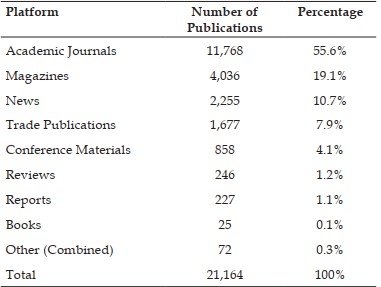
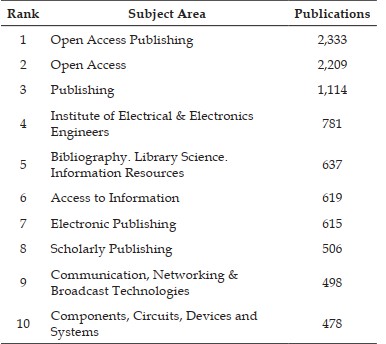
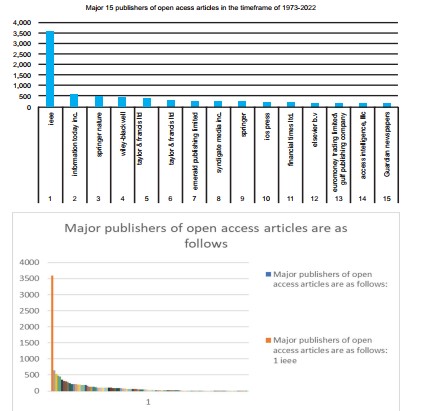
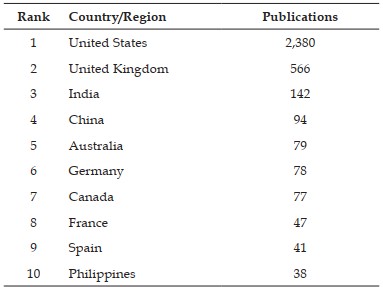
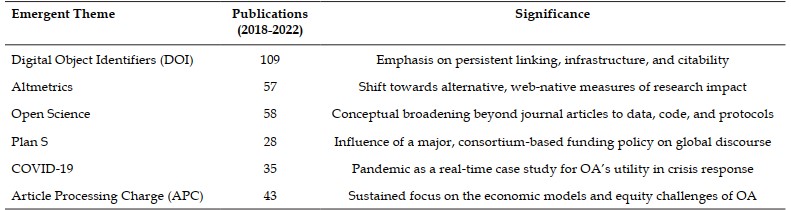
Purpose: This study conducts a comprehensive bibliometric analysis to map the evolution, thematic focus, and geographical dissemination of the global Open Access (OA) movement. Methods: A bibliometric analysis was performed using data from the Factiva database (1973 to mid-2022), encompassing over 20,000 publications from academic journals, news media, magazines, and trade publications. Results: Analysis reveals a dominant and growing engagement with OA in academic literature, led by publishers like IEEE and Springer Nature, with primary thematic focus on engineering, library science, and scholarly publishing. English is the predominant language (>95% of publications), indicating a significant linguistic imbalance. Geographically, contributions are concentrated in the United States and the United Kingdom, though rising output from India, China, and Nigeria suggests gradual diversification. A comparative period analysis (pre-COVID 2017- 2019 vs. 2018-2022) shows a marked acceleration in OA discussions post-2018, with emerging themes including altmetrics, Plan S, and COVID-19. Conclusion: While OA has achieved mainstream status in scholarly communication, persistent inequities in language and geographical representation highlight the need for targeted interventions to foster a truly global and inclusive knowledge commons.
References
- 1. Besançon, L., Peiffer-Smadja, N., Segalas, C., Jiang, H., Masuzzo, P., Smout, C., ... & Leyrat, C. (2021). Open science saves lives: lessons from the COVID-19 pandemic. BMC Medical Research Methodology, *21*(1), 1-18.
- 2. Bohannon, J. (2013). Who’s afraid of peer review? Science, *342*(6154), 60-65.
- 3. Bosman, J., & Kramer, B. (2018). Open access levels: A quantitative exploration using Web of Science and oaDOI data. PeerJ Preprints, *6*, e3520v1.
- 4. Budzinski, O., & Grebel, T. (2022). The economics of Open Access publishing. Journal of Economic Literature, *60*(1), 92-135.
- 5. Laakso, M., Welling, P., Bukvova, H., Nyman, L., Björk, B.C., & Hedlund, T. (2011). The development of open access journal publishing from 1993 to 2009. PLoS ONE, *6*(6), e20961.
- 6. Piwowar, H., Priem, J., Larivière, V., Alperin, J.P., Matthias, L., Norlander, B., ... & Haustein, S. (2018). The state of OA: a large-scale analysis of the prevalence and impact of Open Access articles. PeerJ, *6*, e4375.
- 7. Ramirez, M.L. (2020). Open access and the evolving scholarly communication environment. In Encyclopedia of Library and Information Sciences (4th ed., pp. 3569-3578). CRC Press.
- 8. Solomon, D.J., & Björk, B.C. (2012). A study of open access journals using article processing charges. Journal of the American Society for Information Science and Technology, *63*(8), 1485-1495.
- 9. Tennant, J.P., Waldner, F., Jacques, D.C., Masuzzo, P., Collister, L.B., & Hartgerink, C.H. (2016). The academic, economic and societal impacts of Open Access: an evidence-based review. F1000Research, *5*.
Data Sharing Statement
There are no additional data available. All raw data and code are available upon request.
Funding
This research received no funding.
Author Contributions
All authors contributed significantly to the work and approve its publication.
Ethics Declaration
This article does not involve any human or animal subjects, and therefore does not require ethics approval.
Acknowledgements
We would like to express our gratitude to the patients, their families, and all those who have contributed to this study.
Conflicts of Interest
No conflicts of interest in this work.
About this article

Cite this article
Alpana Saha, G. Mahesh. The Evolution and Landscape of Open Access: A Multi-Platform Bibliometric Analysis (1973–2022). Ind J Lib Inf Sci 2026; 20 (2): 137–143.
Licence:
Attribution-Non-commercial 4.0 International (CC BY-NC 4.0)This license enables reusers to distribute, remix, adapt, and build upon the material in any medium or format for noncommercial purposes only, and only so long as attribution is given to the creator.
| Received | Accepted | Published |
|---|---|---|
| February 06, 2026 | March 09, 2026 | August 30, 2026 |
DOI: https://doi.org/10.21088/ijlis.0973.9548.20226.1
Keywords
Open AccessBibliometricsScholarly communicationPublication trends FactivaCOVID-19 impactScientometricsKnowledge disseminationSearch for Similar Articles
Similar Articles
- Information Seeking Behavior of Legal Practitioners in the Digital Era: A Review...
- Assessment of Library Collection and Services in Automated System in Institute o...
- Prospective Approaches for Artificial Intelligence Integration in Indian School...
- COVID – 19 Pandemic and Readiness on Provision of Library Services in Selected A...
- Digital Library A Channel to Achieve Sustainable Information Society
Article Level Metrics
Last UpdatedSunday 18 October 2026, 23:04:31 (IST)
5213
Accesses
33
835
00
Citations
NA
NA
NA
Download citation
Article Keywords
Keyword Highlighting
Highlight selected keywords in the article text.
Timeline
| Received | February 06, 2026 |
| Accepted | March 09, 2026 |
| Published | August 30, 2026 |
licence
Attribution-Non-commercial 4.0 International (CC BY-NC 4.0)
This license enables reusers to distribute, remix, adapt, and build upon the material in any medium or format for noncommercial purposes only, and only so long as attribution is given to the creator.