Full Text (PDF)
Indian Journal of Library and Information Sciences 20(2):p 145-151, May - August 2026. | DOI: https://doi.org/10.21088/ijlis.0973.9548.20226.2
Original Article
One Nation, One Subscription (ONOS): A Paradigm Shift in Academic Information Access and Research Equity
Author Information
Licence:
Attribution-Non-commercial 4.0 International (CC BY-NC 4.0)This license enables reusers to distribute, remix, adapt, and build upon the material in any medium or format for noncommercial purposes only, and only so long as attribution is given to the creator.
Indian Journal of Library and Information Sciences 20(2):p 145-151, May - August 2026. | DOI: https://doi.org/10.21088/ijlis.0973.9548.20226.2
How Cite This Article:
Debdas Mondal. One Nation, One Subscription (ONOS): A Paradigm Shift in Academic Information Access and Research Equity. Ind J Lib Inf Sci 2026; 20 (2): 145–151.Timeline
Received : November 20, 2025
Accepted : December 27, 2025
Published : August 30, 2026
Abstract
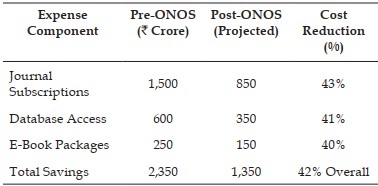
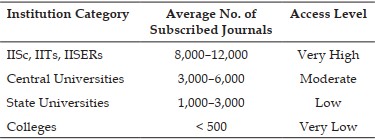
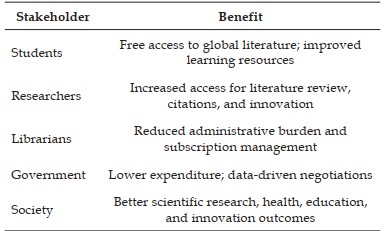
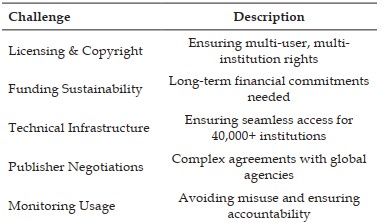
The uneven distribution of scholarly electronic resources across Indian higher education institutions continues to hinder research productivity, teaching quality, and academic equity. Elite institutions enjoy extensive journal and database access, while state universities and colleges face significant limitations due to high subscription costs and fragmented procurement models. This study evaluates the feasibility and impact of an Open National Online Subscriptions (ONOS) model as a centralised framework for improving access to e-resources in India. Using a mixed-method approach that integrates secondary data analysis, comparative evaluation, and policy review, the study examines cost reductions, access disparities, stakeholder benefits, and implementation challenges associated with ONOS. Findings indicate that national-level negotiations and centralised subscriptions could reduce overall expenditure by more than 40%, significantly minimise resource duplication, and ensure equitable access for all institutions. Furthermore, ONOS strengthens national negotiation power, enhances research quality, and aligns with global best practices in digital scholarship. However, issues related to licensing, technological infrastructure, and funding sustainability must be addressed to ensure successful adoption. Overall, the study highlights ONOS as a transformative and sustainable solution capable of advancing India’s research ecosystem and promoting inclusive knowledge development.
References
- 1. Björk, B.C. (2017). Scholarly journal publishing in transition—from restricted to open access. Electronic Markets, 27(2), 101–109.
- 2. Chakraborty, M., & Singh, S. (2019). Library consortia in India: Growth, issues, and challenges. DESIDOC Journal of Library & Information Technology, 39(2), 65–72.
- 3. INFLIBNET Centre. (2020). E-Shodh Sindhu: Consortium for Higher Education Electronic Resources. University Grants Commission. https://ess.inflibnet.ac.in/
- 4. Jisc. (2021). Transformative agreements and national subscription models: A global overview. Jisc Publications.
- 5. Kumar, V., & Panda, K.C. (2022). National digital library initiatives in India: Progress, challenges, and future prospects. Annals of Library and Information Studies, 69(1), 15–24.
- 6. Madhusudhan, M. (2018). Access and use of electronic resources in academic libraries: A review of recent literature. Library Review, 67(3), 229–249.
- 7. Mehta, D., & Shah, C. (2021). Evaluating the impact of digital library consortia on research productivity in India. Journal of Academic Librarianship, 47(5), 102373.
- 8. MoE (Ministry of Education). (2023). National Policy for Digital Education and E-Resources. Government of India.
- 9. Pujar, S.M., & Mahesh, G. (2018). E-resource consortia in India: Models, best practices, and sustainability issues. International Information and Library Review, 50(4), 287–296.
- 10. Suber, P. (2012). Open Access. MIT Press.
- 11. UGC. (2022). Guidelines for strengthening access to electronic resources in higher education institutions. University Grants Commission, Government of India.
- 12. UNESCO. (2021). Open Science Framework: Policy recommendations for member states. UNESCO Publications.
Data Sharing Statement
There are no additional data available. All raw data and code are available upon request.
Funding
This research received no funding.
Author Contributions
All authors contributed significantly to the work and approve its publication.
Ethics Declaration
This article does not involve any human or animal subjects, and therefore does not require ethics approval.
Acknowledgements
We would like to express our gratitude to the patients, their families, and all those who have contributed to this study.
Conflicts of Interest
No conflicts of interest in this work.
About this article

Cite this article
Debdas Mondal. One Nation, One Subscription (ONOS): A Paradigm Shift in Academic Information Access and Research Equity. Ind J Lib Inf Sci 2026; 20 (2): 145–151.
Licence:
Attribution-Non-commercial 4.0 International (CC BY-NC 4.0)This license enables reusers to distribute, remix, adapt, and build upon the material in any medium or format for noncommercial purposes only, and only so long as attribution is given to the creator.
| Received | Accepted | Published |
|---|---|---|
| November 20, 2025 | December 27, 2025 | August 30, 2026 |
DOI: https://doi.org/10.21088/ijlis.0973.9548.20226.2
Keywords
ONOSe-resourcesNational subscription modelDigital librariesHigher educationAccess equityScholarly communicationIndiaSearch for Similar Articles
Similar Articles
- Information Seeking Behavior of Legal Practitioners in the Digital Era: A Review...
- Assessment of Library Collection and Services in Automated System in Institute o...
- Prospective Approaches for Artificial Intelligence Integration in Indian School...
- COVID – 19 Pandemic and Readiness on Provision of Library Services in Selected A...
- Digital Library A Channel to Achieve Sustainable Information Society
Article Level Metrics
Last UpdatedSunday 18 October 2026, 21:57:22 (IST)
5212
Accesses
41
835
00
Citations
NA
NA
NA
Download citation
Article Keywords
Keyword Highlighting
Highlight selected keywords in the article text.
Timeline
| Received | November 20, 2025 |
| Accepted | December 27, 2025 |
| Published | August 30, 2026 |
licence
Attribution-Non-commercial 4.0 International (CC BY-NC 4.0)
This license enables reusers to distribute, remix, adapt, and build upon the material in any medium or format for noncommercial purposes only, and only so long as attribution is given to the creator.