Full Text (PDF)
Indian Journal of Anatomy 8(4):p 283-288, October-December 2019. | DOI: http://dx.doi.org/10.21088/ija.2320.0022.8419.6
Original Article
Sexual Dimorphism in Adult Human Mandible of South Indian Origin
Zafar Sultana , Zafar Sultana1 , T Sreekanth2 , S Niveditha
Author Information
Licence:
Indian Journal of Anatomy 8(4):p 283-288, October-December 2019. | DOI: http://dx.doi.org/10.21088/ija.2320.0022.8419.6
How Cite This Article:
Zafar Sultana, T Sreekanth, S Niveditha. Sexual Dimorphism in Adult Human Mandible of South Indian Origin. Indian J Anat. 2019;8(4):283–288.
Timeline
Received : N/A
Accepted : N/A
Published : N/A
Abstract
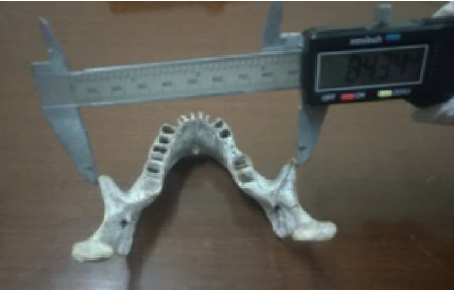
Background: Mandible is the most durable and sexually dimorphic bone of the skull and resists postmortem changes too. Sexual dimorphism is seen in stages of mandibular development, growth rates and duration. Even by simple observation there is clear difference in size, height, thickness and muscle markings of mandible. Context and purpose: To establish and compare few metric parameters to assess sexual dimorphism in adult human mandibles of south Indian population. Methods: The present study was conducted on 60 dry adult human mandibles collected from anatomy dept of Shadan Institute of Medical Sciences and VRK Womens Medical College, Hyderabad. Only adult intact mandibles were included in study damaged, deformed broken bones excluded from study. First we classified bones depending on morphological features/non-metric parameters into males and females. Non-metric parameters were also recorded. Results: The mean bigonial breadth was 93.62 mm in males compared to 80.78 mm in females. Thus it was more in males compared to females and this difference was found out to be statistically significant. The bicoronoid breadth was 91.09 mm in males compared to 84.24 mm in females. Thus the bicoronoid breadth was more in males compared to females and this difference was found out to be statistically significant. Mandibular body height was significantly different for males and females mean for males was 28.13 mm and for females mean was 25.40 mm. Parameters like the mean bicondylar breadth, bimental breadth were not significantly different in males and females. Conclusion: The mean bigonial breadth, mean bicoronoid breadth and mandibular body height was significantly more in males compared to females. But other parameters were similar in both the sexes. Potential implications: Sexual dimorphism of skull is population specific due to combination of genetic as well as environmental factors. Racial and ethnic differences are also there. These metric data are useful for medicolegal, anthropological and dentofacial surgical procedures also.
References
No records found.
About this article

Cite this article
Zafar Sultana, T Sreekanth, S Niveditha. Sexual Dimorphism in Adult Human Mandible of South Indian Origin. Indian J Anat. 2019;8(4):283–288.
Licence:
| Received | Accepted | Published |
|---|---|---|
| N/A | N/A | N/A |
DOI: http://dx.doi.org/10.21088/ija.2320.0022.8419.6
Keywords
Sexual dimorphism; Human mandible; South Indian; Bigonial breadth; Bicondylar breadth; Bimental breadth; bicoronoid breadth; Mandibular body height.Search for Similar Articles
Similar Articles
- Supernumerary Pulmonary Vein: A Rare Anatomical Variation Observed During Cadave...
- Elongated Styloid Process: Anatomical Variations and Their Clinical Relevance: A...
- Bridging the Gap Between Dissection and Surgery: The Role of Soft Embalming in M...
- A Cadaveric Study of Retro Hepatic Segment of Inferior Vena Cava and Ostia Venae...
- Estimation of Stature from Forearm Length in Medical Undergraduate Students of a...
Article Level Metrics
Last UpdatedSunday 20 September 2026, 22:39:42 (IST)
5038
Accesses
11
601
00
Citations
NA
NA
NA
Download citation
Article Keywords
Keyword Highlighting
Highlight selected keywords in the article text.
Timeline
| Received | N/A |
| Accepted | N/A |
| Published | N/A |