Full Text (PDF)
Indian Journal of Anatomy 12(1):p 31-40, January-March 2023. | DOI: https://doi.org/10.21088/ija.2320.0022.12123.3
Original Article
Role of Indigenous Modified Splint for Management of Stiffness of Finger during the COVID-19 Crisis
Ravi Kumar Chittoria, Neljo Thomas, Nishad K null, Barath Kumar Singh, Jacob Antony Chakiath
Author Information
Licence:
Attribution-Non-commercial 4.0 International (CC BY-NC 4.0)This license enables reusers to distribute, remix, adapt, and build upon the material in any medium or format for noncommercial purposes only, and only so long as attribution is given to the creator.
Indian Journal of Anatomy 12(1):p 31-40, January-March 2023. | DOI: https://doi.org/10.21088/ija.2320.0022.12123.3
How Cite This Article:
Thomas N, Chittoria RK, Nishad K, et al. Role of indigenous modified splint for management of stiffness of finger during the COVID-19 crisis. Indian J Anat. 2023;12(1):31–4.Timeline
Received : December 13, 2023
Accepted : December 26, 2023
Published : January 30, 2023
Abstract
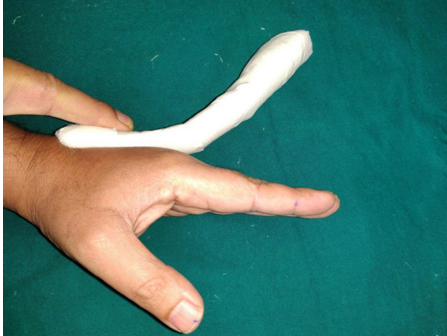
Stiff finger is a common condition found among the elder population due to various types of arthritis. In the younger age group, it occurs usually as a sequel of trauma. It is a difficult condition to treat and follow up. Patient cooperation and strict adherence to exercise routines are paramount for the success of the treatment of stiff fingers. The ideal treatment includes the release of the adhesions and active physiotherapy. However, because of the covid 19 crisis, the usual treatments for the various disease have been compromised due to lack of travel, transport, the need to maintain social distancing, etc. We devised our own splint management for stiff fingers and found it too useful.
References
- 1. Young VL, Wray RC, Weeks PM. The surgical management of stiff joints in the hand. Plast Reconstr Surg. 1978;62(6):835–41.
- 2. Houshian S, Jing SS, Chikkamuniyappa C, Emami-Moghaddam Tehrani M. Management of posttraumatic proximal interphalangeal joint contracture. J Hand Surg Am. 2015;40(10):2081–4.
- 3. Michlovitz SL, Harris BA, Watkins MP. Therapy interventions for improving joint range of motion: a systematic review. J Hand Ther. 2004;17(2):118–31.
- 4. Weeks PM, Wray RC, Kuxhaus M. The results of nonoperative management of stiff joints in the hand. Plast Reconstr Surg. 1978;62(4):581–4.
- 5. Glasgow C, Wilton J, Tooth L. Optimal daily total end range time for contracture: resolution in hand splinting. J Hand Ther. 2003;16(3):207–18.
- 6. Flowers KR, LaStayo P. Effect of total end range time on improving passive range of motion. J Hand Ther. 1994;7(3):150–7.
- 7. Flowers KR. A proposed decision hierarchy for splinting the stiff joint, with an emphasis on force application parameters. J Hand Ther. 2002;15(2):158–62.
- 8. Agee JM, Goss BC. Use of skeletal extension torque in reversing Dupuytren contractures of the proximal interphalangeal joint. J Hand Surg Am. 2012;37(7):1467–74.
- 9. Houshian S, Chikkamuniyappa C, Schroeder H. Gradual joint distraction of post-traumatic flexion contracture of the proximal interphalangeal joint by a mini-external fixator. J Bone Joint Surg Br. 2007;89(2):206–9.
- 10. Houshian S, Jing SS, Kazemian GH, Emami-Moghaddam Tehrani M. Distraction for proximal interphalangeal joint contractures: long-term results. J Hand Surg Am. 2013;38(10):1951–6.
- 11. Houshian S, Chikkamuniyappa C. Distraction correction of chronic flexion contractures of PIP joint: comparison between two distraction rates. J Hand Surg Eur Vol. 2007;32(5):651–6.
Data Sharing Statement
There are no additional data available. All raw data and code are available upon request.
Funding
This research received no funding.
Author Contributions
Whether all authors contributed significantly to the work and approve its publication.
Ethics Declaration
This article does not involve any human or animal subjects, and therefore does not require ethics approval.
Acknowledgements
We would like to express our gratitude to the patients, their families, and all those who have contributed to this study.
Conflicts of Interest
The authors report no conflicts of interest in this work.
About this article

Cite this article
Thomas N, Chittoria RK, Nishad K, et al. Role of indigenous modified splint for management of stiffness of finger during the COVID-19 crisis. Indian J Anat. 2023;12(1):31–4.
Licence:
Attribution-Non-commercial 4.0 International (CC BY-NC 4.0)This license enables reusers to distribute, remix, adapt, and build upon the material in any medium or format for noncommercial purposes only, and only so long as attribution is given to the creator.
| Received | Accepted | Published |
|---|---|---|
| December 13, 2023 | December 26, 2023 | January 30, 2023 |
DOI: https://doi.org/10.21088/ija.2320.0022.12123.3
Keywords
Stiff fingerCOVID-19Corona pandemicSearch for Similar Articles
Similar Articles
- Supernumerary Pulmonary Vein: A Rare Anatomical Variation Observed During Cadave...
- Elongated Styloid Process: Anatomical Variations and Their Clinical Relevance: A...
- Bridging the Gap Between Dissection and Surgery: The Role of Soft Embalming in M...
- A Cadaveric Study of Retro Hepatic Segment of Inferior Vena Cava and Ostia Venae...
- Estimation of Stature from Forearm Length in Medical Undergraduate Students of a...
Article Level Metrics
Last UpdatedTuesday 22 September 2026, 00:54:27 (IST)
5057
Accesses
23
655
00
Citations
NA
NA
NA
Download citation
Article Keywords
Keyword Highlighting
Highlight selected keywords in the article text.
Timeline
| Received | December 13, 2023 |
| Accepted | December 26, 2023 |
| Published | January 30, 2023 |
licence
Attribution-Non-commercial 4.0 International (CC BY-NC 4.0)
This license enables reusers to distribute, remix, adapt, and build upon the material in any medium or format for noncommercial purposes only, and only so long as attribution is given to the creator.