Full Text (PDF)
Indian Journal of Anatomy 14(3):p 87-93, Sept. Dec 2025. | DOI: https://doi.org/10.21088/ija.2320.0022.14325.2
Original Article
Surgeons’ Perspectives on Cadaveric Dissection in Medical Education: A Cross-Sectional Study
Soumitra Trivedi, Ripudaman Arora, Mrithunjay Rathore
Author Information
Licence:
Attribution-Non-commercial 4.0 International (CC BY-NC 4.0)This license enables reusers to distribute, remix, adapt, and build upon the material in any medium or format for noncommercial purposes only, and only so long as attribution is given to the creator.
Indian Journal of Anatomy 14(3):p 87-93, Sept. Dec 2025. | DOI: https://doi.org/10.21088/ija.2320.0022.14325.2
How Cite This Article:
Soumitra Trivedi, Ripudaman Arora, Mrithunjay Rathore. Surgeons’ Perspectives on Cadaveric Dissection in Medical Education: A Cross-Sectional Study. Ind Jr Anat. 2025; 14(3): 87-93.Timeline
Received : August 04, 2025
Accepted : September 05, 2025
Published : December 30, 2025
Abstract
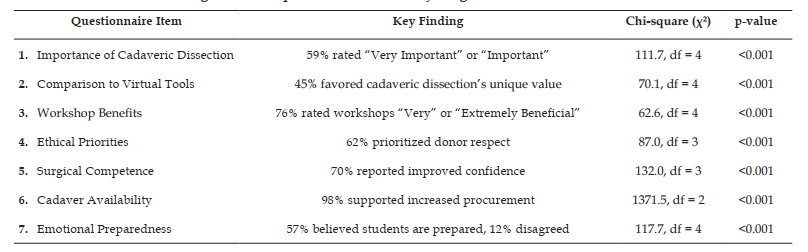
Background: Cadaveric dissection remains a cornerstone of medical education, offering unparalleled anatomical insight, though its relevance is debated with advancements in digital simulation. This study evaluates surgeons’ perceptions of cadaveric dissection’s educational value during workshops. Aim: To assess the educational benefits of cadaveric dissection in surgical training at the Department of Anatomy, AIIMS Raipur. Objectives: 1. Evaluate the role of cadaveric dissection in enhancing surgical skills. 2. Assess its contribution to anatomical understanding. 3. Compare its effectiveness against digital simulation tools. Material: A cross-sectional study was conducted with surgeons participating in cadaver-based workshops at AIIMS Raipur. A structured questionnaire assessed perceptions of educational value. Data were analyzed using Chi-square goodnessof-fit tests (p < 0.05). Result: Among sixty four respondents, there was strong consensus supporting cadaveric dissection’s educational value (p < 0.001). Surgeons emphasized its critical role in deepening anatomical knowledge and refining surgical techniques, citing hands-on experience as superior to digital alternatives. No significant differences were found across experience levels or specialties, indicating broad agreement on its utility
References
- 1. Kalthur S.G., Pandey A.K., Prabhath S. Cadaveric dissection in medical education: A historical perspective. Anat Sci Educ. 2022; 15(1): 22-30.
- 2. Farfán E., Vargas M., Fernández J. Anatomical dissection and its impact on surgical proficiency. Clin Anat. 2023; 36(2): 88-95.
- 3. Asante E.A., Chen Y., Lee M.J. The role of cadaveric dissection in modern medical education. J Med Educ. 2021; 20(3): 45-52.
- 4. Ghazanfar H., Rashid S., Hussain A. Cadaveric dissection for surgical training: A systematic review. Med Teach. 2018; 40(6): 567-73.
- 5. American College of Surgeons. Guidelines for cadaver-based surgical training. Chicago: ACS Publications; 2023.
- 6. Balta J.Y., Cronin M., Cryan J.F. Cadaver-based simulation in surgical training. Surg Educ. 2017; 15(4): 201-9.
- 7. Sharma A., Kumar P., Singh R. Cadaveric workshops for neurosurgical training. J Neurosurg Sci. 2020; 64(5): 432-8.
- 8. Biasutto S.N., Sharma N., McBride J. Teaching anatomy: Cadavers vs. computers? Ann Anat. 2014; 196(4): 237-41.
- 9. Nwachukwu C., Lachance S., Lee K. Cadaveric vs. virtual reality training in arthroscopy. J Orthop Res. 2023; 41(7): 1420-8.
- 10. Balta J.Y., Twomey M., Moloney F. Cadaverbased simulation for surgical training: A review. Surg Innov. 2021; 28(5): 622-30.
- 11. Kumar R., Singh A., Pandey S. Controlled cadaveric exposure for first-year medical students. Med Educ Online. 2023; 28(1): 215-23.
- 12. Goyal S., Patel R., Singh V. Role of cadaveric labs in neurosurgical training. J Neurosurg Sci. 2022; 66(4): 298-305.
- 13. Chen J., Wong A., Lee S. Cadaveric workshops for reconstructive surgery training. Plast Reconstr Surg. 2024; 153(2): 345-52.
- 14. Sugand K., Abrahams P., Khurana A. The anatomy of anatomy: A review for its modernization. Anat Sci Educ. 2010; 3(2): 83-93
- 15. McLachlan J.C., Bligh J, Bradley P. Teaching anatomy without cadavers. Med Educ. 2004;
- 16. Eisma R., Wilkinson T. From “silent teachers” to models: Cadaveric dissection in surgical training. PLoS Med. 2014; 11(10): e1001748.
- 17. Horiuchi-Hirose M., Fukuoka T., Shinji K. Learning outcomes of nursing students’ experience with cadaveric dissection: A scoping review. SAGE Open Nurs. 2024; 10: 23779608241274543.
- 18. Jeyakumar J., Dissanayake M. Dissection in the modern medical curriculum: An exploration into student perception and adaptations for the future. Anat Sci Educ. 2020; 13(3): 366-74.
- 19. BMJ. The first patient: Cadaveric dissection in medical education. BMJ. 2024; 368: m1234.
- 20. Fruhstorfer B.H., Palmer J., Brydges S. Emotional impact of cadaveric dissection on medical students. Clin Anat. 2011; 24(6): 747-53.
- 21. Asante E.A., Maalman R.S., Ali M.A., Donkor Y.O., Korpisah J.K. Perception and Attitude of Medical Students towards Cadaveric Dissection in Anatomical Science Education. Ethiop J Health Sci. 2021; 31(4): 867-874. DOI: 10.4314/ejhs.v31i4.22.
- 22. Solanke K., Kulkarni D., Shekokar A. Role of traditional cadaveric dissection in learning – Perceptions of 1st MBBS students. MedPulse Int J Anat. 2018; 7(1).
- 23. Kochhar S., Tasnim T., Gupta A. Is cadaveric dissection essential in medical education? A qualitative survey comparing pre-and postCOVID-19 anatomy courses. J Osteopath Med. 2022; 122(10): 557-564. DOI: 10.1515/jom-2022- 0016
Data Sharing Statement
There are no additional data available. All raw data and code are available upon request.
Funding
This research received no funding.
Author Contributions
All authors contributed significantly to the work and approve its publication.
Ethics Declaration
This article does not involve any human or animal subjects, and therefore does not require ethics approval.
Acknowledgements
We would like to express our gratitude to the patients, their families, and all those who have contributed to this study.
Conflicts of Interest
No conflicts of interest in this work.
About this article

Cite this article
Soumitra Trivedi, Ripudaman Arora, Mrithunjay Rathore. Surgeons’ Perspectives on Cadaveric Dissection in Medical Education: A Cross-Sectional Study. Ind Jr Anat. 2025; 14(3): 87-93.
Licence:
Attribution-Non-commercial 4.0 International (CC BY-NC 4.0)This license enables reusers to distribute, remix, adapt, and build upon the material in any medium or format for noncommercial purposes only, and only so long as attribution is given to the creator.
| Received | Accepted | Published |
|---|---|---|
| August 04, 2025 | September 05, 2025 | December 30, 2025 |
DOI: https://doi.org/10.21088/ija.2320.0022.14325.2
Keywords
Cadaveric dissectionSurgical educationSkill developmentMedical educationVirtual anatomySearch for Similar Articles
Similar Articles
- Supernumerary Pulmonary Vein: A Rare Anatomical Variation Observed During Cadave...
- Elongated Styloid Process: Anatomical Variations and Their Clinical Relevance: A...
- Bridging the Gap Between Dissection and Surgery: The Role of Soft Embalming in M...
- A Cadaveric Study of Retro Hepatic Segment of Inferior Vena Cava and Ostia Venae...
- Estimation of Stature from Forearm Length in Medical Undergraduate Students of a...
Article Level Metrics
Last UpdatedSunday 20 September 2026, 21:56:53 (IST)
5038
Accesses
18
601
00
Citations
NA
NA
NA
Download citation
Article Keywords
Keyword Highlighting
Highlight selected keywords in the article text.
Timeline
| Received | August 04, 2025 |
| Accepted | September 05, 2025 |
| Published | December 30, 2025 |
licence
Attribution-Non-commercial 4.0 International (CC BY-NC 4.0)
This license enables reusers to distribute, remix, adapt, and build upon the material in any medium or format for noncommercial purposes only, and only so long as attribution is given to the creator.