Full Text (PDF)
New Indian Journal of Surgery 17(2):p 79-82, April-June 2026. | DOI: https://doi.org/10.21088/nijs.0976.4747.17226.7
Case Report
Role of Autologous Platelet-Rich Plasma Spray in an Adult with Electrical Burns
Ravi Kumar Chittoria, Suryanarayanan null, Srinath Rajasekar
Author Information
Licence:
Attribution-Non-commercial 4.0 International (CC BY-NC 4.0)This license
enables reusers to distribute, remix, adapt, and build upon the material in any
medium or format for noncommercial purposes only, and only so long as
attribution is given to the creator.
New Indian Journal of Surgery 17(2):p 79-82, April-June 2026. | DOI: https://doi.org/10.21088/nijs.0976.4747.17226.7
How Cite This Article:
Suryanarayanan, Ravi Kumar Chittoria, Srinath Rajasekar Suryanarayanan. Role of Autologous Platelet-Rich Plasma Spray in an Adult with Electrical Burns. New Indian J Surg. 2025; 17(2): 79-82.Timeline
Received : March 05, 2026
Accepted : April 10, 2026
Published : June 30, 2026
Abstract
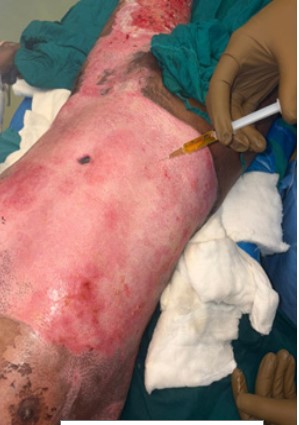
Electrical burns constitute a complex subset of thermal injuries characterized by deep tissue damage and impaired wound healing. Autologous platelet-rich plasma (APRP) has emerged as a regenerative adjunct due to its high concentration of growth factors that enhance angiogenesis, fibroblast proliferation, and collagen synthesis. We report a case of a 46-year-old male with 40% total body surface area (TBSA) electrical burns (mixed second- and third-degree). APRP spray was applied over superficial second-degree burn areas in three sequential dressings alongside collagen scaffold application. Wound healing was assessed using the Bates-Jensen Wound Assessment Tool (BJWAT). Over six days, the BJWAT score reduced from 25 to 20, indicating improvement in wound status with reduction in exudate, improved granulation, and epithelialization. No adverse effects were noted. This case highlights the potential role of APRP spray as a regenerative adjunct in adult electrical burns to accelerate wound healing and improve wound bed preparation.
References
- 1. Bayat A., Ramaiah R., Bhananker S.M. Analgesia and sedation for children undergoing burn wound care. Expert Rev Neurother. 2010; 10: 1747–59.
- 2. Barrow R.E., Spies M., Barrow L.N., Herndon D.N. Influence of demographics and inhalation injury on burn mortality in children. Burns. 2004; 30: 72–7.
- 3. Shelley O.P., Van Niekerk W., Cuccia G, Watson SB. Dual benefit procedures: Combining aesthetic surgery with burn reconstruction. Burns. 2006; 32: 1022–7.
- 4. Munster AM, Smith-Meek M, Sharkey P. The effect of early surgical intervention on mortality and cost-effectiveness in burn care, 1978–91. Burns. 1994;20:61–4.
- 5. Alves R., Grimalt R. Randomized placebocontrolled double-blind study to assess the efficacy of platelet-rich plasma. Dermatol Surg. 2016; 42: 491–7.
- 6. Sánchez-González D.J., Méndez-Bolaina E., Trejo-Bahena N.I. Platelet-rich plasma peptides: key for regeneration. Int J Pept. 2012; 2012: 532519.
- 7. Anitua E., Andia I., Ardanza B., Nurden P., Nurden A.T. Autologous platelets as a source of proteins for healing and tissue regeneration. Thromb Haemost. 2004; 91: 4–15.
- 8. Salazar-Álvarez A.E., Riera-del-Moral L.F., García-Arranz M., Alvarez-García J., Concepción-Rodriguez NA, Riera-de-Cubas L. Use of platelet-rich plasma in chronic ulcers. Actas Dermosifiliogr. 2014; 105: 597–604.
- 9. Picard F., Hersant B., Bosc R., Meningaud J.P. Should we use platelet-rich plasma as adjunct therapy to treat burns? Wound Repair Regen. 2015; 23: 163–70.
- 10. Cobos R., Aizpuru F., Parraza N., Anitua E., Orive G. Effectiveness of platelet-rich plasma in wound treatment. Curr Pharm Biotechnol. 2015; 16: 630–6.
- 11. Sclafani A.P., Azzi J. Platelet preparations for facial rejuvenation and wound healing. Aesthetic Plast Surg. 2015; 39: 495–505.
- 12. Conde Montero E. PRP in wound healing. In: Alves R., Grimalt R., editors. Clinical Indications and Treatment Protocols with PRP in Dermatology. Barcelona: Ediciones Mayo; 2016. pp. 59–72.
- 13. Kim D.H., Je Y.J., Kim C.D., Lee Y.H., Seo Y.J., Lee J.H., et al. Effects of platelet-rich plasma on human dermal fibroblasts. Ann Dermatol. 2011; 23: 424–31.
Data Sharing Statement
There are no additional data available. All raw data and code are available upon request.
Funding
This research received no funding.
Author Contributions
All authors contributed significantly to the work and approve its publication.
Ethics Declaration
This article does not involve any human or animal subjects, and therefore does not require ethics approval.
Acknowledgements
We would like to express our gratitude to the patients, their families, and all those who have contributed to this study.
Conflicts of Interest
No conflicts of interest in this work.
About this article

Cite this article
Suryanarayanan, Ravi Kumar Chittoria, Srinath Rajasekar Suryanarayanan. Role of Autologous Platelet-Rich Plasma Spray in an Adult with Electrical Burns. New Indian J Surg. 2025; 17(2): 79-82.
Licence:
Attribution-Non-commercial 4.0 International (CC BY-NC 4.0)This license
enables reusers to distribute, remix, adapt, and build upon the material in any
medium or format for noncommercial purposes only, and only so long as
attribution is given to the creator.
| Received | Accepted | Published |
|---|---|---|
| March 05, 2026 | April 10, 2026 | June 30, 2026 |
DOI: https://doi.org/10.21088/nijs.0976.4747.17226.7
Keywords
Electrical burnsAutologous platelet-rich plasmaRegenerative therapyAPRP spraySearch for Similar Articles
Similar Articles
- Laparoscopy-Guided Bilateral Oblique Subcostal Transversus Abdominis Plane Bloc...
- Recognizing the Columnar Cell Subtype of Papillary Thyroid Carcinoma: A Case Rep...
- Randomized Controlled Study To Compare Intraperitoneal Plus Port-Site Instillat...
- Single Preoperative Dose Versus Conventional Multidose Antibiotic Prophylaxis In...
- To Compare the Dissection of Gallbladder by Ultrasonic Harmonic Scalpel Versus...
Article Level Metrics
Last UpdatedTuesday 29 September 2026, 15:37:42 (IST)
5241
Accesses
16
437
00
Citations
NA
NA
NA
Download citation
Article Keywords
Keyword Highlighting
Highlight selected keywords in the article text.
Timeline
| Received | March 05, 2026 |
| Accepted | April 10, 2026 |
| Published | June 30, 2026 |
licence
Attribution-Non-commercial 4.0 International (CC BY-NC 4.0)
This license
enables reusers to distribute, remix, adapt, and build upon the material in any
medium or format for noncommercial purposes only, and only so long as
attribution is given to the creator.