Full Text (PDF)
Physiotherapy and Occupational Therapy Journal 17(3):p 147-152, July-September 2024. | DOI: http://dx.doi.org/10.21088/potj.0974.5777.17324.3
Original Article
Psychometric Validation of 6-Minute Walk Test in Patients with Knee Osteoarthritis: An Observational Cross-sectional Study
Dibyendunarayan D. Bid, Ayushkumar Shashikant Pathak, Shahanawaz Syed, Thangamani Ramalingam A.
Author Information
Licence:
Attribution-Non-commercial 4.0 International (CC BY-NC 4.0)This license enables reusers to distribute, remix, adapt, and build upon the material in any medium or format for noncommercial purposes only, and only so long as attribution is given to the creator.
Physiotherapy and Occupational Therapy Journal 17(3):p 147-152, July-September 2024. | DOI: http://dx.doi.org/10.21088/potj.0974.5777.17324.3
How Cite This Article:
Pathak AS, Bid DD, Syed S, et al. Psychometric validation of 6-minute walk test in patients with knee osteoarthritis - an observational cross-sectional study. Physiother Occup Ther J. 2024;17(3):147-52.Timeline
Received : August 05, 2024
Accepted : September 12, 2024
Published : September 30, 2024
Abstract
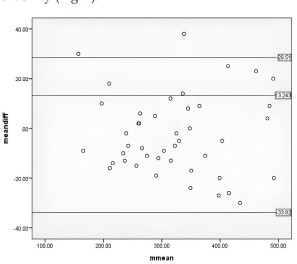
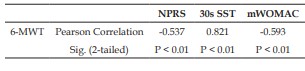
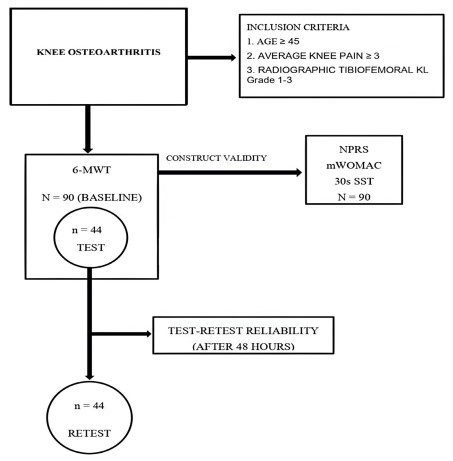
Introduction: The 6-Minute Walk Test (6-MWT) is a simple and commonly used functional performance test that assesses an individual's aerobic capacity and endurance of the lower limb. In knee osteoarthritis, the 6-MWT is often employed as a clinical assessment tool to evaluate functional capacity and monitor changes in physical performance over time. Individuals with knee osteoarthritis may experience pain, stiffness, and reduced mobility, significantly impacting their ability to walk and engage in daily activities. Aim: This study determines the reliability, construct validity, and minimal detectable change of 6-MWT in patients with knee OA. Materials and Method: This was an Observational Cross-sectional study. This study was conducted at The Sarvajanik College of Physiotherapy, Surat for a period of one year i.e. from July 2022 to June 2023. A total of 90 patients with knee OA were selected as participants, and the study used outcome measures such as mWOMAC to assess the level of disability and 30s SST to examine the Functional capacity and Strength of the lower limbs. Only 44 of 90 participants performed 6-MWT again after 48 hours for reliability. Data obtained were analysed in SPSS version 20.0. Intra-class correlation coefficient (ICC) values were derived for test-retest reliability, Pearson's correlation was seen for validity assessment, and standard error of measurement (SEM) and minimum detectable change (MDC) were also calculated. Results: The mean age of the patient was 59.66±8.237, and the mean pain score was 6.04±1.805. The ICC values for test-retest reliability were 0.992, which showed excellent reliability. The SEM and MDC values were 9.018 meters and 24.92 meters, respectively. 6-MWT showed a high-level positive correlation with the 30sSST (r = 0.821) and a moderate negative correlation with the mWOMAC and NPRS (r = -0.593 & r = -0.537), respectively. Conclusion: The 6-minute walk test is a reliable, valid test to assess the functional capacity in knee OA patients.
References
- 1. Hutton CW. Osteoarthritis: the cause not result of joint failure? Annals of the rheumatic diseases. 1989;48(11):958-61.
- 2. The burden of musculoskeletal conditions at the start of the new millennium. World Health Organization technical report series. 2003;919:i-x, 1-218, back cover.
- 3. Lawrence JS, Bremner JM, Bier F. Osteo-arthrosis. Prevalence in the population and relationship between symptoms and x-ray changes. Annals of the rheumatic diseases. 1966;25(1):1-24.
- 4. ATS statement: guidelines for the six-minute walk test. American journal of respiratory and critical care medicine. 2002;166(1):111-7.
- 5. Ateef M, Kulandaivelan S, Tahseen S. Test–retest Reliability and Correlates of 6-minute Walk Test in Patients with Primary Osteoarthritis of Knees. 2016;11(4):192-6.
- 6. Hamilton DM, Haennel RG. Validity and reliability of the 6-minute walk test in a cardiac rehabilitation population. Journal of cardiopulmonary rehabilitation. 2000;20(3):156-64.
- 7. Arcuri JF, Borghi-Silva A, Labadessa IG, Sentanin AC, Candolo C, Pires Di Lorenzo VA. Validity and Reliability of the 6-Minute Step Test in Healthy Individuals: A Cross-sectional Study. Clinical journal of sport medicine : official journal of the Canadian Academy of Sport Medicine. 2016;26(1):69-75.
- 8. Nunnally JC. Psychometric Theory. 3 ed: Tata McGraw-Hill Education; 1994.
- 9. Shrout PE. Measurement reliability and agreement in psychiatry. Statistical methods in medical research. 1998;7(3):301-17.
- 10. Kohn MD, Sassoon AA, Fernando ND. Classifications in Brief: Kellgren-Lawrence Classification of Osteoarthritis. Clinical orthopaedics and related research. 2016;474(8):1886-93.
- 11. Ateef M, S K, Tahseen S. Test-retest reliability and correlates of 6-minute walk test in patients with primary osteoarthritis of knees. Indian Journal of Rheumatology. 2016;11.
- 12. Jones CJ, Rikli RE, Beam WC. A 30-s chair-stand test as a measure of lower body strength in community-residing older adults. Research quarterly for exercise and sport. 1999;70(2):113-9.
- 13. Rejeski WJ, Ettinger WH, Jr., Schumaker S, James P, Burns R, Elam JT. Assessing performance-related disability in patients with knee osteoarthritis. Osteoarthritis and cartilage. 1995;3(3):157-67.
- 14. Dobson F, Hinman RS, Roos EM, Abbott JH, Stratford P, Davis AM, et al. OARSI recommended performance-based tests to assess physical function in people diagnosed with hip or knee osteoarthritis. Osteoarthritis and cartilage. 2013;21(8):1042-52.
- 15. Nambi G, Rathod P. Translation and Validation of Gujarati Version of WOMAC and Lequesne Questionnaire in Subjects with Knee Osteoarthritis2018.
- 16. Khuman R, Chavda D, Devi L, Bhatt U. Reliability and validity of modified Western Ontario and McMaster universities osteoarthritis index Gujarati version in participants with knee osteoarthritis. 2018;12:8-15.
- 17. Alghadir AH, Anwer S, Iqbal A, Iqbal ZA. Test-retest reliability, validity, and minimum detectable change of visual analog, numerical rating, and verbal rating scales for measurement of osteoarthritic knee pain. Journal of pain research. 2018;11:851-6.
- 18. Salaffi F, Stancati A, Silvestri CA, Ciapetti A, Grassi W. Minimal clinically important changes in chronic musculoskeletal pain intensity measured on a numerical rating scale. European journal of pain (London, England). 2004;8(4):283-91.
- 19. Portney LG, Watkins MP. Foundations of Clinical Research: Applications to Practice: F. A. Davis Company; 2015.
- 20. Bland JM, Altman DG. Statistical methods for assessing agreement between two methods of clinical measurement. Lancet (London, England). 1986;1(8476):307-10.
- 21. Meys R, Janssen SMJ, Franssen FME, Vaes AW, Stoffels AAF, van Hees HWH, et al. Test-retest reliability, construct validity and determinants of 6-minute walk test performance in adult patients with asthma. Pulmonology. 2023;29(6):486-94.
- 22. Rikli R, Jones J. The Reliability and Validity of a 6-Minute Walk Test as a Measure of Physical Endurance in Older Adults. Journal of Aging and Physical Activity. 1998;6:363-75.
- 23. Kennedy DM, Stratford PW, Wessel J, Gollish JD, Penney D. Assessing stability and change of four performance measures: a longitudinal study evaluating outcome following total hip and knee arthroplasty. BMC musculoskeletal disorders. 2005;6(1):3.
- 24. McDonald CM, Henricson EK, Abresch RT, Florence J, Eagle M, Gappmaier E, et al. The 6-minute walk test and other clinical endpoints in duchenne muscular dystrophy: reliability, concurrent validity, and minimal clinically important differences from a multicenter study. Muscle & nerve. 2013;48(3):357-68.
- 25. Sandberg A, Cider Å, Jivegård L, Nordanstig J, Wittboldt S, Bäck M. Test-retest reliability, agreement, and minimal detectable change in the 6-minute walk test in patients with intermittent claudication. Journal of Vascular Surgery. 2020;71(1):197-203.
Data Sharing Statement
There are no additional data available.
Funding
This research received no funding.
Author Contributions
All authors contributed significantly to the work and approve its publication.
Ethics Declaration
This article does not involve any human or animal subjects, and therefore does not require ethics approval
Acknowledgements
Information Not Provided
Conflicts of Interest
No conflicts of interest in this work.
About this article

Cite this article
Pathak AS, Bid DD, Syed S, et al. Psychometric validation of 6-minute walk test in patients with knee osteoarthritis - an observational cross-sectional study. Physiother Occup Ther J. 2024;17(3):147-52.
Licence:
Attribution-Non-commercial 4.0 International (CC BY-NC 4.0)This license enables reusers to distribute, remix, adapt, and build upon the material in any medium or format for noncommercial purposes only, and only so long as attribution is given to the creator.
| Received | Accepted | Published |
|---|---|---|
| August 05, 2024 | September 12, 2024 | September 30, 2024 |
DOI: http://dx.doi.org/10.21088/potj.0974.5777.17324.3
Keywords
6-minute walk testNPRSWOMAC30-second sit-to-standReliabilityValiditySearch for Similar Articles
Similar Articles
- Cross-Cultural Adaptation, Reliability, and Validity of the Gujarati Version of...
- Physiotherapy Management of Multiple Sclerosis: An Overview of Recent Technologi...
- Converging Technologies in Cardiopulmonary Physiotherapy: A Review of VR, AR, AI...
- Cross-Cultural Adaptation, Reliability, and Validity of the Gujarati Version of...
- Effects of Kinesiotaping in Lateral Epicondylitis: A Narrative Review
Article Level Metrics
Last UpdatedThursday 30 July 2026, 08:03:06 (IST)
1985
Accesses
5
429
00
Citations
NA
NA
NA
Download citation
Article Keywords
Keyword Highlighting
Highlight selected keywords in the article text.
Timeline
| Received | August 05, 2024 |
| Accepted | September 12, 2024 |
| Published | September 30, 2024 |
licence
Attribution-Non-commercial 4.0 International (CC BY-NC 4.0)
This license enables reusers to distribute, remix, adapt, and build upon the material in any medium or format for noncommercial purposes only, and only so long as attribution is given to the creator.