Full Text (PDF)
Physiotherapy and Occupational Therapy Journal 17(3):p 153-158, July-September 2024. | DOI: http://dx.doi.org/10.21088/potj.0974.5777.17324.4
Original Article
To Compare the Effects of Dynamic Cupping Therapy Versus Active Release Technique on Hamstring Flexibility in Recreational Athletes
Niraj Kumar, Tanmay Garg, Sharda Sharma, Surbhi Thapliyal3 null, Niraj Kumar, Pragya Sharma
Author Information
Licence:
Attribution-Non-commercial 4.0 International (CC BY-NC 4.0)This license enables reusers to distribute, remix, adapt, and build upon the material in any medium or format for noncommercial purposes only, and only so long as attribution is given to the creator.
Physiotherapy and Occupational Therapy Journal 17(3):p 153-158, July-September 2024. | DOI: http://dx.doi.org/10.21088/potj.0974.5777.17324.4
How Cite This Article:
Garg T, Sharma S, Thapliyal S, et al. To compare the effects of dynamic cupping therapy versus active release technique on hamstring flexibility in recreational athletes. Physiother Occup Ther J. 2024;17(3):153-8.Timeline
Received : August 04, 2024
Accepted : September 12, 2024
Published : September 30, 2024
Abstract
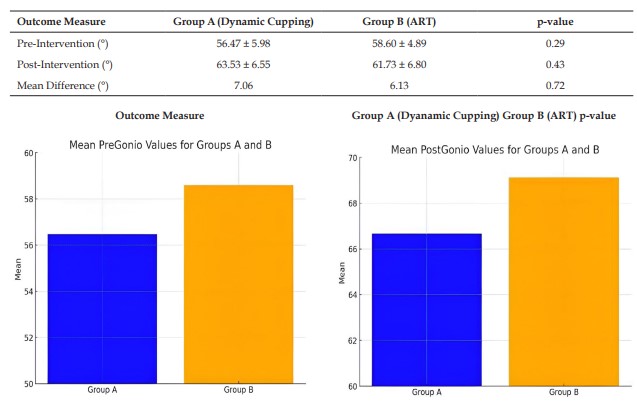
Introduction: Hamstring flexibility is crucial for athletic performance and injury prevention. Various therapeutic techniques have been explored to improve hamstring flexibility, with dynamic cupping and Active Release Technique (ART) being two popular methods. However, limited research exists comparing the efficacy of these interventions. Need to Study: Need of study is to compare that which technique is more effective on enhancing hamstring flexibility in recreational athletes either dynamic cupping or active release technique. Method: This study involved 30 recreational athletes randomly divided into two groups. Group A (n=15) received dynamic cupping therapy, while Group B (n=15) underwent Active Release Technique (ART). Both groups received three treatment sessions over three days. Hamstring flexibility was assessed using a goniometer, and pain intensity was measured using the Numeric Pain Rating Scale (NPRS). Conclusion: In summary, this study indicates that both dynamic cupping and Active Release Technique (ART) effectively improve hamstring flexibility and reduce pain in recreational athletes. However, ART demonstrated slightly greater effectiveness in enhancing flexibility compared to dynamic cupping. These findings suggest that while both techniques are viable options, ART may be the preferred choice for athletes aiming to optimize hamstring flexibility and prevent injury. Future research should explore larger sample sizes and longer follow-up periods to further elucidate the comparative benefits of these interventions.
References
- 1. Faris A, Mohammad A, Hala A, et al. The effect of passive stretching combined with quadriceps activation on hamstring flexibility: A randomized clinical trial. S Afr J Physiother. 2019;75(1):1-7.
- 2. Warren AJ, Stover J, Orr M, et al. Effects of myofascial decompression vs. self- myofascial release on hamstring flexibility and patient outcomes. Int J Sports Phys Ther. 2020;15(3):377-86.
- 3. George JW, Tunstall R, Dawes JJ, et al. The effects of Active Release Technique on hamstring flexibility in male participants: A pilot study. J Chiropr Med. 2006;5(1):1-7.
- 4. Serhat K, Mehmet K, Ahmet D, et al. The effects of cupping therapy in musculoskeletal conditions: A systematic review. J Korean Soc Phys Med. 2021;16(2):45-55.
- 5. Diaz J, Garcia Y. Comparing Active Release Technique and proprioceptive neuromuscular facilitation in improving hamstring flexibility: A randomized control trial. J Sports Med. 2017;12(4):102-7.
- 6. Macwan NS, Patel P. A randomized control trial comparing cupping therapy vs. stretching exercises for hamstring flexibility. J Innov Med. 2024;19(2):135-40.
- 7. Maghade S, Anand B, Thakur P. Immediate effect of active release technique vs dynamic soft tissue mobilization on hamstring tightness in young adults. MOJ Yoga Phys Ther. 2018;3(1):39-43
- 8. Upasana oshi, arang Srivastava, Anirban Patra et. al./ffectiveness of FoamRoller on Plantar Fascia andamstringin Combination with Active Release echniue for amstring ightness in College Students/Physiotherapy and ccupational herapyournal.2021;14(4):1-10.
Data Sharing Statement
There are no additional data available.
Funding
This research received no funding
Author Contributions
All authors contributed significantly to the work and approve its publication.
Ethics Declaration
This article does not involve any human or animal subjects, and therefore does not require ethics approval
Acknowledgements
Information Not Provided
About this article

Cite this article
Garg T, Sharma S, Thapliyal S, et al. To compare the effects of dynamic cupping therapy versus active release technique on hamstring flexibility in recreational athletes. Physiother Occup Ther J. 2024;17(3):153-8.
Licence:
Attribution-Non-commercial 4.0 International (CC BY-NC 4.0)This license enables reusers to distribute, remix, adapt, and build upon the material in any medium or format for noncommercial purposes only, and only so long as attribution is given to the creator.
| Received | Accepted | Published |
|---|---|---|
| August 04, 2024 | September 12, 2024 | September 30, 2024 |
DOI: http://dx.doi.org/10.21088/potj.0974.5777.17324.4
Keywords
Dynamic Cupping TherapyActive Release TherapyRecreational AthletesHamstring FlexibilitySearch for Similar Articles
Similar Articles
- Exploring the Connection Between Stress, Anxiety, and Central Pain Mechanisms
- Comparative Effectiveness of Mulligan SNAGs and the McKenzie Method in the Mana...
- To Compare the Effectiveness of Dual Task Training Versus Task Oriented Circuit...
- Role of Virtual Reality in Physiotherapy
- Normative Values of One Leg Stance in Urban Adults of 20-40 Years
Article Level Metrics
Last UpdatedSaturday 07 February 2026, 16:29:48 (IST)
493
Accesses
1
147
00
Citations
NA
NA
NA
Download citation
Article Keywords
Keyword Highlighting
Highlight selected keywords in the article text.
Timeline
| Received | August 04, 2024 |
| Accepted | September 12, 2024 |
| Published | September 30, 2024 |
licence
Attribution-Non-commercial 4.0 International (CC BY-NC 4.0)
This license enables reusers to distribute, remix, adapt, and build upon the material in any medium or format for noncommercial purposes only, and only so long as attribution is given to the creator.