Full Text (PDF)
Physiotherapy and Occupational Therapy Journal 18(4):p 339-349, Oct. -Dec. 2025. | DOI: 10.21088/potj.0974.5777.18425.7
Original Article
To Compare the Effectiveness of Dual Task Training Versus Task Oriented Circuit Training Along with Conventional Therapy on Balance in Patients with Ataxia
Niraj Kumar, Pooja Kandwal, Tabassum
Author Information
Licence:
Attribution-Non-commercial 4.0 International (CC BY-NC 4.0)This license enables reusers to distribute, remix, adapt, and build upon the material in any medium or format for noncommercial purposes only, and only so long as attribution is given to the creator.
Physiotherapy and Occupational Therapy Journal 18(4):p 339-349, Oct. -Dec. 2025. | DOI: 10.21088/potj.0974.5777.18425.7
How Cite This Article:
Kandwal P, Kumar N, Tabassum. To Compare the Effectiveness of Dual Task Training Versus Task Oriented Circuit Training Along with Conventional Therapy on Balance in Patients with Ataxia. Therapy Jr. 2025;18(4):339-49.Timeline
Received : August 11, 2025
Accepted : August 21, 2025
Published : December 30, 2025
Abstract
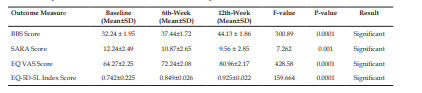
Background: Patients with ataxia tend to have most issues with balance as people disturb the path of cerebellar or sensorial communication. Conventional treatment procedures primarily involve individual activities and cannot entirely deal with everyday functioning problems. To evaluate and compare the effects of Dual Task Training (DTT) and Task-Oriented Circuit Training (TOCT), both incorporated with Conventional Therapy (CT) on improving balance and quality of life in ataxic patients, the study was carry out a crossover clinical trial. Objective: To evaluate the comparative effectiveness of dual task training and task-oriented circuit training combined with conventional therapy for enhancing balance in patients with ataxia. Methods: Fifty-eight subjects with ataxia were randomly selected and divided into two groups. Group A was given DTT conjoined with CT, whereas Group B was given TOCT with CT. Both groups had three sessions per week for 12 weeks. The Berg Balance Scale (BBS), Scale for the Assessment and Rating of Ataxia (SARA), and EQ-5D-5L to measure quality of life were used at baseline, week 6, and week 12. Results: Both groups experienced significant improvements in balance and quality of life throughout the 12-week intervention. Nevertheless, the group undergoing Task-Oriented Circuit Training along with Conventional Therapy showed significantly superior gains in balance measures and EQ-5D-5L index scores compared to the group receiving Dual Task Training with Conventional Therapy at the 12-week. Overall, the Task-Oriented Circuit Training group demonstrated greater enhancements in both balance and quality of life. Conclusion: Task-Oriented Circuit Training along with Conventional Therapy improved balance and quality of life more than Dual Task Training. These findings justify using task-based circuit training in rehabilitation to achieve better functional results. Future studies should target larger samples and further follow-ups.
References
- 1. Ashizawa T., Xia G. Ataxia. Continuum (Minneap Minn). 2016 Aug; 22(4): 1208–1226. DOI: 10.1212/CON.0000000000000362.
- 2. Ojoga F., Marinescu S. Physical therapy and rehabilitation for ataxic patients. Balneo Res J. 2013 May 20; 4(2): 81–84. DOI: 10.12680/ balneo.2013.1044
- 3. Zhang Q., Zhou X., Li Y., Yang X., Abbasi Q.H. Clinical Recognition of Sensory Ataxia and Cerebellar Ataxia. Front Hum Neurosci. 2021 Apr 1; 15: 639871. DOI: 10.3389/ fnhum.2021.639871.
- 4. Marsden J, Harris C. Cerebellar ataxia: pathophysiology and rehabilitation. Clin Rehabil. 2011; 25(3): 195–216. DOI: 10.1177/0269215510382495.
- 5. Takakusaki K. Functional neuroanatomy for posture and gait control. J Mov Disord. 2017; 10(1): 1-17. DOI: 10.14802/jmd.16062.
- 6. Buckner R.L. The cerebellum and cognitive function: 25 years of insight from anatomy and neuroimaging. Neuron. 2013 Oct; 80(3): 807– 815. DOI: 10.1016/j.neuron.2013.10.044
- 7. Ruano L., Melo C., Silva M.C., Coutinho P. The Global Epidemiology of Hereditary Ataxia and Spastic Paraplegia: A Systematic Review of Prevalence Studies. Neuroepidemiology. 2014; 42(3): 174-83. DOI: 10.1159/000358801.
- 8. Salman M.S. Epidemiology of Cerebellar Diseases and Therapeutic Approaches. Cerebellum. 2018; 17(1): 4–11. DOI: 10.1007/s12311-017-0885-2.349 POTJ/Volume 18 Number 4 / October - December 2025
- 9. Akbar U., Ashizawa T. Ataxia. Neurol Clin. 2015 Feb; 33(1): 225–248. DOI: 10.1016/j. ncl.2014.09.004
- 10. Erichsen A.K., Koht J., Stray-Pedersen A., Abdelmoor M., Tallaksen CME. Prevalence of hereditary ataxia and spastic paraplegia in southeast Norway: a population-based study. Brain. 2009; 132(6): 1577–1588. DOI: 10.1093/brain/awp056.
- 12. Rosa C.V. Effect of a home-based core stability exercise program in hereditary ataxia: A randomized controlled trial. Harvard Dataverse. 2023 Jan 1. DOI: 10.1002/mdc3.14036
- 13. Pavone P., Praticò A.D., Pavone V., Lubrano R., Falsaperla R., Rizzo R., et al. Ataxia in children: early recognition and clinical evaluation. Ital J Pediatr. 2017; 43:6. DOI:10.1186/s13052-016- 0325-9.
- 14. Hartley H, Cassidy E, Bunn L, Kumar R, Pizer B, Lane S, et al. Exercise and physical therapy interventions for children with ataxia: a systematic review. Cerebellum. 2019; 18:951– 968. DOI: 10.1007/s12311-019-01063-z
- 15. Mitoma H., Manto M., Hampe C.S. Immunemediated cerebellar ataxias: from bench to bedside. Cerebellum Ataxias. 2017; 4:16. DOI: 10.1186/s40673-017-0073-7.
- 16. Kwei K.T., Kuo S.H. An overview of the current state and the future of ataxia treatments. Neurol Clin. 2020; 38(2): 449-467. DOI: 10.1016/j. ncl.2020.01.008.
- 17. Jen J.C., Graves T.D., Hess E.J., Hanna M.G., Griggs R.C., Baloh R.W., et al. Primary episodic ataxias: diagnosis, pathogenesis and treatment. Brain. 2007; 130(9): 2484–2493. DOI: 10.1093/ brain/awm126
- 18. Ilg W., Synofzik M., Brötz D., Burkard S., Giese M.A., Schöls L. Intensive coordinative training improves motor performance in degenerative cerebellar disease. Neurology. 2009; 73(22): 1823-1830. DOI: 10.1212/ WNL.0b013e3181c33adf.
- 19. Kisner C., Colby L.A. Therapeutic exercise: foundations and techniques. 5th ed. Philadelphia: F.A. Davis Company; 2007.
- 20. Martin C.L., Tan D., Bragge P., Bialocerkowski A. Effectiveness of physiotherapy for adults with cerebellar dysfunction: a systematic review. Clin Rehabil. 2009; 23(1): 15–26. DOI: 10.1177/0269215508097853
- 21. Silsupadol P., Shumway-Cook A., Lugade V, van Donkelaar P., Chou L-S, Mayr U., et al. Effects of single-task versus dual-task training on balance performance in older adults: a double-blind, randomized controlled trial. Arch Phys Med Rehabil. 2009; 90(3): 381–387. DOI: 10.1016/j.apmr.2008.09.559
- 22. Park J.H. Is dual-task training clinically beneficial to improve balance and executive function in community-dwelling older adults with a history of falls? Int J Environ Res Public Health. 2022 Aug 17; 19(16): 10198. DOI: 10.3390/ijerph191610198
- 23. Sarasso E., Parente M.P., Agosta F., Filippi M., Corbetta D. Dual-task vs. single-task gait training to improve spatiotemporal gait parameters in people with Parkinson’s disease: a systematic review and meta-analysis. Brain Sci. 2024 May 1; 14(5): 517. DOI: 10.3390/ brainsci14050517
- 24. Hiyamizu M., Morioka S., Shomoto K., Shimada T. Effects of dual-task balance training on dual-task performance in elderly people: a randomized controlled trial. Clin Rehabil. 2011; 25(1): 69–78. DOI: 10.1177/0269215510394222
- 25. Ali A.S., Darwish M.H., Shalaby N.M., Abbas R.L., Soubhy H.Z. Efficacy of core stability versus task-oriented trainings on balance in ataxic persons with multiple sclerosis: a singleblinded randomized controlled trial. Mult Scler Relat Disord. 2021 May; 50: 102866. DOI: 10.1016/j.msard.2021.102866
Data Sharing Statement
There are no additional data available. All raw data and code are available upon request.
Funding
This research received no funding.
Author Contributions
All authors contributed significantly to the work and approve its publication.
Ethics Declaration
This article does not involve any human or animal subjects, and therefore does not require ethics approval.
Acknowledgements
We would like to express our gratitude to the patients, their families, and all those who have contributed to this study.
Conflicts of Interest
No conflicts of interest in this work.
About this article

Cite this article
Kandwal P, Kumar N, Tabassum. To Compare the Effectiveness of Dual Task Training Versus Task Oriented Circuit Training Along with Conventional Therapy on Balance in Patients with Ataxia. Therapy Jr. 2025;18(4):339-49.
Licence:
Attribution-Non-commercial 4.0 International (CC BY-NC 4.0)This license enables reusers to distribute, remix, adapt, and build upon the material in any medium or format for noncommercial purposes only, and only so long as attribution is given to the creator.
| Received | Accepted | Published |
|---|---|---|
| August 11, 2025 | August 21, 2025 | December 30, 2025 |
DOI: 10.21088/potj.0974.5777.18425.7
Keywords
AtaxiaDual Task TrainingTask-Oriented Circuit TrainingNeurorehabilitationBerg Balance ScaleBalance rehabilitationScale for the Assessment and Rating of AtaxiaSearch for Similar Articles
Similar Articles
- Leadership in Physiotherapy: A Narrative Review
- Effectiveness of Low Level Laser Theapy in the Management of Temporomandibular J...
- The Impact of Air Pollution on Cardiopulmonary Health: Molecular Mechanisms, Pre...
- Efectiveness of Physiotherapy in Postpartum Women with Diastasis Recti: A Review
- Pain Neuroscience Education: Transforming Physiotherapy Practice
Article Level Metrics
Last UpdatedFriday 23 October 2026, 15:23:44 (IST)
4358
Accesses
32
739
00
Citations
NA
NA
NA
Download citation
Article Keywords
Keyword Highlighting
Highlight selected keywords in the article text.
Timeline
| Received | August 11, 2025 |
| Accepted | August 21, 2025 |
| Published | December 30, 2025 |
licence
Attribution-Non-commercial 4.0 International (CC BY-NC 4.0)
This license enables reusers to distribute, remix, adapt, and build upon the material in any medium or format for noncommercial purposes only, and only so long as attribution is given to the creator.