Full Text (PDF)
Physiotherapy and Occupational Therapy Journal 17(3):p 159-166, July-September 2024. | DOI: http://dx.doi.org/10.21088/potj.0974.5777.17324.5
Original Article
Comparative Study of Proprioceptive Exercise with Neuro Muscular Training Versus Conventional Training with Functional Training in Subject with Osteoarthritis Knee
Niraj Kumar, Rahipal Singh, Sharda Sharma, Surbhi Thapliyal, Manjul Nautyal
Author Information
Licence:
Attribution-Non-commercial 4.0 International (CC BY-NC 4.0)This license enables reusers to distribute, remix, adapt, and build upon the material in any medium or format for noncommercial purposes only, and only so long as attribution is given to the creator.
Physiotherapy and Occupational Therapy Journal 17(3):p 159-166, July-September 2024. | DOI: http://dx.doi.org/10.21088/potj.0974.5777.17324.5
How Cite This Article:
Singh R, Sharma S, Thapliyal S, et al. Comparative study of proprioceptive exercise with neuro muscular training versus conventional training with functional training in subject with osteoarthritis knee. Physiother Occup Ther J. 2024;17(3):159-66.Timeline
Received : September 08, 2024
Accepted : September 13, 2024
Published : September 30, 2024
Abstract
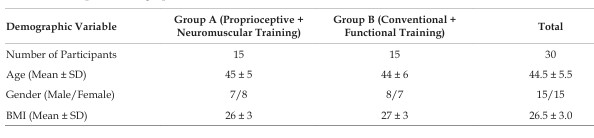
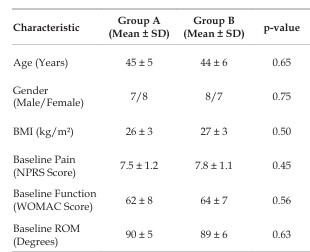
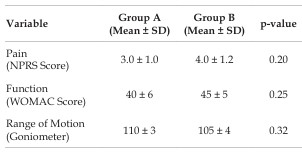
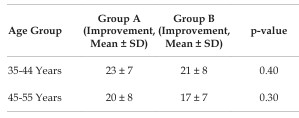
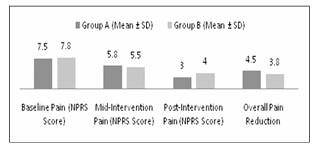
Introduction: This study compares the effectiveness of two therapeutic interventions in patients with upper trapezius myofascial pain syndrome: Group A (Proprioceptive Neuromuscular Training) and Group B (Conventional Functional Training). A total of 30 participants were divided equally into both groups. The study evaluated demographic factors, pain reduction, functional improvement, and range of motion (ROM) over the course of treatment. Purpose of the Study: To compare the effectiveness of proprioceptive exercise with neuromuscular training versus conventional training with functional training in subjects with osteoarthritis of the knee. Methodology: A total of 30 subjects will be taken for the study by convenience sampling method. Subjects will be divided into 2 groups, with 15 subjects in each group. Group A will receive proprioceptive exercise with neuromuscular training exercises. Group B will receive conventional training with functional training exercises. Both groups received their respective intervention for a duration of six weeks, with pre and post treatment evaluations conducted. Conclusion: These findings suggest that clinicians can utilize either approach, depending on patient preferences or specific clinical circumstances, as both interventions appear to provide comparable outcomes in pain relief, functional enhancement, and range of motion improvement. Keywords: Proprioceptive Neuromuscular Training; Conventional Functional Training; Pain reduction; Range of motion (ROM); Functional improvement; NPRS; WOMAC.
References
- 1. Jigyasa Juya, Anirban Patra, Shama, et al./ To Compare the Effects of VMO Strengthening Exercise wth Quadriceps Isometric Exercise Versus VMO Strengthening with Gluteus Medius Strengthening Exercise to Normalize Q Angle in Patients with Knee Osteoarthritis. Physiotherapy and Occupational Therapy Journal. 2022;15(3):123-130.DOI: http://dx.doi. org/10.21088/potj.0974.5777.15322.3
- 2. Prabhakar, A. J., et al. (2020). Proprioceptive training in osteoarthritis: A randomized controlled trial. Journal of Musculoskeletal Rehabilitation, 34(2), 197-203.
- 3. Bharat Puri, Potsangbam Nandita, Tarang Srivastava, et al. To Study the Effects of Proprioceptionand Resistance Training to Improve Performance Level in Taekwondo Athletes. Physiotherapy and Occupational Therapy Journal. 2021;14(1):19-31DOI: http://dx.doi. org/10.21088/potj.0974.5777.14121.2
- 4. Sazo-Rodríguez, S., et al. (2017). Effects of progressive neuromuscular training on postural balance and functionality in patients with knee osteoarthritis. Journal of Physical Therapy Science, 29(8), 1423-1428.
- 5. Rezaeipour, M., et al. (2018). Effect of neuromuscular and proprioceptive training on postural stability in active middle-aged men. Journal of Sports Medicine and Physical Fitness, 58(4), 485-492.
Data Sharing Statement
There are no additional data available.
Funding
This research received no funding
Author Contributions
All authors contributed significantly to the work and approve its publication.
Ethics Declaration
This article does not involve any human or animal subjects, and therefore does not require ethics approval
Acknowledgements
Information Not Provided
Conflicts of Interest
No conflicts of interest in this work.
About this article

Cite this article
Singh R, Sharma S, Thapliyal S, et al. Comparative study of proprioceptive exercise with neuro muscular training versus conventional training with functional training in subject with osteoarthritis knee. Physiother Occup Ther J. 2024;17(3):159-66.
Licence:
Attribution-Non-commercial 4.0 International (CC BY-NC 4.0)This license enables reusers to distribute, remix, adapt, and build upon the material in any medium or format for noncommercial purposes only, and only so long as attribution is given to the creator.
| Received | Accepted | Published |
|---|---|---|
| September 08, 2024 | September 13, 2024 | September 30, 2024 |
DOI: http://dx.doi.org/10.21088/potj.0974.5777.17324.5
Keywords
Proprioceptive Neuromuscular TrainingConventional Functional TrainingPain reductionRange of motion (ROM)Functional improvementNPRSWOMACSearch for Similar Articles
Similar Articles
- Cross-Cultural Adaptation, Reliability, and Validity of the Gujarati Version of...
- Physiotherapy Management of Multiple Sclerosis: An Overview of Recent Technologi...
- Converging Technologies in Cardiopulmonary Physiotherapy: A Review of VR, AR, AI...
- Cross-Cultural Adaptation, Reliability, and Validity of the Gujarati Version of...
- Effects of Kinesiotaping in Lateral Epicondylitis: A Narrative Review
Article Level Metrics
Last UpdatedWednesday 29 July 2026, 20:58:38 (IST)
1979
Accesses
5
429
00
Citations
NA
NA
NA
Download citation
Article Keywords
Keyword Highlighting
Highlight selected keywords in the article text.
Timeline
| Received | September 08, 2024 |
| Accepted | September 13, 2024 |
| Published | September 30, 2024 |
licence
Attribution-Non-commercial 4.0 International (CC BY-NC 4.0)
This license enables reusers to distribute, remix, adapt, and build upon the material in any medium or format for noncommercial purposes only, and only so long as attribution is given to the creator.