Full Text (PDF)
Indian Journal of Agriculture Business 12(1):p 95-105, January 2026. | DOI: https://doi.org/10.21088/ijab.2454.7964.12126.10
Review Article
Potential of Macroalgae in Ruminant Nutrition
Shalini Vaswani, Singana Bala Sai, Vinod Kumar, Pummy Chaudary, Nitin Yadav, Kali Prasad Rai, Chanchal Kumari, Kajal Rajvanshi
Author Information
Licence:
Attribution-Non-commercial 4.0 International (CC BY-NC 4.0)This license enables reusers to distribute, remix, adapt, and build upon the material in any medium or format for noncommercial purposes only, and only so long as attribution is given to the creator.
Indian Journal of Agriculture Business 12(1):p 95-105, January 2026. | DOI: https://doi.org/10.21088/ijab.2454.7964.12126.10
How Cite This Article:
Singana Bala Sai, Shalini Vaswani, Vinod Kumar et. al, Potential of Macroalgae in Ruminant Nutrition. J Agri Busi 2026; 12(1): 95–105.Timeline
Received : September 11, 2025
Accepted : October 29, 2025
Published : June 20, 2026
Abstract
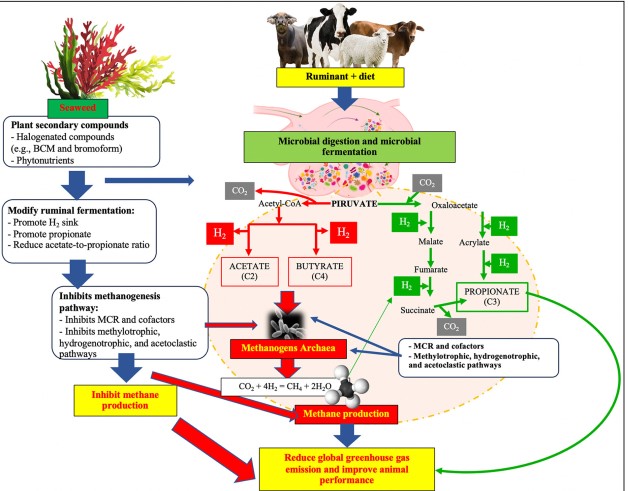
Seaweeds broadly classified as brown, red, and green algae, are rich in proteins, essential amino acids, polyunsaturated fatty acids, vitamins, and minerals, along with bioactive polysaccharides such as laminarin, fucoidan, carrageenan, and ulvan. These compounds exert diverse biological effects, including antioxidant, anti-inflammatory, prebiotic, and immunomodulatory functions, thereby improving gut health, feed efficiency, and overall productivity of ruminants. of particular importance is their ability to mitigate enteric methane emissions. Certain red seaweeds, such as Asparagopsis species, contain halogenated compounds like bromoform, which inhibit methyl-coenzyme M reductase, the key enzyme in methanogenesis, leading to significant reductions in methane output while redirecting hydrogen toward propionate formation, an energetically favorable pathway. This dual role of enhancing nutrient utilization and reducing environmental burden underscores their significance. Despite these advantages, challenges remain, including variability in nutrient composition across species and seasons, presence of recalcitrant polysaccharides that hinder digestibility, risks of heavy metal accumulation, excessive iodine levels, and nutrient instability during processing. Addressing these constraints through standardized harvesting, processing, and supplementation strategies will be critical for large-scale adoption. Overall, macroalgae hold great promise as a renewable, nutrient-dense, and ecofriendly feed additive and their inclusion in ruminant diets can improve animal health and productivity, reduce reliance on conventional feed resources, and contribute to global efforts in climate change mitigation and sustainable livestock production.
References
- 1. Beheshtipour H, Mortazavian AM, Haratian P, Darani KK (2012) Effects of Chlorella vulgaris and Arthrospira platensis addition on viability of probiotic bacteria in yogurt and its biochemical properties. Eur J Food Res Technol 235:719–728.
- 2. Berghuis, B.A., Yu, F.B., Schulz, F., Blainey, P.C., Woyke, T., Quake, S.R., 2019. Hydrogenotrophic methanogenesis in archaeal phylum Verstraetearchaeota reveals the shared ancestry of all ethanogens. PNAS 116, 5037e44. https://doi.org/10.1073/pnas.1815631116.
- 3. Campos AM, Matos J, Afonso C, Gomes R, Bandarra NM, Cardoso C (2019) Azorean macroalgae (Petalonia binghamiae, Halopteris scoparia and Osmundea pinnatifida) bioprospection: a study of fatty acid profiles and bioactivity. Int J Food Sci Tech 54:880–890
- 4. Cavicchioli, R., 2007. Archaea: Molecular and Cellular Biology. ASM Press, Washington DC.
- 5. Costa M, Cardoso C, Afonso C, Bandarra NM, Prates JAM (2021) Current knowledge and future perspectives of the use of seaweeds for livestock production and meat quality: a systematic review. J Anim Physiol Anim Nutr 105:1075–1102.
- 6. Cunningham S, Joshi L (2010) In: Kole C (ed) Transgenic crop plants. Springer, Berlin, pp 343–357.
- 7. Denman, S.E., Tomkins, N.W., McSweeney, C.S., 2007. Quantitation and diversity analysis of ruminal methanogenic populations in response to the antimethanogenic compound bromochloromethane. FEMS Microbiol. Ecol. 62, 313–322. https://doi.org/10.1111/j.1574-
- 6941. 2007.00394.x.
- 8. Devillé C, Gharbi M, Dandrifosse G, Peulen O (2007) Study on the effects of laminarin, a polysaccharide from seaweed, on gut characteristics. J Sci Food Agric 87:1717–1725.
- 9. Ellis, J., Dijkstra, J., Kebreab, E., Bannink, A., Odongo, N., McBride, B., France, J., 2008.
- 10. Goel, G., Makkar, H.P., Becker, K., 2009. Inhibition of methanogens by bromochloromethane: effects on microbial communities and rumen fermentation using batch and continuous fermentations. Br. J. Nutr. 101, 1484–1492. https://doi.org/10.1017/
- 11. Gómez-Guzmán, M., Rodríguez-Nogales, A., Algieri, F. & Gálvez, J. (2018). Potential role of seaweed polyphenols in cardiovascularassociated disorders. Mar Drugs, 16: 250.
- 12. Gotteland M, Riveros K, Gasaly N, Carcamo C, Magne F, Liabeuf G, Beattie A, Rosenfeld S (2020) The pros and cons of using algal polysaccharides as prebiotics. Front Nutr 7:163.
- 13. Guiry MD (2014) The seaweed site: information on marine algae. Seaweed.Ie. Assessed 2 Feb 2022.
- 14. Gupta S, Abu-Ghannam N (2011) Recent developments in the application of seaweeds or seaweed extracts as a means for enhancing the safety and quality attributes of foods. Innov Food Sci Emerg Technol 12:600–609.
- 15. Holdt, S.L., Kraan, S., 2011. Bioactive compounds in seaweed: functional food applications and legislation. J. Appl. Phycol. 23, 543–597. https://doi.org/10.1007/s10811-010-9632-5.
- 16. Kumar CS, Ganesan P, Suresh P, Bhaskar N (2008) Seaweeds as a source of nutritionally
- 17. Lahaye M, Robic A (2007) Structure and function properties of Ulvan, a polysaccharide
- 18. Li YX, Wijesekara I, Li Y, Kim SK (2011) Phlorotannins as bioactive agents from brown algae. Process Biochem 46:2219–2224.
- 19. Lynch MB, Sweeney T, Callan JJ, O’Sullivan JT, O’Doherty JV (2010) The effects of dietary
- 20. Machado L, Magnusson M, Paul NA, de Nys R, Tomkins N (2014) Effects of marine and freshwater macroalgae on in-vitro total gas and methane production. PLoS One 9:e85289.
- 21. Makkar HPS, Tran G, Heuzé V, GigerReverdin S, Lessire M, Lebas F, Ankers P (2016) Seaweeds for livestock diets: a review. Anim Feed Sci Technol 212:1–17.
- 22. Maschek JA, Baker BJ (2008) The chemistry of algal secondary metabolism. In: Amsler CD
- 23. Michalak I, Chojnacka K (2015) Algae as production systems of bioactive compounds. Eng Life Sci 15:160–176.
- 24. Michalak I, Marycz K (2019) Algae as a promising feed additive for horses. In: Pereira L, Bahcevandziev K, Joshi NH (eds) Seaweeds as plant fertilizer, agricultural biostimulants and animal fodder. CRC, Boca Raton, FL, pp 128–142.
- 25. Mikami K, Hosokawa M (2013) Biosynthetic pathway and health benefits of fucoxanthin, an algae-specific xanthophyll in brown seaweeds. Int J Mol Sci 14:13763–13781.
- 26. Min, B.R., Parker, D., Brauer, D., Waldrip, H., Lockard, C., Hales, K., Akbay, A., Augyte, S., 2021. The role of seaweed as a potential dietary supplementation for enteric methane mitigation in ruminants: challenges and opportunities. Anim. Nutr. 7, 1371–1387. https://doi.org/10.1016/j.aninu.2021.10.003.
- 27. Misurcová L (2012) Chemical composition of seaweeds. In: Kim SK (ed) Handbook of marine macroalgae: biotechnology and applied phycology. Wiley, New York, p 567.
- 28. Mohapatra A, Trivedi S, Kolte AP, Tejpal CS, Elavarasan K, Vaswani S, Malik PK, Ravishankar CN and Bhatta R (2024) Effect of Padina gymnospora biowaste inclusion on in vitro methane production, feed fermentation, and microbial diversity. Front. Microbiol. 15:1431131. doi: 10.3389/fmicb.2024.1431131
- 29. Mohapatra, A.; Trivedi, S.; Tejpal, C.S.; Aware, M.J.; Vaswani, S.; Prajapati, V.J.; Kolte, A.P.; Malik, P.K.; Sahoo, A.; Ravishankar, C.N.; et al. Effect of Two Selected Levels of Padina gymnospora Biowaste and Enteric Methane Emission, Nutrient Digestibility, and Rumen Metagenome in Growing Sheep. Microorganisms 2025, 13, 780. https://doi.org/10.3390/microorganisms13040780
- 30. Morais T, Inácio A, Coutinho T, Ministro M, Cotas J, Pereira L, Bahcevandzied K (2020) Seaweed potential in the animal feed: a review. J Mar Sci Eng 8:559
- 31. Moreda-Pineiro A, Pena-Vásquez E, BermejoBarrera P (2012) Significance of the presence of trace and ultratrace elements in seaweeds. In: Kim SK (ed) Handbook of marine macroalgae: biotechnology and applied phycology. Wiley, New York, p 567
- 32. Mottet, A., De Haan, C., Falcucci, A., Tempio, G., Opio, C. & Gerber, P. (2017). Livestock: On our plates or eating at our table? A new analysis of the feed/food debate. Glob Food Sec, 14: 1-8.
- 33. Neri-Numa IA, Arruda HS, Geraldi MV, Maróstica Júnior MR, Pastore GM (2020) Natural prebiotic carbohydrates, carotenoids and flavonoids as ingredients in food systems. Curr Opin Food Sci 33:98–107.
- 34. O’Doherty JV, Dillon S, Figat S, Callan JJ, Sweeney T (2010) The effects of lactose
- 35. Øverland M, Mydland LT, Skrede A (2019) Marine macroalgae as sources of protein and bioactive compounds in feed for monogastric animals. J Sci Food Agr 99(2):13–24.
- 36. Patra A, Park T, Kim M, Yu Z (2017) Rumen methanogens and mitigation of methane emission by anti-methanogenic compounds and substances. J Anim Sci Biotechnol 8:1–18.
- 37. Pereira L (2016) Edible seaweeds of the world. CRC Press, Boca Raton Ramnani P, Chitarrari R, Tuohy K, Grant J, Hotchkiss S, Philp K, Campbell R, Gill C, Rowland I (2012) In vitro fermentation and prebiotic potential of novel low molecular weight polysaccharides derived from agar and alginate seaweeds. Anaerobe 18:1–16.
- 38. Malik, P.K.; Kolte, A.P.;Trivedi, S.; Tamilmani, G.; Mohapatra, A.; Vaswani, S.; elevendran,
- 39. Anti-Methanogenic Potential of Seaweeds and Impact on Feed Fermentation and Rumen Microbiome In Vitro. Microorganisms 2025, 13, 123. https://doi.org/10.3390/microorganisms13010123.
- 40. R.K. Thauer. The wolfe cycle comes full circle, Proc. Natl. Acad. Sci. 109 (2012) 15084.
- 41. Roque, B.M., Venegas, M., Kinley, R.D., de Nys, R., Duarte, T.L., Yang, X., Kebreab, E., 2021. Red seaweed (Asparagopsis taxiformis) supplementation reduces enteric methane by over 80 percent in beef steers. PLoS One 16, e0247820. https://doi.org/10.1371/journal.pone.0247820.
- 42. Shang, Q., Song, G., Zhang, M., Shi, J., Xu, C., Hao, J., et al. (2017). Dietary fucoidan improves metabolic syndrome in association with increased Akkermansia population in the gut microbiota of high-fat diet-fed mice. J Funct Foods, 28: 138-146.
- 43. Song MY, Ku SK, Han JS (2012) Genotoxicity testing of low molecular weight fucoidan from brown seaweeds. Food Chem Toxicol 50(3–4): 790–796.
- 44. Stams, A.J., Plugge, C.M., 2009. Electron transfer in syntrophic communities of anaerobic bacteria and archaea. Nat. Rev. Microbiol. 7, 568–577. https://doi.org/10.1038/nrmicro2166.
- 45. Tayyab U, Novoa-Garrido M, Roleda MY, Lind V, Weisbjerg MR (2016) Ruminal and intestinal protein degradability of various seaweed species measured in situ in dairy cows. Anim Feed Sci Technol 213:44–54.
- 46. Tsui MTK, Cheung KC, Tam NFY, Wong MH (2006) A comparative study on metal sorption by brown seaweed. Chemosphere 65:51–57.
- 47. Ungerfeld, E., Rust, S., Boone, D., Liu, Y., 2004. Effects of several inhibitors on pure cultures of ruminal methanogens. J. Appl. Microbiol. 97, 520–526. https://doi.org/10.1111/j.1365-2672.2004.02330.x.
- 48. Van Zanten, H.H., Van Ittersum, M.K. & De Boer, I.J. (2019). The role of farm animals in a circular food system. Glob Food Sec, 21: 18-22.
- 49. Vasconcelos MTS, Leal MFC (2001) Seasonal variability in the kinetics of cu, Pb, cd and
- 50. Vieira, E.F., Soares, C., Machado, S., Correia, M., Ramalhosa, M.J., Oliva-Teles, M.T., et al.
- 51. Wanapat, M., Kang, S., Polyorach, S., 2013. Development of feeding systems and
- 52. Wang Y, Han F, Hu B, Li J, Yu W (2006) In vivo prebiotic properties of alginate
- 53. Wang, K., Xiong, B., Zhao, X., 2023a. Could propionate formation be used to reduce
- 54. Wang, M., Cheong, K.L., 2023. Preparation, structural characterisation, and bioactivities of fructans: a review. Molecules 28, 1613. https:// doi.org/10.3390/molecules28041613.
- 55. Wood JM, Kennedy FS, Wolfe RS (1968) Reaction of multi halogenated hydrocarbons
- 56. Yaich H, Garna H, Besbes S, Paquot M, Blecker C, Attia H (2011) Chemical composition and functional properties of Ulva lactuca seaweed collected in Tunisia. Food Chem 128:895–901
- 57. Zargarzadeh, M., Amaral, A.J., Custódio, C.A. & Mano, J.F. (2020). Biomedical applications of laminarin. Carbohydr Polym, 232: 115774.
- 58. Zheng, Y., Li, Y., Yang, Y., Zhang, Y., Wang, D., Wang, P., Wong, A.C., et al. (2022). Recent Advances in Bioutilization of Marine Macroalgae Carbohydrates: Degradation, Metabolism, and Fermentation. J Agric Food Chem, 70: 1438-1453.
Data Sharing Statement
There are no additional data available. All raw data and code are available upon request.
Funding
This research received no funding.
Author Contributions
All authors contributed significantly to the work and approve its publication.
Ethics Declaration
This article does not involve any human or animal subjects, and therefore does not require ethics approval.
Acknowledgements
We would like to express our gratitude to the patients, their families, and all those who have contributed to this study.
Conflicts of Interest
No conflicts of interest in this work.
About this article

Cite this article
Singana Bala Sai, Shalini Vaswani, Vinod Kumar et. al, Potential of Macroalgae in Ruminant Nutrition. J Agri Busi 2026; 12(1): 95–105.
Licence:
Attribution-Non-commercial 4.0 International (CC BY-NC 4.0)This license enables reusers to distribute, remix, adapt, and build upon the material in any medium or format for noncommercial purposes only, and only so long as attribution is given to the creator.
| Received | Accepted | Published |
|---|---|---|
| September 11, 2025 | October 29, 2025 | June 20, 2026 |
DOI: https://doi.org/10.21088/ijab.2454.7964.12126.10
Keywords
MacroalgaeSeaweedMethane MitigationPrebioticFeed AdditiveSearch for Similar Articles
Similar Articles
- Studies on Bee and Pollination is Changing Environment: A Review
- Cultivating Rosemary: A Guide to its Medicinal and Therapeutic Wonders
- Active Biodegradable Edible Packaging System: An Affluent Predisposition Towards...
- Routine Management Practices for Sustainable Dairy Production
- Diagnosis and Management of Diseases Caused by Abiotic and Biotic Stress in Vege...
Article Level Metrics
Last UpdatedWednesday 21 October 2026, 09:21:02 (IST)
3477
Accesses
36
496
00
Citations
NA
NA
NA
Download citation
Article Keywords
Keyword Highlighting
Highlight selected keywords in the article text.
Timeline
| Received | September 11, 2025 |
| Accepted | October 29, 2025 |
| Published | June 20, 2026 |
licence
Attribution-Non-commercial 4.0 International (CC BY-NC 4.0)
This license enables reusers to distribute, remix, adapt, and build upon the material in any medium or format for noncommercial purposes only, and only so long as attribution is given to the creator.