Full Text (PDF)
Indian Journal of Agriculture Business 12(1):p 121-138, January 2026. | DOI: https://doi.org/10.21088/ijab.2454.7964.12126.13
Review Article
Diseases of Pulse Crops and their Management in India
Author Information
Licence:
Attribution-Non-commercial 4.0 International (CC BY-NC 4.0)This license enables reusers to distribute, remix, adapt, and build upon the material in any medium or format for noncommercial purposes only, and only so long as attribution is given to the creator.
Indian Journal of Agriculture Business 12(1):p 121-138, January 2026. | DOI: https://doi.org/10.21088/ijab.2454.7964.12126.13
How Cite This Article:
Amar Bahadur. Diseases of Pulse Crops and their Management in India. J Agri Busi 2026; 12(1): 121–138.Timeline
Received : February 21, 2026
Accepted : April 02, 2026
Published : June 20, 2026
Abstract
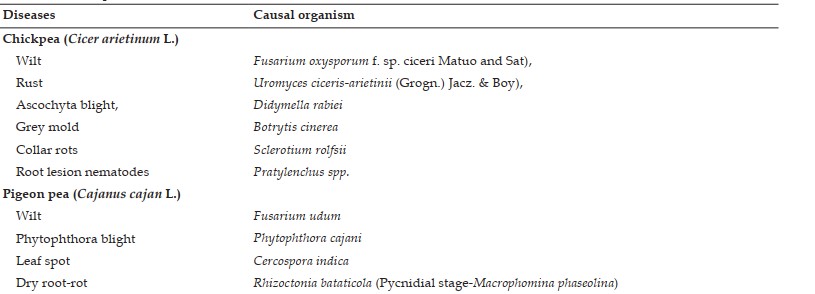
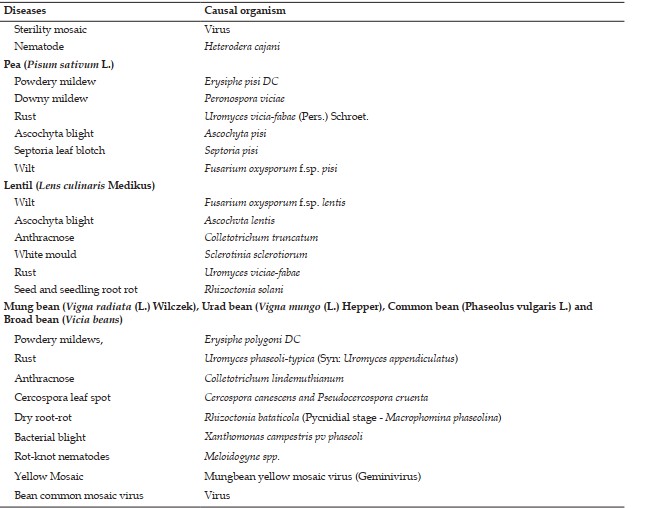
Pulses are annual leguminous crops and one of the most important food crops globally due to their high protein content and rich sources of dietary fiber, minerals and vitamins. Legume crops belong to the family Fabaceae (Leguminosae). Its contribute approximately 20–25% of the protein consumed in the form of dal as an source of plant-based protein in the human diet. The crop residues viz., leaves, pod coats, and bran are used as dry fodder for livestock. Mung bean plants are also utilized as green manure, improving soil health and enhancing nutrient. Pulses crops maintaining soil fertility through biological nitrogen fixation, their root nodules harbor Rhizobium bacteria in a symbiotic relationship. The bacteria receive carbohydrates such as sugars and starch from the host plant. These bacteria fix atmospheric nitrogen and convert it into nitrates. Each nodule remains functional for about four weeks before decomposing and releasing nitrogen into the soil. India is the largest producer of pulses in the world. Major pulse crops grown in India include chickpea (Cicer arietinum L.), pigeon pea (Cajanus cajan L.), mung bean (Vigna radiata L.), urad bean (Vigna mungo L.), lentil (Lens culinaris Medik.), pea (Pisum sativum L.), and various other beans. Pulse crops are cultivated during the Kharif, Rabi, and Zaid seasons. However, pulse production is constrained by several biotic and abiotic stresses, including diseases, insect pests, drought, water logging, salinity, and other environmental stresses. Among these, diseases significantly reduce crop yield. Legumes are susceptible to a wide range of pathogens, including fungi, bacteria, viruses, and nematodes. Major diseases of legumes include rusts, powdery and downy mildews, Ascochyta blights, Botrytis grey mould, anthracnose, root rots, collar rots, wilts, viral diseases, bacterial blights, and nematode infestations. These pathogens are transmitted through air, soil, and seed, posing a major constraint to yield. Seed serves as the primary source of inoculums for many pathogens. Seed-borne diseases of pulses include Ascochyta blight, Botrytis (grey) mould, Stemphylium blight, anthracnose, Alternaria leaf spot, bacterial blight, and mosaic diseases, all of which require effective management strategies. Among major pulse crops, chickpea is affected by Fusarium wilt (Fusarium oxysporum f. sp. ciceri), blight (Mycosphaerella pinodes), and rust (Uromyces ciceris-arietini). Pigeon pea suffers from wilt (Fusarium oxysporum f. sp. udum) and sterility mosaic disease. Pea is mainly affected by powdery mildew (Erysiphe polygoni) and rust (Uromyces viciaefabae), along with several other minor diseases.
References
- 1. Boye J, Zare F, Pletch A. Pulse proteins: Processing, characterization, functional properties and applications in food and feed. Food Res. Int. 2010; 43: 414–431.
- 2. Zahran HH. Rhizobium-legume symbiosis and nitrogen fixation under severe conditions and in an arid climate Microbiol Mol Biol Rev, 1999; 63(4): 968-989.
- 3. Pandey A, Gupta RK, Arora AP. Spiritual climate of business organizations and its impact on customers’ experience. Journal of Business Ethics, 2009;. 88(2): 313–332.
- 4. Zotikov VI, Naumkina TS, Sidorenko VS . Leguminous crops of Russia, Orel, FGBNU, “VNIIZBN”, 2016; 31-32.
- 5. Knights EJ, Acikgoz N, Warkentin T, Bejiga G, Yadav SS. Sandu JS. Area, production and distribution. In: Chickpea Breeding and Management, S.S. Yadav, R. Redden, W. Chen, B. Sharma (eds.). CABI Publishing. 2007; pp. 167-178.
- 6. Chibbar RN, Ambigaipalan P, Hoover R. Molecular diversity in pulse seed starch and complex carbohydrates and its role in human nutrition and health. Cereal Chem., 2010; 87: 342-352.
- 7. Wood JA, Grusak MA. Nutritional value of chickpea. In: Chickpea Breeding and Management, S.S. Yadav, R. Redden, W. Chen, B. Sharma (eds.). CABI Publishing. 2007; pp.101-142
- 8. Kannaiyan J, Nene YL, Reddy MV, Ryan JG, Raju TN. Prevalence of pigeonpea diseases and associated crop losses in Asia, Africa and America. Trop. Pest Manage. 1984; 30: 62–71.
- 9. Reddy MV, Raju TN, Lenne JM. Diseases of pigeonpea In: The Pathology of Food and Pasture Legumes (Allen D.J. and Lenne J.M., eds), Wallingford, Oxfordshire: CAB International.1998; pp. 517–558.
- 10. Mitra M. Report of the Imperial Mycologist. Sci. Rep. Agric. Res. Inst. Pusa,1931; 19: 58–71.
- 11. Nene YL, Sheila VK, Sharma SB. A World List of Chickpea (Cicer arietinum) and Pigeonpea (Cajanus cajan). Pathogens, 5th edn ICRISAT, Patancheru, India: ICRISAT Publication. 1996.
- 12. Newton W, Peiris JWL. Virus diseases of plants in Ceylon. FAO Plant Protect. Bull. 1953; 2: 17–21.
- 13. Williams FJ, Grewal JS, Amin KS. Serious and new diseases of pulse crops in India in 1966. Pl Dis Rep. 1968; 52: 300-304.
- 14. Reddy MV, Raju TN, Sharma SB, Nene YL, McDonald D, Pande S, Sharma M. Handbook of Pigeonpea Diseases (Revised) Information Bulletin No. 42. Patancheru, AP 502 324, India: International Crops Research Institute for the Semi-Arid Tropics. 2012. 64 pp. ISBN 92-9066 277-8.
- 15. Vishwa Dhar, Reddy MV, Chaudhary RG. Major diseases of pigeonpea and their management. In. Ed. Ali Masood, and Shiv Kumar. IIPR, Kanpur, India. Adv Pigeonpea Res, 2005; 229-261.
- 16. Reddy MV, Gridley HE, Kaack HJ. Major disease problems of chickpea in North Africa Int. Chickpea Newslett 1980; 13-14.
- 17. Gradoboeva TP. Resistance of pea varieties to ascochitosis in changing environmental conditions Agricultural Science of the EuroNorth-East, 2017; 2(57): 17-18.
- 18. Nene YL. A rewiew of Ascochyta blight of chickpea Tiop. Pest Manag. 1982; 1: 61-70.
- 19. Brown JK, Hovmller MS. Aerial dispersal of pathogens on the global and continental scales and its impact on plant disease. Science, 2002; 297: 537–541.
- 20. Conner RL, Bernier CC. Host range of Uromyces viciaefabae. Phytopathology, 1982; 72: 687–689.
- 21. Mendgen K. The Uredinales. The Mycota Vol. V Plant Relationships Part B (Esser K & Lemke PA, eds), Springer-Verlag, Berlin, 1997; pp. 79–94.
- 22. Mendgen K . Development and physiology of teliospores. The Cereal Rusts, Vol. I. (Bushnell WR & Roelfs AP, eds), Academic Press, Orlando, 1984; pp. 375–398.
- 23. Woods AM, Beckett A. Wall structure and ornamentation of the urediniospores of Uromyces viciae-fabae. Can J Bot,1987; 65: 2007–2016.
- 24. Cummins GB. Rust Fungi on Legumes and Composites in North America, University of Arizona Press, Tucson, 1978; 424 pp.
- 25. Saksena HK, Prasada R. Studies in gram rust, Uromyces ciceris-arietini (Grogn.) Jacz. Indian Phytopathol. 1955; 8:94-98.
- 26. Stavely JR, Steadman JR, McMillan-Junior RT. New pathogenic vari-ability in Uromyces appendiculatus in North America. Plant Disease, 1989; 73: 428- 432.
- 27. Gold RE, Mendgen K. Cytology of teliospore germination and basidio- spore formation in Uromyces appendiculatus var. appendiculatus. Proto- plasma, 1984a; 119, 150-155.
- 28. Gold RE, Mendgen K. Vegetative development of Uromyces appendi-culatus var. appendiculatus in Phaseolus vulgaris. Canadian Journal of Botany, 1984b; 62: 2003-2010.
- 29. Stavely JR, Pastor-Corrales MA. Rust. In: Schwartz HF, Pastor-Cor- rales MA (Eds) Bean Production Problems in the Tropics (2nd Edn), Centro Internacional de Agricultura Tropical Press, Cali, 1989; pp 159-194.
- 30. Mmbaga MT, Steadman JR, Stavely JR. The use of host resistance in disease management of rust in common bean. Integrated Pest Management Reviews, 1996a; 1: 191-200.
- 31. Vieira C, Borém A, Ramalho MAP, Carneiro JES. Melhoramento do feijão. In: Borém A (Ed) Melhoramento de Espécies Cultivadas, Universi-dade Federal de Viçosa Press, 2005; pp 301-391.
- 32. Baker CJ, Stavely JR, Thomas CA, Sasser M, McFall JS. Inhibitory effect of Bacillus subtilis on Uromyces phaseoli and on development of rust pustules on bean leaves. Phytopathology, 1983; 73: 1148-1152.
- 33. Allen PJ. Verticillium lecanii on the bean rust fungus, Uromyces appendiculatus. Transactions of the British Mycological Society, 1982; 79: 362-364.
- 34. Quebral FC, Cowell, R. Powdery mildew and Cercospora leaf spot of green gram in Philippines. First International Green gram Symposium, Philippines. 1978; 147-148.
- 35. Legapsi BM, Catipon EM, Hubbll JN. AVRDC Phillippine Qutreash programme Mungbean studies. First International Symposium on Mungbean, 1978; 32 pp.
- 36. Anonymous. Asian Vegetable Research and Development Centre, Centerpoint shanhua, Taiwan, Republic of China, 1982; 3(1): 85.
- 37. Smith PH, Foster EM, Boyd LA, Brown JKM. The early development of Erysiphe pisi on Pisum sativum L. Plant Pathol, 1996; 45: 302–309.
- 38. Khare N, Lankpale N, Agarwal K C. Epidemiology of powdery mildew of mungbean in Chattisgarh region of Madhya Pradesh. Journal of Mycolology and Plant Pathology, 1998; 28: 5-10.
- 39. Arjunan G, Vidyasekaran P, Kolandaisamy S. How to control diseases of green gram. Farmer and Parliament, 1976; 12:17-18.
- 40. Dixon GR. Powdery mildews of vegetables and allied crops. In: Spencer DM, ed. The Powdery
- 41. Fondevilla S, Rubiales D. Powdery mildew control in pea. A review Agron Sustain Dev, 2012; 32 401- 409.
- 42. Hogenboom NG. Economic importance of breeding for disease resistance. In: Jacobs T, Parlevliet JE, eds Durability of Disease Resistance. Dordrecht, the Netherlands: Kluwer Academic Publishers, 1993; 5–9.
- 43. Pande S, Sharma M, Mangla UN, Ghosh R, Sundaresan G. Phytophthora blight of pigeonpea [Cajanus cajan (L.) Millsp.]: An updating review of biology, pathogenicity and disease management. Crop Prot. 2011; 30:951-957.
- 44. Erwin DC, Ribeiro OK. Phytophthora diseases worldwide. American Phytopathological Society, St Paul, MN, 1996.
- 45. Babadoost M, Islam SZ. Fungicide seed treatment effects on seedling damping off ofpumpkin caused by Phytophthora capsici Pl Di. 2002; 87: 63-68.
- 46. Dekker J. Preventing and managing fungicide resistance. p. 347-354. In: U.S. National Research Council Committee on Strategies for the Management of Pesticide - Resistant Pest Populations, Pesticide resistance: Strategies and actics for management. National Academy Press, Washington, DC 1986.
- 47. Samoucha Y, Gisi U. Use of two- and three-way mixtures to prevent build up of resistance to phynylamide fungicides in Phytophthora and Plasmopara. Phytopathol. 1987; 77:1405-1409.
- 48. Akhtar MS, Siddiqui ZA. Arbuscular mycorrhizal ungi as potential bioprotectants against plant pathogens. Mycorrhizae Sustainable Agriculture and Forestry. Library of Congress. Springer Science. 2008; 61-97.
- 49. Harman GE, Howell CR, Viterbo A, Chet I, LoritoM. Trichoderma species-opportunistic, avirulent plant symbionts. Nat Rev, 2004; 2: 43–56.
- 50. Walker JC. Plant Pathology. McGraw-Hill, New York, USA, 1957.
- 51. Pastor-Corrales MA, Tu JC. Anthracnose. Schwartz HF, Pastor-Corrales MA eds. (2ndedn), Bean production problems in the tropics. CIAT, Cali, Colombia. 1989.
- 52. Mudawi HI, Idris MO, El Balla MA. Anthracnose Disease in Common Bean (Phaseolus vulgaris L.) in Shambat, Sudan: Disease incidence, severity and effect on yield. U of K J Agric Sci, 2009; 17: 118-130.
- 53. Bassanezi RB, Amorin L, Filho AB, Hau B, Berger RD. Accounting for photosynthetic efficiency of ean leaves with rust, angular leaf spot and anthracnose to assess crop damage. Plant Pathol, 2001; 50: 443-452.
- 54. Alexopoulos CJ, Mims CW. Introductory Mycology. (3rdedn), Wiley, 1979.
- 55. Bailey JA, O’Connell RJ, Nash C. Infection strategy of Colletotrichum lindemuthiamun species. In: Bailey, J.A. and Jeger, M.J. (eds.). Colletotrichum: Biology, Pathology and Control CAB International, Wallingford, UK, 1992.
- 56. Tu JC. Epidemiology of anthracnose caused by Colletotrichum Iindemuthianum on white bean (Phaseolus vulgaris) in Southern Ontario: Survival of the pathogen. Plant Disease, 1983; 67: 402-404.
- 57. Yusuf M, Sangchote S. Seed Transmission and Epidemics Colletotrichum lindemuthianum in the major common bean growing areas of Ethiopia. Kasetsart J, 2005; 39: 34-45.
- 58. Beshir T. Biology and Control of Bean Anthracnose in Ethiopia. A PhD Thesis submitted to the Faculty of Natural and Agricultural Sciences, University of Free State. Bloemfontein, South Africa, 2003.
- 59. Buruchara R, Mukankusi C, Ampofo K. Bean Diseases and Pest Identification and Management. Kampala, UG: International Center for Tropical Agriculture (CIAT); PanAfrican Bean Research Alliance (PABRA)-Handbook for Small Scale Seed Producers, 2010.
- 60. CIAT. Bean Program Annual Report 1995. Working Document. 1997.
- 61. Thomazella C, Gonçalves-Vidigal MC, Vidigal Filho PS, Nunes WMC, Vida JB. Characterization of Colletotrichum lindemuthianum races in Paraná state, Brazil. Crop Breeding and Applied Biotechnology, 2002; 2: 55-60.
- 62. O’Connell RJ, Pain NA, Hutchinson KA, Jones GL, Green JR. Ultrastructure and composition of the cell surfaces of infection structures formed by the fungal plant pathogen Colletotrichum lindemuthianum. J Microscopy, 1996; 181: 204-212.
- 63. McGee DC. Epidemiological approach to disease management through seed technology. Annu Rev Phytopathol, 1995; 33: 445-466.
- 64. Padder BA, Sharma PN, Kapil R, Pathania A, Sharma OP. Evaluation of Bioagents and Bio-esticides against Colletotrichum lindemuthianum and its Integrated Management in Common Bean. NotulaeScientiaBiologicae. 2010;2: 72-76.
- 65. Bankole SA, Adebjano A. Bio-control of brown blotch of cowpea caused by Colletotrichum truncatum with Trichoderma viride. Crop Protect, 1996; 15: 633-636.
- 66. Onifade AK. Antifungal effect of Azadirachta indica extract on Colletotrichum lindemuthianum. Global J Pure Appl Sci, 2000; 6: 425-428.
- 67. Ravi S, Sabitha D, Valluvaparidasan V, Jayalakshmi C. Production of Colletotrichum lindemuthianum free French bean seeds. Legume Research, 2000; 23: 170-173.
- 68. Mohammed A, Ayalew A, Dechassa N. Effect of Integrated Management of Bean Anthracnose (Colletotrichum lindemuthianum Sacc. and Magn.) Through Soil Solarization and Fungicide Applications on Epidemics of the Disease and Seed Health in Hararghe Highlands, Ethiopia. J Plant Pathol Microb, 2013; 4: 182.
- 69. Munjal RL, Lal G, Chona BL. Some Cercospora species from India-IV. Indian Phytopatholology. 1960; 13:144- 149.
- 70. Grewal JS, Pal M, Kulshreshtha DD. Control of Cercospora leaf spots of greengram by spraying Bavistin. Indian J Agric. Sci. 1980; 50:707-711.
- 71. Jamadar MM. Studies on leaf spot of greengram (Vigna radiate L.) Wilczek caused by Cercospora canescens Ell. and Mart. M.Sc. (Agri.) Thesis, Univ. Agri. Sci. Dharwad, 1988, 117pp
- 72. Williams MAJ. C.M.I. description of pathogenic fungi and bacteria. Cercospora zonata, No. 939.
- 73. Windels CE, Lamay HA, Hilde D, Winder J, Knudsen T. A Cercospora leaf spot model for sugar beet. Plant Diseases. 1998; 82:716-726.
- 74. Barbetti MJ. Infection studies with Cercospora zebrine on pasture legumes in Western Australia. Australian Journal of Experimental Agriculture. 1985; 25:850-855.
- 75. Uddin M, Bakr N, Islam MA, Hossain MR, Hossain MI. Bioefficacy of Plant Extracts to Control Cercospora Leaf Spot of Mungbean (Vigna radiata). International J Agric. Res. Inno. and Tech. 2013; 3:60-65.
- 76. Singh DV, Singh RR. Field evaluation of fungicides for the control of Cercospora leaf spot of green gram. Pesticides, 1978; 9(12):28.
- 77. Khunti JP, Bhoraniya ME, Vora VD. Management of powdery mildew and Cercospora leaf spot of Mungbean by some systemic fungicides. Legume Research An Int.Journal. 2005; 28:65-67.
- 78. Singh DV, Srivastava KD, Aggarwal R. Recent advances in Karnal bunt research. In: Singh T, PC Trivedi, eds. Vistas in Seed Pathology. Jaipur, India: Printwell, 1994;156– 65.
- 79. Iqbal SM, Ghafoor A, Bashir M, Malik BA. Estimation of losses in yield components of mugbean due to Cersospora leaf spot. Pakistan J Phytopathol. 1995; 7:80- 83.
- 80. Khunti JP, Bhoraniya MF, Vora VD. Management of powdery mildew and Cercospora leaf spot of mungbean by some systemic fungicides. J Mycol. Pl. Pathol. 2002; 32(1):103-105.
- 81. Khan AA, Khan RU, Singh R. Management of cercospora leaf spot and anthracnose disease of mungbean by fungicides. Ann. Pl. Protec. Sci. 2005; 13(2):465-529.
- 82. Butler EJ. The wilt disease of pigeonpea and pepper. Agri J India. 1906;1: 25–36.
- 83. Kannaiyan J, Nene YL, Reddy MV, Ryan JG, Raju TN. Prevalence of pigeonpea diseases and associated crop losses in Asia, Africa and the Americas. Trop Pest Manag. 1998; 30: 62–71.
- 84. Karimi R, James OO, Silim SN. Importance and management of Fusarium wilt of pigeonpea. Int J Agric Res. 2012; 2:1–14.
- 85. Gerlach W, Nerenberg H. The genus Fusarium, a pictorial Atlas. Berlin and Hamburg. 1982. P 406.
- 86. Pandey SU, Sharma MA, Guvvala GO. An updated review of biology, pathogenicity, epidemiology and management of wilt disease of pigeonpea (Cajanus cajan (L.) Millsp.). Journal of Food Legumes. 2013; 26(1-2):1-4.
- 87. Kannaiyan J, Nene YL. Influence of wilt at different growth stages on yield loss in Pigeonpea. Trop. Pest Manage.1981;27: 141.
- 88. Okiror MA. Evaluation of pigeonpea (Cajanus cajan) germplasm for resistance to Fusarium wilt. Indian J. Agric. Sci. 1999; 69: 600–601.
- 89. Rangaswamy E, Gopika K, Pushpavathi B, Reddy SS, Krishna MSR. An overview of variability of Fusarium udum, the incident of wilt in pigeonpea. Int J Appl Biol Pharm Technol. 2016;7: 404–15.
- 90. Ravikumara BM. Virulence profiling, host plant resistance and management of Fusarium wilt of pigeonpea. PhD thesis, Univ. of Agri. Sci. Raichur, Karnataka, India. 2015. p 400.
- 91. Gupta O, Kotasthane SR, Khare MN. Strain variation in F. udum in Madhya Pradesh India. Int Pigeonpea Newsl. 1988; 7: 22–25.
- 92. Sharma M, Ghosh R, Telangre R, Rathore A, Saifulla M, Mahalinga DM, Saxena DR, Jain YK. Environmental influences on Pigeonpea Fusarium udum interactions and stability of genotypes to Fusarium wilt. Front Plant Sci. 2016; 7:253.
- 93. Bhatnagar H. Influence of agricultural production systems on plant diseases. International Crops Research Institute for the Semi-Arid Tropics, Patancheru, Andhra Pradesh: Report submitted to crop protection division; 1995.
- 94. Prasad PS, Muhammad S, Mahesh M,Kumar GNV. Management of pigeonpea wilt caused by Fusarium udum Butler through integrated approaches. Journal of Biological Control, 2012; 26(4):361-367.
- 95. Maisuria VB, Gohel V, Mehta AN, Patel RR, Chhatpar HS. Biological control of Fusarium wilt of pigeonpea by Pantoea dispersa, a field assessment. Annals of microbiology, 2008; 58(3): 411-419.
- 96. Kim W, Chen W. Phytotoxic metabolites produced by legumeassociated Ascochyta and its related genera in the Dothideomycetes. Toxins, 2019; 11: 627.
- 97. Nene YL, Haware MP, Reddy MV. Chickpea diseases: resistance-screening techniques. ICRISAT Information Bulletin ICRISAT India, 1981; 10: 7–11.
- 98. Singh G. Identification and designation of physiologic races of Ascochyta rabiei in India. Indian Phytopathology, 1990; 43: 48–52.
- 99. Pande S, Siddique KHM, Kishore GK, Bayaa B, Gaur PM, Gowda CLL. et al. Ascochyta blight of chickpea (Cicer arietinum L.): a review of biology, pathogenicity, and disease management. Australian Journal of Agricultural Research, 2005; 56: 317–332.
- 100. Kimber RBE, Shtienberg D, Ramsey MD, Scott ES. The role of seedling infection in epiphytotics of ascochyta blight on chickpea. European Journal of Plant Pathology, 2007; 117: 141–152.
- 101. Nene YL, Reddy MV. Chickpea diseases and their control. In: Saxena, M.C. & Singh, K.B. (Eds.) The chickpea. Wallingford (UK): Commonwealth Agricultural Bureaux International, 1987; pp. 233–270.
- 102. Shahid AA, Husnain T, Riazuddin S. Ascochyta blight of chickpea: production of phytotoxins and disease management. Biotechnology Advances, 2008; 26: 511–515.
- 103. Ford R, Moore K, Sambasivan P, Mehmood Y, Hobson K, Walela C, Brand J, Davidson J. Why adhering to integrated Ascochyta rabiei management strategy is now more important than ever to sustain a profitable chickpea industry. 2018; https:// grdc.com.au/resources-and-publications/grdcupdate-papers/ tab-content/grdc-updatepapers/2018/03/why-adhering-to-integ
- 104. Wise KA, Henson RA, Bradley CA. Fungicide seed treatment effects on seed-borne Ascochyta
- 105. Backhouse D, Willets HJ. A histochemical study of sclerotia of Botrytis cinerea and Botrytis fabae. Can. J. Microbiol. 1984; 30: 171– 178.
- 106. Leroux P. Chemical control of Botrytis and its resistance to chemical fungicides. In: Botrytis: Biology, Pathology and Control. ( Y. Elad, B. Williamson, P. Tudzynski and N. Delen, eds), Dordrecht, The Netherlands: Kluwer Academic Press,2004; pp. 195– 222.
- 107. Rosslenbroich HJ, Stuebler D. Botrytis cinerea—history of chemical control and novel fungicides for its management. Crop Protection, 2000;19: 557– 561.
- 108. Kaur S, Chauhan VB, Singh JP, Singh RB. Status of Macrophomina stem canker disease of pigeonpea in eastern Uttar Pradesh. Journal of Food Legumes, 2012; 25(1): 76- 78.
- 109. Shrivastava SK, Singh SN, Khare MN. Assessment of yield losses in some promising gram cultivars due to fusarial wilt. Indian J. Pl. Protec. 1984; 12: 125-126.
- 110. Punja ZK. The biology, ecology, and control of Sclerotium rolfsii. Annual Review of Phytopathology 1985; 23: 97-127.
- 111. Pandey K K, Upadhyay JP. Sensitivity of different fungicides to Fusarium udum, Trichoderma harzianum and Trichoderma viride for integrated approach of disease management. Veg. Sci. 1998; 2: 89-92.
- 112. Malathi P, Sabitah D. Compatibility of Trichoderma harzianum with fungicides against Macrophomina phaseolina. Pl. Dis. Res. Ludhiana, 2002; 18(2): 139-143.
- 113. Irigoyen ED, Garbagnoli C. Common bacteriosis in common bean (Xanthomonas axonopodis pv. phaseoli (E.F. Smith) Dowson): Detection, infection and transmission through seeds. Fitopatologia 1997; 32: 166-172.
- 114. Fourie D. Distribution and severity of bacterial disease of dry beans (Phaseolus vulgaris) in South Africa. J Plant Pathol, 2002; 150: 220-226.
- 115. Mahuku GS, Jara C, Henriquez MA, Castellanos G, Cuasquer J. Genotypic characterization of the common bean bacterial blight pathogens, Xanthomonas axonopodis pv. phaseoli and Xanthomonas axonopodis pv. phaseoli var. fuscans by rep-PCR and PCR-RFLP of the Ribosomal Genes. J phytopathol, 2006; 154: 35-44.
- 116. Kassahun A. Reaction of common bean cultivars to Xanthomonas axonopodis pv. phaseoli strains and integrated management of common bacterial blight in Eastern Amhara Region, Ethiopia. M.Sc. Thesis. Huaramaya University, Haramaya, Ethiopia of Xanthomonas axonopodis pv. phaseoli in Iran. J Phytopathol, 2008 164: 56-60.
- 117. Fininsa C, Tefera T. Effect of primary inoculum sources of common bean common bacterial
- 118. Gillard CL, Conner RL, Howard RJ, Pauls KP, Shaw L, et al. The performance of dry bean cultivars with and without common bacterial blight resistance in field studies across Canada. Can J Plant Sci, 2009; 89: 405-416
- 119. Saettler AW. Common bacterial blight. In: Compendium of bean diseases. In: Hall R (Ed).
- 120. Selvi R, Muthiah AR, Manivannan N. Tagging of RAPD marker for MYMV resistance in mungbean (Vigna radiata (L.) Wilczek). Asian J. Plant Sci.,2006; 5: 277–280.
- 121. Biswas KK, Malath VG, Varma A. Diagnosis of symptomless Yellow mosaic begomovirus infection in pigeonpea by using cloned mungbean yellow mosaic India virus as probe. J. Plant Biochem. Biotechnol. 2008; 17 (1): 9–14
- 122. Nariani TK. Yellow mosaic of mung (Phaseolus aureus L.). Indian Phytopathol., 1960; 13: 24–29.
- 123. Malathi VC, John P. “Mungbean yellow mosaic viruses,” in Desk encyclopedia of plant and fungal virology. Eds. M. Van Regenmortal and B. Mahy (London: Academic press), 2009; 217–226.
- 124. Naimuddin K, Akram M, Singh NP. Yellow mosaic of mungbean and urdbean: current status and future strategies. J. Food Legumes, 2016; 29 (2): 77–93.
- 125. Briddon RW, Patil BL, Basavaraj B, Nawaz-ulRehman MS, Fauquet CM. Distinct evolutionary histories of the DNA-A and DNA-B components of bipartite begomoviruses. BMC Evol. Biol. 2010; 10: 97.
- 126. Honda Y, Iwaki M, Saito Y. Mechanical transmission, purification and some properties of whitefly-borne mungbean yellow mosaic virus in Thailand. Plant Dis., 1983; 67: 801–804.
- 127. Morinaga T, Ikegami M, Miura K. The nucleotide sequence and genome structure of mungbean yellow mosaic geminivirus. Microbiol. Immunol. 1993; 37: 471–476.
- 128. Mandal B, Varma A, Malathi VG. Systemic infection of Vigna mungo using the cloned DNAs of the blackgram isolate of mungbean yellow mosaic geminivirus through agroinoculation and transmission of the progeny virus by whiteflies. J. Phytopathol., 1997; 145: 505–510.
- 129. Fishpool LDC, Burban C. Bemisia tabaci: the whitefly vector of African cassava mosaic geminivirus. Trop. Sci., 1994; 34 (1): 55–72.
- 130. Czosnek H, Ghanim M, Ghanim M. Circulative pathway of begomoviruses in the whitefly vector Bemisia tabaci– insights from studies with tomato yellow leaf curl virus. Ann. Appl. Biol. 2002; 140: 215–231.
- 131. Fiallo-Olivé E, Pan LL, Liu SS, Navas-Castillo J. Transmission of begomoviruses and other whitefly-borne viruses: dependence on the vector species. Phytopathol. 2020; 10 (1): 10–17.
- 132. Ghanim M, Morin S, Czosnek H. Rate of tomato yellow leaf curl virus (TYLCV) translocation in the circulative transmission pathway of its vector, the whitefly Bemisia tabaci. Phytopathol. 2001; 91: 188–196.
- 133. Yang C, Guo R, Jie F, Nettleton D, Peng J, Carr T, et al. Spatial analysis of Arabidopsis thaliana gene expression in response to Turnip mosaic virus infection. Mol. Plant Microbe Interact. 2007; 20: 359–370.
- 134. Wang Z, Yao M, Wu Y. Cross-resistance, inheritance and biochemical mechanisms of imidacloprid resistance in B-biotype Bemisia tabaci. Pest Manag. Sci., 2009; 65: 1189–1194.
- 135. Dubey SC, Singh B. Integrated management of major diseases of mungbean by seed treatment and foliar application of insecticide, fungicides and bioagent. Crop Prot., 2013; 47: 55–60.
- 136. Mishra GP, Singh B, Seth T, Singh AK, Halder J, Krishnan N, et al. Biotechnological advancements and begomovirus management in okra (Abelmoschus esculentus L.): Status and perspectives. Front. Plant Sci.,2017; 8: 360.
- 137. Channabasavanna GP. Contributions to acarology in India In: Proceedings of the 1st All India Symposium in Acarology (ChannaBasavanna G.P., Mallik B. and Ghopardé K.D., eds), Bangalore: Acarological Society of India,1981; 256 p.
- 138. Kulkarni NK, Kumar PL, Muniyappa V, Jones AT, Reddy DVR. Transmission of Pigeon pea
- 139. Hoy MA. Agricultural Acarology: Introduction to Integrated Mite Management. Boca Raton, FL: CRC Press, Taylor & Francis Group, 2011.
- 140. Marcic D. Acaricides in modern management of plant-feeding mites. J. Pest. Sci. 2012; 85: 395–408.
- 141. Van Leeuwen T, Witters J, Nauen R, Duso C, Tirry L. The control of eriophyoid mites: state of the art and future challenges. Exp. Appl. Acarol. 2010; 51: 205–224.
- 142. Hussey RS, Grundler FM. Nematode parasitism of plants. In RN Perry, J Wright, eds, Physiology and Biochemistry of FreeLiving and Plant Parasitic Nematodes. CAB International Press, Oxford, 1998; pp 213–243.
- 143. Barker K. Introduction and synopsis of advancements in nematology. In KR Barker, GA Pederson, GL Windham, eds, Plant Nematode Interactions. American Society of Agronomy, Crop Science Society of America, Soil Science Society of America, Madison, WI, 1998; pp 1–20.
- 144. Wesemael WML, Viaene N, Moens M. Rootknot nematodes (Meloidogyne spp.) in Europe. Nematology, 2011; 13: 3– 16.
- 145. Moens M, Perry RN, Starr JL. Meloidogyne species—a diverse group of novel and important plant parasites. In: Root-Knot Nematodes (R.N. Perry, M. Moens and J.L. Starr, eds), Wallingford, Oxfordshire: CAB International, 2009; pp. 1– 17.
- 146. Chitwood DJ, Perry RN. Reproduction, physiology and biochemistry. In: Root-Knot Nematodes (R.N. Perry, M. Moens and J.L. Starr, eds), Wallingford, Oxfordshire: CAB International. 2009; pp. 182–200.
- 147. Manzanilla-López RH, Starr JL. Interactions with other pathogens. In: Root-Knot Nematodes (R.N. Perry, M. Moens and J.L. Starr, eds), Wallingford, Oxfordshire: CAB International, 2009; pp. 223– 245.
- 148. Hussey RS. Disease-inducing secretions of plant-parasitic nematodes. Annu Rev Phytopathol, 1989; 27: 123–141.
- 149. Goellner M, Wang XH, Davis EL. Endo-beta- 1,4-glucanase expression in compatible plantnematode interactions. Plant Cell, 2001; 13: 2241–2255.
- 150. Grainger J. Factors affecting the control of eelworm diseases. Nematologica, 1964; 10: 5–20.
- 151. Perry RN. Hatching. In: The Biology of Nematodes (D.L. Lee, ed.), pp. 147– 169. London: Taylor and Francis, 2002.
- 152. Golinowski W, Sobczak M, Kurek W, Grymaszewska G. The structure of syncytia. In: Cellular and Molecular Aspects of Plant– Nematode Interactions (C. Fenoll, F.M.W. Grundler and S. Ohl, eds), Dordrecht: Kluwer Academic Publishers.1997; pp. 80– 97.
- 153. Sobczak M, Golinowski W. Cyst nematodes and syncytia. In: Genomics and Molecular Genetics of Plant–Nematode Interactions (J.T. Jones, G. Gheysen and C. Fenoll, eds), pp. 61– 82. Heidelberg: Springer, 2011
- 154. Castillo P;Volvas N. Pratylenchus (Nematoda: Pratylenchidae); Diagnosis, Biology, Pathogenicity and Management. Nematology Monographs and Perspectives 6. Leiden: Brill, 2007.
Data Sharing Statement
There are no additional data available. All raw data and code are available upon request.
Funding
This research received no funding.
Author Contributions
All authors contributed significantly to the work and approve its publication.
Ethics Declaration
This article does not involve any human or animal subjects, and therefore does not require ethics approval.
Acknowledgements
We would like to express our gratitude to the patients, their families, and all those who have contributed to this study.
Conflicts of Interest
No conflicts of interest in this work.
About this article

Cite this article
Amar Bahadur. Diseases of Pulse Crops and their Management in India. J Agri Busi 2026; 12(1): 121–138.
Licence:
Attribution-Non-commercial 4.0 International (CC BY-NC 4.0)This license enables reusers to distribute, remix, adapt, and build upon the material in any medium or format for noncommercial purposes only, and only so long as attribution is given to the creator.
| Received | Accepted | Published |
|---|---|---|
| February 21, 2026 | April 02, 2026 | June 20, 2026 |
DOI: https://doi.org/10.21088/ijab.2454.7964.12126.13
Keywords
PulsesDiseasesCauseLossesManagementSearch for Similar Articles
Similar Articles
- Studies on Bee and Pollination is Changing Environment: A Review
- Cultivating Rosemary: A Guide to its Medicinal and Therapeutic Wonders
- Active Biodegradable Edible Packaging System: An Affluent Predisposition Towards...
- Routine Management Practices for Sustainable Dairy Production
- Diagnosis and Management of Diseases Caused by Abiotic and Biotic Stress in Vege...
Article Level Metrics
Last UpdatedWednesday 21 October 2026, 09:23:41 (IST)
3477
Accesses
48
496
00
Citations
NA
NA
NA
Download citation
Article Keywords
Keyword Highlighting
Highlight selected keywords in the article text.
Timeline
| Received | February 21, 2026 |
| Accepted | April 02, 2026 |
| Published | June 20, 2026 |
licence
Attribution-Non-commercial 4.0 International (CC BY-NC 4.0)
This license enables reusers to distribute, remix, adapt, and build upon the material in any medium or format for noncommercial purposes only, and only so long as attribution is given to the creator.