Full Text (PDF)
Indian Journal of Obstetrics and Gynecology 12(3):p 117-123, July-September 2024. | DOI: http://dx.doi.org/10.21088/ijog.2321.1636.12324.2
Original Article
Occupational Predictors of Obstetric and Perinatal Outcomes in Working Women in a Health Care Facility: A Hospital-based Observational Study
Kavita Khoiwal, Amrita Gaurav, Rajlaxmi Mundhra, Latika Chawla, Jaya Chaturvedi, Kripa Yadav
Author Information
Licence:
Attribution-Non-commercial 4.0 International (CC BY-NC 4.0)This license enables reusers to distribute, remix, adapt, and build upon the material in any medium or format for noncommercial purposes only, and only so long as attribution is given to the creator.
Indian Journal of Obstetrics and Gynecology 12(3):p 117-123, July-September 2024. | DOI: http://dx.doi.org/10.21088/ijog.2321.1636.12324.2
How Cite This Article:
Yadav K, Khoiwal K, Gaurav A, et al. Occupational predictors of obstetric and perinatal outcomes in working women in a health care facility: a hospital-based observational study. Indian J Obstet Gynecol. 2024;12(3):117-23.Timeline
Received : May 09, 2024
Accepted : June 16, 2024
Published : June 24, 2024
Abstract
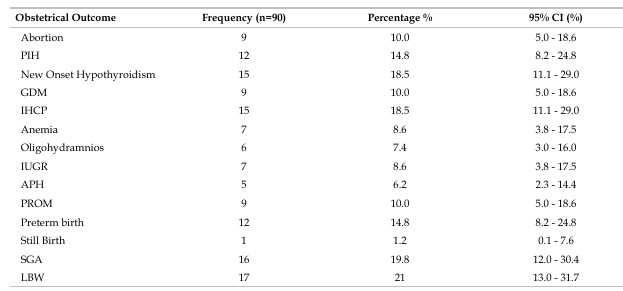
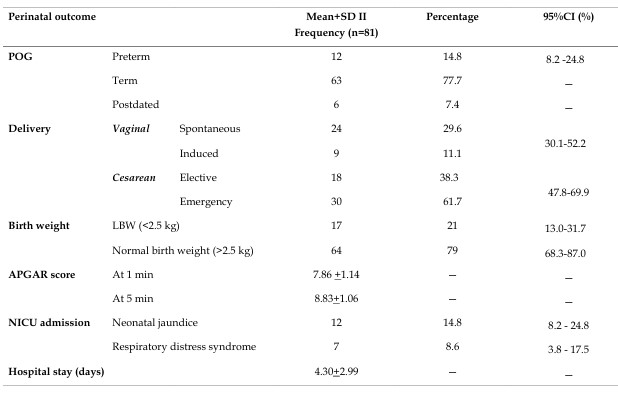
Objective: To determine the effect and rate of adverse obstetrical and perinatal out-comes due to occupational factors and effects of sociodemographic factors, work characteristics, and type of occupation on obstetrical and perinatal outcomes in pregnant working women. Study design: A Hospital-based observational study, conducted over one year and six months at a tertiary care center, AIIMS Rishikesh among pregnant women who were working at AIIMS Rishikesh. Results: Out of 90 working women, 9 (10%) had an abortion, 7 (8.6%) developed anemia, 15 (18.5%) developed hypothyroidism, 15 (18.5%) had intrahepatic cholestasis of pregnancy (IHCP), 12 (14.8%) had pregnancy-induced hypertension (PIH), 9 (11.1%) had gestational diabetes Mellitus (GDM), 7 (8.6%) had intrauterine growth retardation (IUGR), 6 (7.4%) had oligohydramnios, 12 (14.8%) had a preterm birth (PTB), 16 (19.8%) had small for gestational age (SGA), 5 (6.2%) had antepar-tum hemorrhage (APH), 9 (11.1%) had premature rupture of membrane (PROM), 1 (1.2%) had a stillbirth and 17 (21%) had low birth weight (LBW). Elderly gravida, preobese/obese, urban, and stressed women were at high risk for PIH, FGR, SGA, and GDM. Conclusion: In working women, adverse pregnancy outcomes such as abortion, PIH, GDM, PTB, SGA, etc. were reported. The main occupational predictors among health professionals for adverse pregnancy outcomes were advanced age, higher BMI, urban residency, upper or upper-middle socio economic class, long working hours, shift duties including night, more physical activity, and moderate stress levels.
References
- 1. Arafa M, Amine T, Abdel Fattah M. Association of Maternal Work with Adverse Perinatal Outcome. Canadian journal of public health. 2007; 98 (3): 217-21.
- 2. Hathout HM, Dalatony MM El, Anwar MM. Work-Related Risk Factors and Pregnancy Outcome between Working Women. Egyptian Journal of Occupational Medicine. 2015; 39 (2): 119-33.
- 3. ACOG Committee Opinion No. 733. Employment Considerations During Pregnancy and the Postpartum Period. Obstetrics & Gynecology. 2018; 131 (4): 115-123
- 4. Addisu D, Biru S, Mekie M. Predictors of adverse pregnancy outcome at Hospitals in South Gondar Zone, North-central Ethiopia. A multicenter facility-based unmatched case control study. Heliyon. 2021; 7(2): e06323.
- 5. Wright EA. Low birth weight in the plateau region of Nigeria. East Afr Med J. 1990;67(12): 894-9.
- 6. Vrijkotte T, Van der wal MF, Van eijsden M, Bonsel GJ. First-trimester working conditions and birthweight. A prospective cohort study. Am J Public Health. 2009; 99(8):1409-16.
- 7. Knight-Agarwal, C R, Jani R, Foraih, M A. Maternal body mass index and country of birth in relation to the adverse outcomes of large for gestational age and gestational diabetes mellitus in a retrospective cohort of Australian pregnant women.BMC Pregnancy Childbirth. 2021; 21(1): 649
- 8. The General Practice Physical Activity Questionnaire (GPPAQ). Department of Health; 2006.
- 9. Workplace stress survey of The American Institute of Stress (AIS); 2011.
- 10. Park C, Kang Y, Kim D. Prevalence of abortion and adverse pregnancy outcomes among working women in Korea: A cross-sectional study. PLoS One. 2017;12(8): e0182341.
- 11. Bonde JP, Kristian Tore Jqrgensen, Matteo Bonzini. Risk of miscarriage and occupational activity: A systematic review and meta-analysis regarding shift work, working hours, lifting, standing and physical workload. Scand J Work Environ Health. 2013; 39(4): 325–34.
- 12. Suzumori N, Ebara T, Taro Matsuki T. Effects of long working hours and shift work during pregnancy on obstetric and perinatal outcomes: A large prospective cohort study. Japan Environment & Children‘s Study Group, Birth. 2020; 47(1):67-69.
- 13. Spadarella E, Leso V, Fontana L. Occupational Risk Factors and Hypertensive Disorders in Pregnancy: A Systematic Review. Int. J. Environ. Res. Public Health. 2021; 18(16); 8277
- 14. Bonzini M, Palmer K, Coggon D. Shift work and pregnancy outcomes: A systematic review with meta-analysis. BJOG: An International Journal of Obstetrics & Gynaecology. 2011; 118(12): 1429-37.
- 15. Laura J Lee, Elaine Symanski, Philip J Lupo. Role of maternal occupational physical activity and psychosocial stressors on adverse birth outcomes.Occup Environ Med 2017; 74(3):192–9.
- 16. Claudia A Snijder, Teus Brand,Vincent Jaddoe. Physically demanding work, fetal growth, and the risk of adverse birth outcomes. The Generation R Study. Occup Environ Med 2012; 69(8):543-50.
Funding
This research received no funding.
Author Contributions
All authors contributed significantly to the work and approve its publication.
Ethics Declaration
This article does not involve any human or animal subjects, and therefore does not require ethics approval
Acknowledgements
Information Not Provided
Conflicts of Interest
No conflicts of interest in this work.
About this article

Cite this article
Yadav K, Khoiwal K, Gaurav A, et al. Occupational predictors of obstetric and perinatal outcomes in working women in a health care facility: a hospital-based observational study. Indian J Obstet Gynecol. 2024;12(3):117-23.
Licence:
Attribution-Non-commercial 4.0 International (CC BY-NC 4.0)This license enables reusers to distribute, remix, adapt, and build upon the material in any medium or format for noncommercial purposes only, and only so long as attribution is given to the creator.
| Received | Accepted | Published |
|---|---|---|
| May 09, 2024 | June 16, 2024 | June 24, 2024 |
DOI: http://dx.doi.org/10.21088/ijog.2321.1636.12324.2
Keywords
Occupational PredictorsObstetric and Perinatal OutcomesWorking WomenSearch for Similar Articles
Similar Articles
- When Eclampsia Strikes the Brain Twice
- Emergency Management of Cesarean Scar Pregnancy: A Rare Case of Life-Threatenin...
- The Efficacy of Structured Teaching Programs in Enhancing Pregnancy Management...
- Audit of Caesarean Sections by the Robson Ten Group Classification: A Six-Month...
- A Cross-Sectional Study on the Epidemiology and Risk Factors of Uterine Fibroids
Article Level Metrics
Last UpdatedThursday 18 June 2026, 04:28:30 (IST)
1422
Accesses
4
152
00
Citations
NA
NA
NA
Download citation
Article Keywords
Keyword Highlighting
Highlight selected keywords in the article text.
Timeline
| Received | May 09, 2024 |
| Accepted | June 16, 2024 |
| Published | June 24, 2024 |
licence
Attribution-Non-commercial 4.0 International (CC BY-NC 4.0)
This license enables reusers to distribute, remix, adapt, and build upon the material in any medium or format for noncommercial purposes only, and only so long as attribution is given to the creator.