Full Text (PDF)
Indian Journal of Forensic Medicine and Pathology 11(2):p 55-59, April-June 2018. | DOI: 10.21088/ijfmp.0974.3383.11218.1
Original Article
Occupational Health Hazards of Workers on Construction Sites
Ajay Patil,, Chandrakant M. Kokatanur
Author Information
Licence:
Attribution-Non-commercial 4.0 International (CC BY-NC 4.0)This license enables reusers to distribute, remix, adapt, and build upon the material in any medium or format for noncommercial purposes only, and only so long as attribution is given to the creator
Indian Journal of Forensic Medicine and Pathology 11(2):p 55-59, April-June 2018. | DOI: 10.21088/ijfmp.0974.3383.11218.1
How Cite This Article:
Timeline
Received : March 08, 2018
Accepted : March 31, 2018
Published : April 30, 2018
Abstract
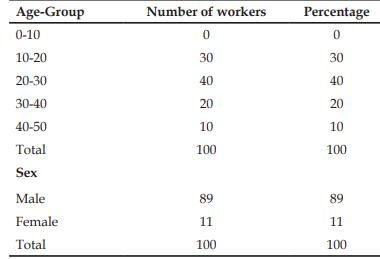
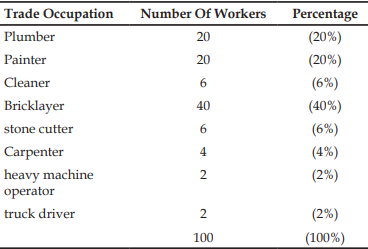
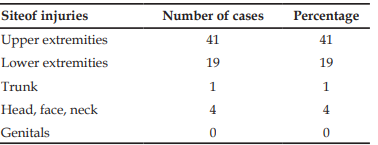
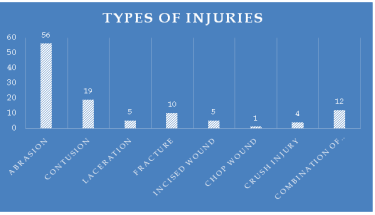
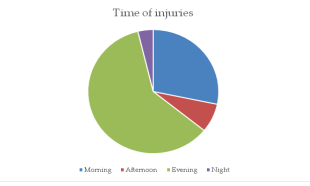
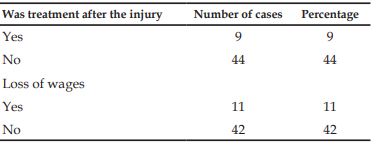
Introduction: Occupational health hazards faced by this large and growing number of people depend on the region and its economic standing. Aim: To study occupational health status of workers, causes and patternsof occupational injuries. Materials and methods: It is a cross-sectional study in total of 100 workers who wereexamined at different construction sites and hazards were noted. Results: It is being observed that most of the construction workers belong to the age group of 20-30 yrs. Male gender dominates construction workers. Distribution of the workers in different categories observed in this study was bricklayers 40% plumber 20%, painters 20%, stone cutters 6%, cleaners 6%, carpenters 4%, heavy machine operator 2%, truck driver 2%. The total injuries abrasions (56) contributed more. Site of injuries is categorized as upper extremities in 41 workers, lower 19 cases. Most of the injuries are afflicted in the evening hours followed by morning and afternoon. Accidents and the injuries occurred predominantly in the overtime’. Use of PPE was only in 4 cases and other 49 cases observed never used the PPE. 9 workers could get an immediate medical attention where 44 others could get first aid. 11 workers lost their daily wages and 42 others escaped from the loss of salary. The loss of daily wages ranged from 1 day to 5 days and the average of it being of daily wage loss per person. Conclusions: There is need that the employers address all the potential risk factors at the workplace and educate employees on safe work practices and risk awareness.
References
- 1. Adei D. Occupational health and safety policy in the wood processing industry in Kumasi, Ghana. J Sci Technol. 2009;27:151-71.
- 2. World Health Organization. Safety and health report in construction sites. New York: Allyn & Bacon; 2002.
- 3. World Health Organization. Global goals for occupational health and safety. Int Occ J. 2010;3(1):84-7.
- 4. Ogula PA. Research methods. Nairobi: Catholic University of Eastern Africa (CUEA) Publications; 2005.
- 5. Mugenda OM, Mugenda AG. Research methods: quantitative and qualitative approaches. Nairobi: Acts Press; 1999.
- 6. Khairuzzaman M, Chowdhury FM, Zaman S, Mamun AA, Bari ML. Food safety challenges towards safe, healthy, and nutritious street foods in Bangladesh. Int J Food Sci. 2014;2014:483519.
- 7. Guidotti TL. Global occupational health. Oxford: Oxford University Press; 2011.
- 8. Acharya SR. Utilization pattern of personal protective equipment among industrial workers of Nawalparasi, Nepal. Health Prospect. 2014;13(2):1-5.
- 9. International Labour Organization. News, safe work highlights. Afr Newslet Occup Health Saf. 2007;10(2).
- 10. Kimeto SK. Evaluation of occupational safety and health awareness and practices among workers at Kenya Tea Development Agency factories in Kenya [master’s thesis]. Nairobi: Jomo Kenyatta University of Agriculture and Technology; 2014.
- 11. Aguwa EN. A review of Sir Thomas Legge’s aphorisms and workplace personal protective equipments – is there a gap in knowledge, attitude and utilization? Occup Med Health Aff. 2013;1(6):1-6.
- 12. Muchemedzi S, Charamba L. National health and safety training course. Harare: NSSA; 2006.
- 13. Ahmed H, Smith MS. Knowledge and practices related to occupational hazards among cement workers in United Arab Emirates. J Egypt Public Health Assoc. 2010;85(3-4):149-52.
- 14. Muchemi DN. Impact of occupational heat on the comfort of factory workers. Bull World Health Organ. 2012;7(1):67-99.
Data Sharing Statement
There are no additional data available. All raw data and code are available upon request.
Funding
This research received no funding.
Author Contributions
Whether all authors contributed significantly to the work and approve its publication.
Ethics Declaration
This article does not involve any human or animal subjects, and therefore does not require ethics approval.
Acknowledgements
We would like to express our gratitude to the patients, their families, and all those who have contributed to this study.
Conflicts of Interest
The authors report no conflicts of interest in this work.
About this article

Cite this article
Licence:
Attribution-Non-commercial 4.0 International (CC BY-NC 4.0)This license enables reusers to distribute, remix, adapt, and build upon the material in any medium or format for noncommercial purposes only, and only so long as attribution is given to the creator
| Received | Accepted | Published |
|---|---|---|
| March 08, 2018 | March 31, 2018 | April 30, 2018 |
DOI: 10.21088/ijfmp.0974.3383.11218.1
Keywords
Occupational Health HazardsPersonal Protective EquipmentOccupational InjuriesSearch for Similar Articles
Similar Articles
- Diatom Analysis in Thermophilic water bodies: A Study on Hot Water Springs of Ma...
- Morphometric Study of Supra-meatal Triangle and Mastoid process in the Adult dry...
- Histopathological Spectrum of Autopsy Cases: A One Year Retrospective Observatio...
- Forensic Differentiation of Manner of Death in Railway Fatalities: A FourCase Se...
- Understanding assault Patterns: A Cross-sectional study of Cases at Chri, Kelamb...
Article Level Metrics
Last UpdatedSunday 18 October 2026, 10:58:44 (IST)
16257
Accesses
7
3205
00
Citations
NA
NA
NA
Download citation
Article Keywords
Keyword Highlighting
Highlight selected keywords in the article text.
Timeline
| Received | March 08, 2018 |
| Accepted | March 31, 2018 |
| Published | April 30, 2018 |
licence
Attribution-Non-commercial 4.0 International (CC BY-NC 4.0)
This license enables reusers to distribute, remix, adapt, and build upon the material in any medium or format for noncommercial purposes only, and only so long as attribution is given to the creator