Full Text (PDF)
Journal of Plastic Surgery and Transplantation 5(2):p 53-56, July - Dec. 2025. | DOI: n.a
Case Report
Management of Ischial Pressure Ulcer Using Hatchet Flap: Case Report
Author Information
Licence:
Attribution-Non-commercial 4.0 International (CC BY-NC 4.0)This license enables reusers to distribute, remix, adapt, and build upon the material in any medium or format for noncommercial purposes only, and only so long as attribution is given to the creator.
Journal of Plastic Surgery and Transplantation 5(2):p 53-56, July - Dec. 2025. | DOI: n.a
How Cite This Article:
Nareshkumar Codandabany. Management of Ischial Pressure Ulcer Using Hatchet Flap: Case Report. J of Pla Sur and Trans. 2025; 5(2): 59-62.Timeline
Received : September 19, 2025
Accepted : December 02, 2025
Published : December 30, 2025
Abstract
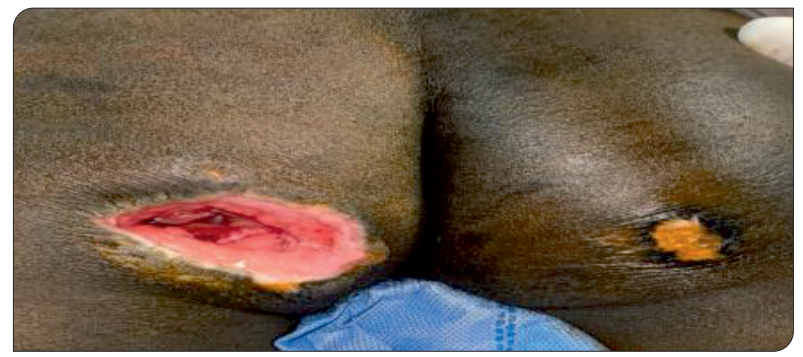
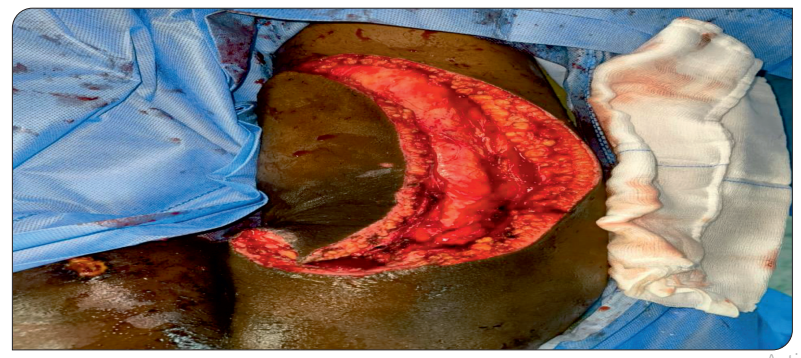
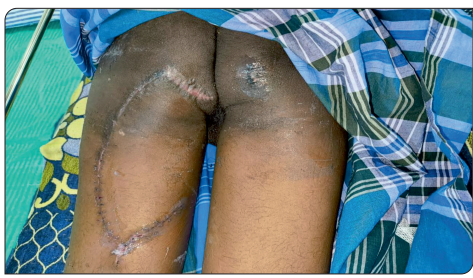
Background: Individuals who spend long periods seated without repositioning are at increased risk of developing pressure ulcers over the ischial tuberosity. Aim: To describe the management of an ischial pressure injury using a hatchet flap. Objectives: To reduce wound-related morbidity, improve quality of life, and prevent recurrence of pressure injuries. Material: A 22-year-old male developed a Grade IV ischial pressure ulcer six months after sustaining paraplegia from a fall. Although his neurological status improved gradually, the ulcer persisted and became recurrently infected. Staged wound debridement and hatchet flap coverage were performed. Result: The flap healed uneventfully, and there was no recurrence after the patient resumed mobilization. Conclusion: The random-pattern hatchet flap is a reliable option for the management of pressure sores of limited size, with minimal complications.
References
- 1. Singh H, Jain A, Mahendru S, Khazanchi RK. Hatchet thigh flap with hemi-gluteus flap for recurrent ischial sore reconstruction. J Wound Manag Res. 2020;16(3):158-63. doi:10.22467/ jwmr.2020.01172
- 2. Djedovic G, Morandi EM, Metzler J, Wirthmann A, Matiasek J, Bauer T, et al. The posterior thigh flap for defect coverage of ischial pressure sores: a critical single-centre analysis. Int Wound J. 2017;14(6):1154-9. doi:10.1111/iwj.12776
- 3. Ku I, Lee GK, Yoon S, Jeong E. A dual padding method for ischial pressure sore reconstruction with an inferior gluteal artery perforator fasciocutaneous flap and a split inferior gluteus maximus muscle flap. Arch Plast Surg. 2019;46(5):455-61. doi:10.5999/aps.2019.00031
- 4. Foster RD, Anthony JP, Mathes SJ, Hoffman WY. Ischial pressure sore coverage: a rationale for flap selection. Br J Plast Surg. 1997;50(6): 374-9.
Data Sharing Statement
There are no additional data available. All raw data and code are available upon request.
Funding
This research received no funding.
Author Contributions
All authors contributed significantly to the work and approve its publication.
Ethics Declaration
This article does not involve any human or animal subjects, and therefore does not require ethics approval.
Acknowledgements
We would like to express our gratitude to the patients, their families, and all those who have contributed to this study.
Conflicts of Interest
No conflicts of interest in this work.
About this article

Cite this article
Nareshkumar Codandabany. Management of Ischial Pressure Ulcer Using Hatchet Flap: Case Report. J of Pla Sur and Trans. 2025; 5(2): 59-62.
Licence:
Attribution-Non-commercial 4.0 International (CC BY-NC 4.0)This license enables reusers to distribute, remix, adapt, and build upon the material in any medium or format for noncommercial purposes only, and only so long as attribution is given to the creator.
| Received | Accepted | Published |
|---|---|---|
| September 19, 2025 | December 02, 2025 | December 30, 2025 |
DOI: n.a
Keywords
Ischial Pressure UlcerHatchet FlapPosterior Thigh Flap.Search for Similar Articles
Similar Articles
- Application of Amnion Allograft in Treatment of Thermal Burns
- Bio-cellulose Dressing in the Management of Deep Second-Degree Burns: Our Experi...
- Autologous Whole Blood Clot Matrix in the Management of SecondDegree Burns
- CT Image Reconstruction & 3D Reconstruction CT in Plastic Surgery: A Review
- Out of Love and Affection: A Medicolegal Paradox for Denying Gains Vs Pleading C...
Article Level Metrics
Last UpdatedSaturday 24 October 2026, 22:35:46 (IST)
1122
Accesses
33
539
00
Citations
NA
NA
NA
Download citation
Article Keywords
Keyword Highlighting
Highlight selected keywords in the article text.
Timeline
| Received | September 19, 2025 |
| Accepted | December 02, 2025 |
| Published | December 30, 2025 |
licence
Attribution-Non-commercial 4.0 International (CC BY-NC 4.0)
This license enables reusers to distribute, remix, adapt, and build upon the material in any medium or format for noncommercial purposes only, and only so long as attribution is given to the creator.