Full Text (PDF)
Journal of Plastic Surgery and Transplantation 7(1):p 19-22, January-June 2026. | DOI: NA
Case Report
Autologous Whole Blood Clot Matrix in the Management of SecondDegree Burns
Ravi Kumar Chittoria, Rucha Palkritwar, Srinath Rajasekar, Tanya Gupta
Author Information
Licence:
Attribution-Non-commercial 4.0 International (CC BY-NC 4.0)This license
enables reusers to distribute, remix, adapt, and build upon the material in any
medium or format for noncommercial purposes only, and only so long as
attribution is given to the creator.
Journal of Plastic Surgery and Transplantation 7(1):p 19-22, January-June 2026. | DOI: NA
How Cite This Article:
Rucha Palkritwar, Ravi Kumar Chittoria, Srinath Rajasekar, et al. Autologous Whole Blood Clot Matrix in the Management of Second-Degree Burns. J of Pla Sur and Trans. 2026; 7(1): 19-22.Timeline
Received : February 16, 2026
Accepted : March 19, 2026
Published : June 30, 2026
Abstract
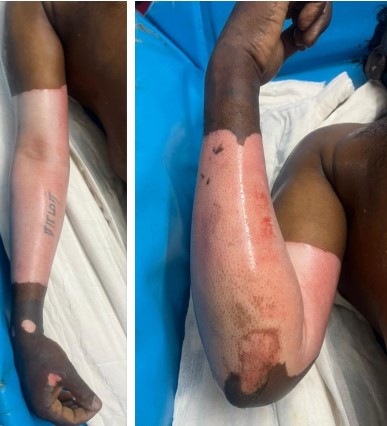
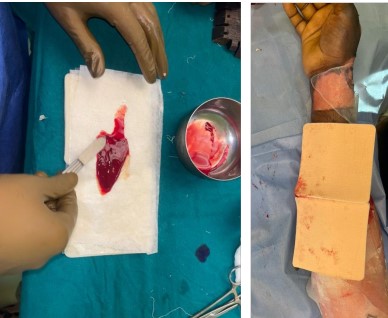
Second-degree (partial-thickness) burns constitute a significant proportion of burn injuries encountered in clinical practice. These are usually managed conservatively, yet delayed epithelialisation and suboptimal healing remain concerns. Autologous whole blood clot (AWBC) therapy has shown efficacy in chronic wounds, but evidence in acute burns is limited. We report a 46-year-old male with a seconddegree superficial upper-limb burn treated with a point-of-care AWBC dressing following wound cleansing. The clot adhered well to the wound, maintained a moist environment, and acted as a stable biological cover. No adverse events were observed. Progressive epithelialisation with reduction in BJWAT score, good pain control, and absence of infection were noted. This case suggests that AWBC is a feasible and safe adjunct for second-degree superficial burns, warranting further evaluation in controlled studies.
References
- 1. Singer A.J., Clark R.A. Cutaneous wound healing. N Engl J Med. 1999; 341(10): 738–746.
- 2. Guo S., DiPietro L.A. Factors affecting wound healing. J Dent Res. 2010; 89(3): 219–229.
- 3. Diegelmann R.F., Evans M.C. Wound healing: an overview of acute, fibrotic and delayed healing. Front Biosci. 2004; 9: 283–289.
- 4. Schultz G.S., Davidson J.M., Kirsner R.S., Bornstein P., Herman I.M. Dynamic reciprocity in the wound microenvironment. Wound Repair Regen. 2011; 19(2): 134–148.
- 5. Snyder R.J., Nouvong A., Ulloa J., Wahab N, Treadwell T, Bruwer F, et al. Efficacy and safety of autologous whole blood clot in diabetic foot ulcers: a randomised controlled trial. J Wound Care. 2024; 33(9): 688–699.
- 6. Landau Z., Whitacre K.L., Leewood C., Hawkins J., Wachuku CD. Utilization of a topical autologous blood clot for treatment of pressure ulcers. Int Wound J. 2023; 20(3): 806–812.
- 7. Barrientos S., Stojadinovic O., Golinko M.S., Brem H., Tomic-Canic M. Growth factors and cytokines in wound healing. Wound Repair Regen. 2008; 16(5): 585–601.
- 8. Werner S., Grose R. Regulation of wound healing by growth factors and cytokines. Physiol Rev. 2003; 83(3): 835–870.
Data Sharing Statement
There are no additional data available. All raw data and code are available upon request.
Funding
This research received no funding.
Author Contributions
All authors contributed significantly to the work and approve its publication.
Ethics Declaration
This article does not involve any human or animal subjects, and therefore does not require ethics approval.
Acknowledgements
We would like to express our gratitude to the patients, their families, and all those who have contributed to this study.
Conflicts of Interest
No conflicts of interest in this work.
About this article

Cite this article
Rucha Palkritwar, Ravi Kumar Chittoria, Srinath Rajasekar, et al. Autologous Whole Blood Clot Matrix in the Management of Second-Degree Burns. J of Pla Sur and Trans. 2026; 7(1): 19-22.
Licence:
Attribution-Non-commercial 4.0 International (CC BY-NC 4.0)This license
enables reusers to distribute, remix, adapt, and build upon the material in any
medium or format for noncommercial purposes only, and only so long as
attribution is given to the creator.
| Received | Accepted | Published |
|---|---|---|
| February 16, 2026 | March 19, 2026 | June 30, 2026 |
DOI: NA
Keywords
Blood clotSuperficial burnsmatrixSearch for Similar Articles
Similar Articles
- Application of Amnion Allograft in Treatment of Thermal Burns
- Bio-cellulose Dressing in the Management of Deep Second-Degree Burns: Our Experi...
- CT Image Reconstruction & 3D Reconstruction CT in Plastic Surgery: A Review
- Out of Love and Affection: A Medicolegal Paradox for Denying Gains Vs Pleading C...
- Surgical Wound Nursing Care: An Integrative Review of Evidence Based Practice
Article Level Metrics
Last UpdatedSunday 18 October 2026, 12:00:25 (IST)
1077
Accesses
14
522
00
Citations
NA
NA
NA
Download citation
Article Keywords
Keyword Highlighting
Highlight selected keywords in the article text.
Timeline
| Received | February 16, 2026 |
| Accepted | March 19, 2026 |
| Published | June 30, 2026 |
licence
Attribution-Non-commercial 4.0 International (CC BY-NC 4.0)
This license
enables reusers to distribute, remix, adapt, and build upon the material in any
medium or format for noncommercial purposes only, and only so long as
attribution is given to the creator.