Full Text (PDF)
Indian Journal of Library and Information Sciences 18(2):p 104-112, May - August 2024. | DOI: 10.21088/ijlis.0973.9548.18224.1
Original Article
Library Services and Facilities to Differently-Abled Users of the Indian Institute of Technology, Bhopal and the Indian Institute of Technology, Design and Management, Jabalpur: A Comparative Study
Author Information
Licence:
Attribution-Non-commercial 4.0 International (CC BY-NC 4.0)This license enables reusers to distribute, remix, adapt, and build upon the material in any medium or format for noncommercial purposes only, and only so long as attribution is given to the creator.
Indian Journal of Library and Information Sciences 18(2):p 104-112, May - August 2024. | DOI: 10.21088/ijlis.0973.9548.18224.1
How Cite This Article:
Kumar M, Jana A. Library services and facilities to differently-abled users of the Indian Institute of Technology, Bhopal and the Indian Institute of Technology, Design and Management, Jabalpur: a comparative study. Indian J Lib Inf Sci. 2024;18(2):104-12.Timeline
Received : February 19, 2024
Accepted : May 22, 2024
Published : August 18, 2024
Abstract
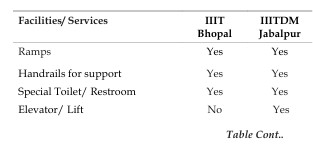
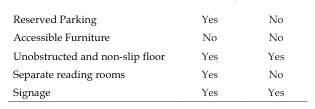
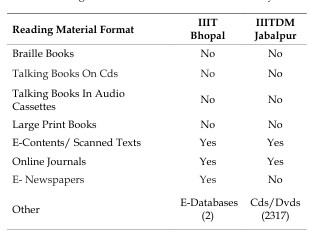
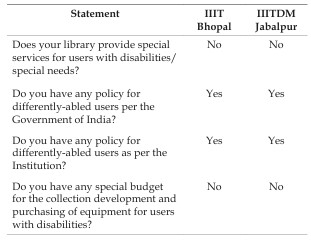
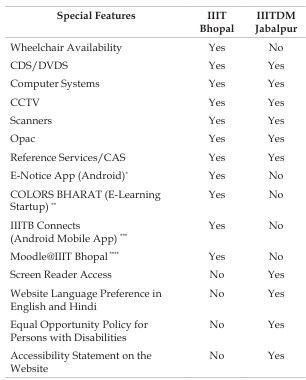
The focus of this study is to compare the accessibility and inclusivity measures of the libraries and institutes at IIIT Bhopal and IIITDM Jabalpur for differently-abled users. The study delves into the facilities, services, policies, and resources that these institutions offer to cater to the needs of such users. The data collection process involves offline questionnaires filled out by library professionals and unstructured interviews with them, as well as assessing the institutional websites for relevant information. The findings of the study highlight both the similarities and differences between the two institutions. While both IIIT Bhopal and IIITDM Jabalpur have policies in line with government directives and provide basic amenities such as computer systems, CCTV surveillance, and scanners, there are differences in the accessibility infrastructure, specialized reading materials provided, and funding allotted for assisting users with disabilities. The study concludes with recommendations for improving inclusivity and accessibility in the library environments of both IIIT Bhopal and IIITDM Jabalpur. These recommendations include investing in accessibility infrastructure, acquiring specialized reading materials, allocating dedicated budgets, implementing special services and support programs, engaging stakeholders, providing training and awareness, and conducting regular evaluations of accessibility initiatives. By implementing these recommendations, both institutions can create more inclusive and accessible library environments that cater to the diverse needs of all users, promoting equity, diversity, and inclusion within the academic community
References
- 1. Ahmed, M. R. & Naveed, M. A. (2020). Information accessibility for visually impaired students.
- 2. Pakistan Journal of Information Management & Libraries. 22, 16-36. https://doi.org/10.47657/1793.
- 3. Ambika, C.A., Ganeshan, P. (2021). Central university library websites in India: web content analysis. Library Philosophy and Practice (e-journal). 5405 https://digitalcommons.unl.edu/ libphilprac/5405.
- 4. Cambridge Dictionary. (n.d.). Differently abled. In Cambridge Dictionary. Retrieved December 28, 2023, from https://dictionary.cambridge.org/ dictionary/english/differently-abled.
- 5. Dodamani, A. M. & Dodamani, S. M. (2019). Provision of assistive technology for students with visual impairment in university libraries in India. DESIDOC Journal of Library & Information Technology. 39(3), 104-108. DOI: 10.14429/ djlit.39.3.14329.
- 6. Gill, K., Sharma, R. & Gupta, R. (2017). Empowering visually impaired students through e-learning at higher education: problems and solutions. IOSR Journal of Humanities and Social Science, 22(8), 27- 35. DOI: 10.9790/0837-2208072735.
- 7. Khan, H. M., Abbas, K. & Khan, H. N. (2023). Investigating the impact of COVID-19 on individuals with visual impairment. British Journal of Visual Impairment.1-10. DOI: 10.1177/02646196231158919.
- 8. Leshota, P. L., & Sefotho, M. M. (2020). Being differently abled: Disability through the lens of hierarchy of binaries and Bitso-lebe-ke Seromo. African journal of disability, 9, 643. https://doi. org/10.4102/ajod.v9i0.643.
- 9. Literary Devices Editors. (n.d.). Differently abled. Retrieved December 28, 2023, from https:// literarydevices.net/differently-abled/.
- 10. Mahawariya, K. and Yadav, M. (2021). Exploring needs and requirements of differently-abled students at equal opportunity cell, University of Delhi. Athens Journal of Social Sciences, 8(1), 9-30. https://doi.org/10.30958/ajss.8-1-1.
- 11. Merriam-Webster. (n.d.). Differently abled. In Merriam-Webster.com thesaurus. Retrieved December 28, 2023, from https://www.merriam-webster.com/thesaurus/ differently%20abled.
- 12. National Institute for the Empowerment of Persons with Intellectual Disabilities. (2024, January 15) Acts and Policies. Department of Empowerment of Persons with Disabilities (Divyangjan), MSJ&E, Govt. of India. Retrieved January 15, 2024, from https://niepid.nic.in/acts-and-policies.php.
- 13. Nazim, M., Beg, A. & Sarkar, M. (2021). Access to library facilities and services for users with disabilities: a study of Aligarh Muslim University in India. Journal of Access Services, 18(1), 30-49. DOI: 10.1080/15367967.2020.1870120.
- 14. Patil, R. R. & Kumbar, B. D. (2020). Public library services for differently abled person: literature review with global perspective. Journal of Indian Library Association, 56(1), 56-64.
- 15. Salauddin, N. (2022). Accessibility of Information Resources and Services in the Library for the Users with Disabilities: a study. Indian Journal of Information Sources and Services. 12(1), 47-51. https://doi.org/10.51983/ijiss-2022.12.1.3158.
- 16. Srivastava, G. G. & Bhatt, R. K. (2016). Library services in inclusive environment: role of marketing tools. International and Journal of Information Dissemination and Technology, 6(2), 122-126.
- 17. The Office of the Chief Commissioner for Persons with Disabilities. (2021, August 8). Disability in India. Ministry of Social Justice and Empowerment, Government of India. Retrieved January 8, 2024, from http://ccdisabilities.nic.in/resources/ disability-india.
- 18. World Health Organization. (2016). Priority assistive products list. World Health Organization.
- 19. Retrieved February 08, 2024, from https://iris. who.int/bitstream/handle/10665/207694/ WHO_EMP_PHI_2016.01_eng.pdf?sequence=1.
Data Sharing Statement
There are no additional data available.
Funding
This research received no funding.
Author Contributions
All authors contributed significantly to the work and approve its publication.
Ethics Declaration
This article does not involve any human or animal subjects, and therefore does not require ethics approval.
Acknowledgements
Information not provided.
Conflicts of Interest
The authors report no conflicts of interest in this work.
About this article

Cite this article
Kumar M, Jana A. Library services and facilities to differently-abled users of the Indian Institute of Technology, Bhopal and the Indian Institute of Technology, Design and Management, Jabalpur: a comparative study. Indian J Lib Inf Sci. 2024;18(2):104-12.
Licence:
Attribution-Non-commercial 4.0 International (CC BY-NC 4.0)This license enables reusers to distribute, remix, adapt, and build upon the material in any medium or format for noncommercial purposes only, and only so long as attribution is given to the creator.
| Received | Accepted | Published |
|---|---|---|
| February 19, 2024 | May 22, 2024 | August 18, 2024 |
DOI: 10.21088/ijlis.0973.9548.18224.1
Keywords
AccessibilityDifferently-abled usersLibrary facilitiesInclusivityAccessible infrastructureDisability policiesAssistive technologiesDisability awarenessAccessibility initiativesPolicy complianceInclusive practicesIndian Institute of Information TechnologyLibrary environmentSearch for Similar Articles
Similar Articles
- Scientometric Portrait of Dr. Anil Kumar Dhiman, an Information Scientist-Part I...
- A Study on Humanities Students’ Literacy Skills at Alagappa University in Using...
- Awareness and Utilization of Artificial Intelligence Tools (ChatGPT) among Stude...
- Global Trends on Artificial Intelligence in Science Research: A Scientometric Ob...
- Information Needs of Persons with Visual Impairments: A Socioeconomic Analysis
Article Level Metrics
Last UpdatedThursday 10 September 2026, 03:34:36 (IST)
3922
Accesses
18
738
00
Citations
NA
NA
NA
Download citation
Article Keywords
Keyword Highlighting
Highlight selected keywords in the article text.
Timeline
| Received | February 19, 2024 |
| Accepted | May 22, 2024 |
| Published | August 18, 2024 |
licence
Attribution-Non-commercial 4.0 International (CC BY-NC 4.0)
This license enables reusers to distribute, remix, adapt, and build upon the material in any medium or format for noncommercial purposes only, and only so long as attribution is given to the creator.